
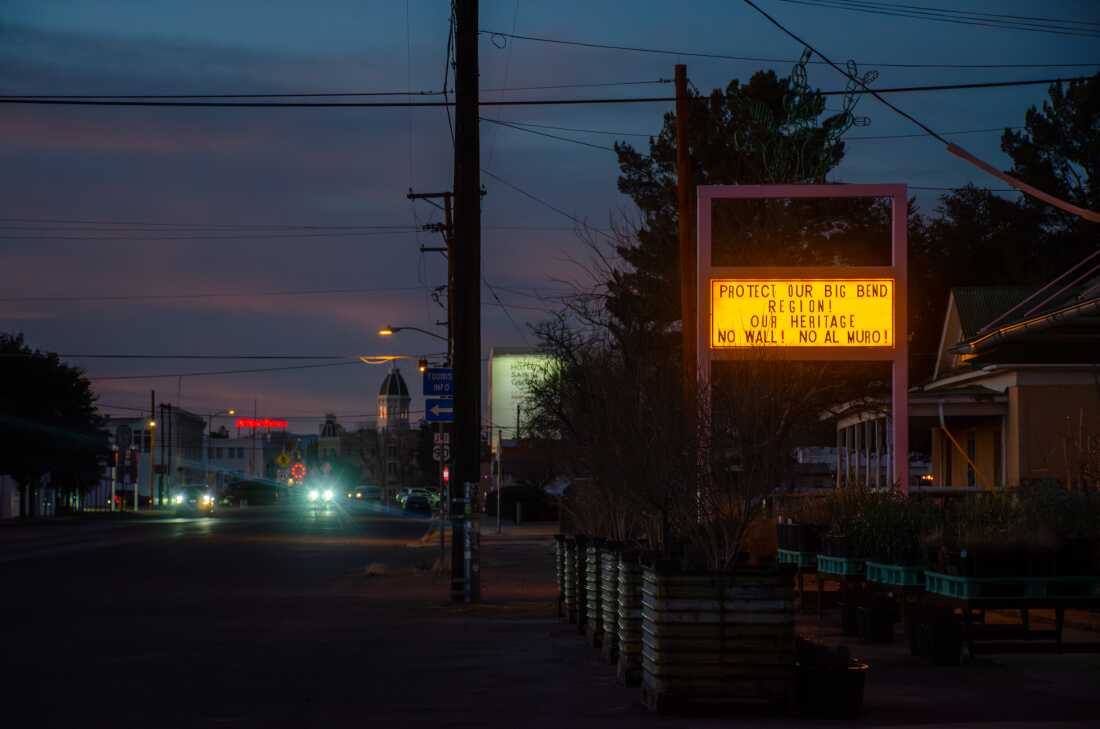
Across the Big Bend region, anti-wall signs, flyers, and messages have appeared in homes and businesses, such as a liquor store in Marfa, Texas.
Joe Pineda, a 52-year-old resident of Redford, Texas, drives across his land near the Rio Grande. He points out places where he herds cattle, grows alfalfa, and visits the family cemetery dating back to the late 1800s. Near the river, he slows down his truck and shares memories of his family’s deep ties to the Big Bend area, a place linked to many childhood and family moments.
“It’s these things that I’m going to miss,” said Pineda, feeling the wind under the mesquite trees alongside the Rio Grande. “Times with your kids, enjoying the heritage of the land where your ancestors lived—and it’s going to be taken.”
Pineda and his family received a letter from the federal government about eminent domain. They are asked to sell land or give access for border wall construction. The government aims to construct approximately 175 miles of border fencing, involving steel fences, patrol roads, flood lighting, and surveillance systems, in the Big Bend area—a region known for its untouched frontier land.
An unusual coalition across the political spectrum opposes the wall, citing environmental threats and impacts on Indigenous sites, dark skies, and wildlife like Black bears, bobcats, and bighorn sheep. This wall could jeopardize the $56-million tourism industry according to Pineda, who claims,
“They’re killing our economy with this wall.”
The area is historically less trafficked due to its rugged terrain, leading to fewer crossings into the U.S. from Mexico. Since President Trump’s second term started, crossings have reduced further. The Customs and Border Protection’s Big Bend Sector, covering nearly 500 miles of the Rio Grande, recorded 498 apprehensions in the first three months this year—a fraction compared to Texas’ busiest sector.
Brewster County Sheriff Ronny Dodson points out they are not the most frequent crossing spot. Dodson, along with other border sheriffs, communicated to officials that a border wall may not effectively secure the region, suggesting monitoring and increased manpower as better approaches.
Dodson’s county hosts the Big Bend National Park, initially marked for tall steel fencing. However, Customs and Border Protection revised plans—the park will have vehicle barriers and patrol roads, still affecting sensitive land.
Residents, landowners, and advocates in Big Bend held rallies against the proposed wall in Presidio, Texas. Letters were sent to President Trump and Texas Governor Greg Abbott requesting visits to the area and reconsideration of border security spending. Each border barrier mile costs about $17 million.
Hudspeth County Judge Joanna Mackenzie remarks,
“These numbers are mind-boggling; that kind of money is generational changing.”
Local officials penned a joint-letter requesting input in border security decisions. Some landowners threaten legal action to halt border developments.
Raymond Skiles, wildlife biologist and landowner, views plans as destructive, likening a wall through Big Bend to cutting into the cultural landscape.
“It would be a rip in the treasured landscape of the Big Bend,” Skiles explains, viewing it as a permanent scar on his home.
Skiles receives a map showing proposed wall paths across his land.