
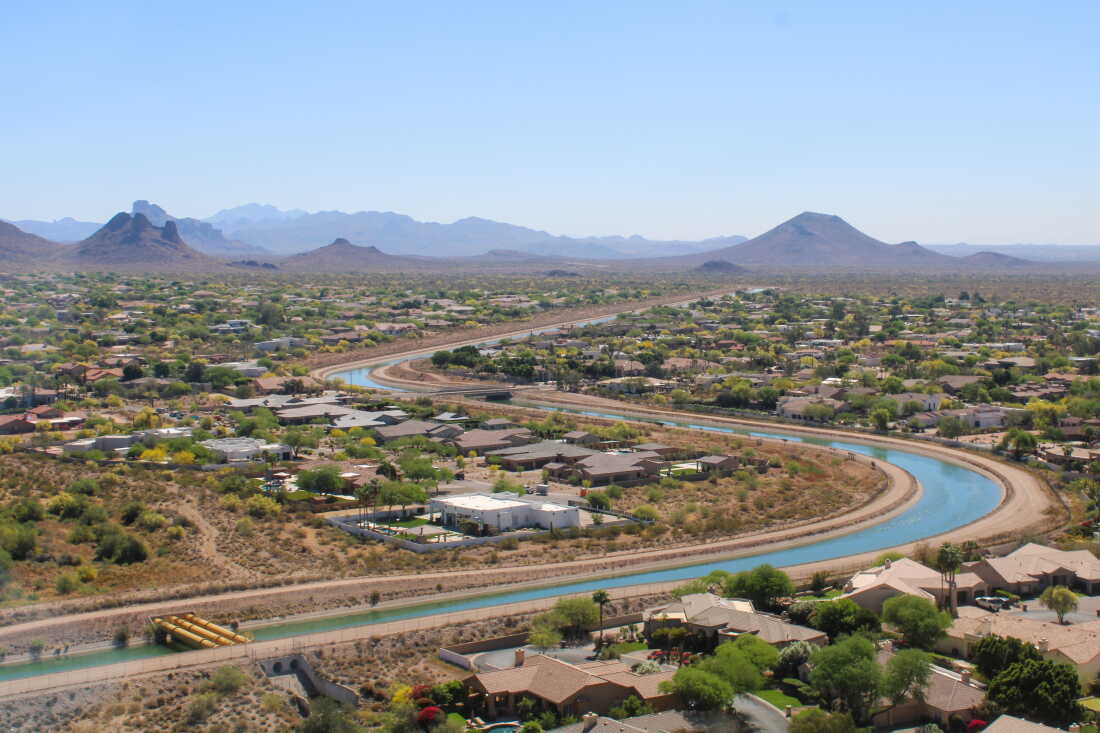
The Central Arizona Project canal winds through Phoenix, a vital artery bringing water from the Colorado River to the Phoenix and Tucson areas. But swelling challenges lie ahead as water supplies for the canal’s users face reductions under a new federal strategy.
A New Federal Plan
The new federal plan mandates significant cuts to Arizona’s Colorado River water supply, driven by over two decades of drought and dwindling reservoirs at Lake Powell and Lake Mead. Starting on January 1, the plan will impose mandatory reductions of 27% each year through 2028, with an option for even steeper cuts beyond.
“Arizonans have been solving water problems for our entire history,” said Max Wilson, Phoenix’s water resources management advisor. “We’re going to do it again now.”
Despite the looming cuts, Wilson remains optimistic that Phoenix’s residents will continue to receive the water they need due to long-term planning and infrastructure investments.
Engineering Feats and Financial Hurdles
The Central Arizona Project canal system, a remarkable engineering achievement from the 1960s, will face challenges as cuts take effect. Phoenix’s water supplies rely heavily on the canal, with Colorado River water constituting 40% of their resources. New solutions and technological advancements will be necessary to counter diminished supplies.
Efforts to ensure water flow aren’t without significant financial implications. Wilson acknowledges that while necessary, the costs will inevitably be passed down to consumers.
“Our customers are going to have to pay that bill,” Wilson stated.
Decades of Preparation
Phoenix’s survival through water cuts is bolstered by its diverse water portfolio, primarily from the Salt and Verde Rivers and groundwater. Initiatives include reservoir management and maintaining reliable backup sources.
Roosevelt Dam, constructed in 1911, symbolizes the area’s historical capacity for water management. Phoenix has spent millions enhancing infrastructure, with projects like the “drought pipeline” facilitating redistribution of water.
Community and Infrastructure Impacts
Communities are directly impacted by the financial burden of new infrastructure. Gilbert has seen water bills double since 2024 as the town adapts its water systems for sustainability amidst cuts.
Kathryn Sorensen, director of research at the Kyl Center for Water Policy, argues that higher water rates can incentivize conservation.
“Price signals are really effective,” Sorensen said.
Phoenix has reduced peak summertime water use by 40% since the 1980s, thanks in part to strategic pricing.
Facing Uncertainty
Despite thorough planning, unpredictable variables remain. Climate projections indicate persistent dry conditions, challenging long-term water strategies.
EPCOR’s Doug Dunham highlights that while adaptations through infrastructure and policy changes are possible, they demand significant effort and investment.
Debates over stored water access with the Arizona Water Banking Authority further underline the region’s complex water management stage.
Water Recycling and Future Readiness
Phoenix is taking major steps in recycling water resources with the Cave Creek Water Reclamation Plant. The facility aims to transform wastewater into drinkable water, marking a promising method for future sustainable water management.
Wilson encourages federal assistance to ease financial strains on projects like these, supporting the state’s adaptability to dry conditions.
“The federal government…made a choice, which is that they’re going to need to step up,” Wilson said.
Through long-term infrastructure investments and visionary strategies in water recycling, Phoenix aims to bolster its resilience against Colorado River cuts and ensure sustainable water access for future generations.