
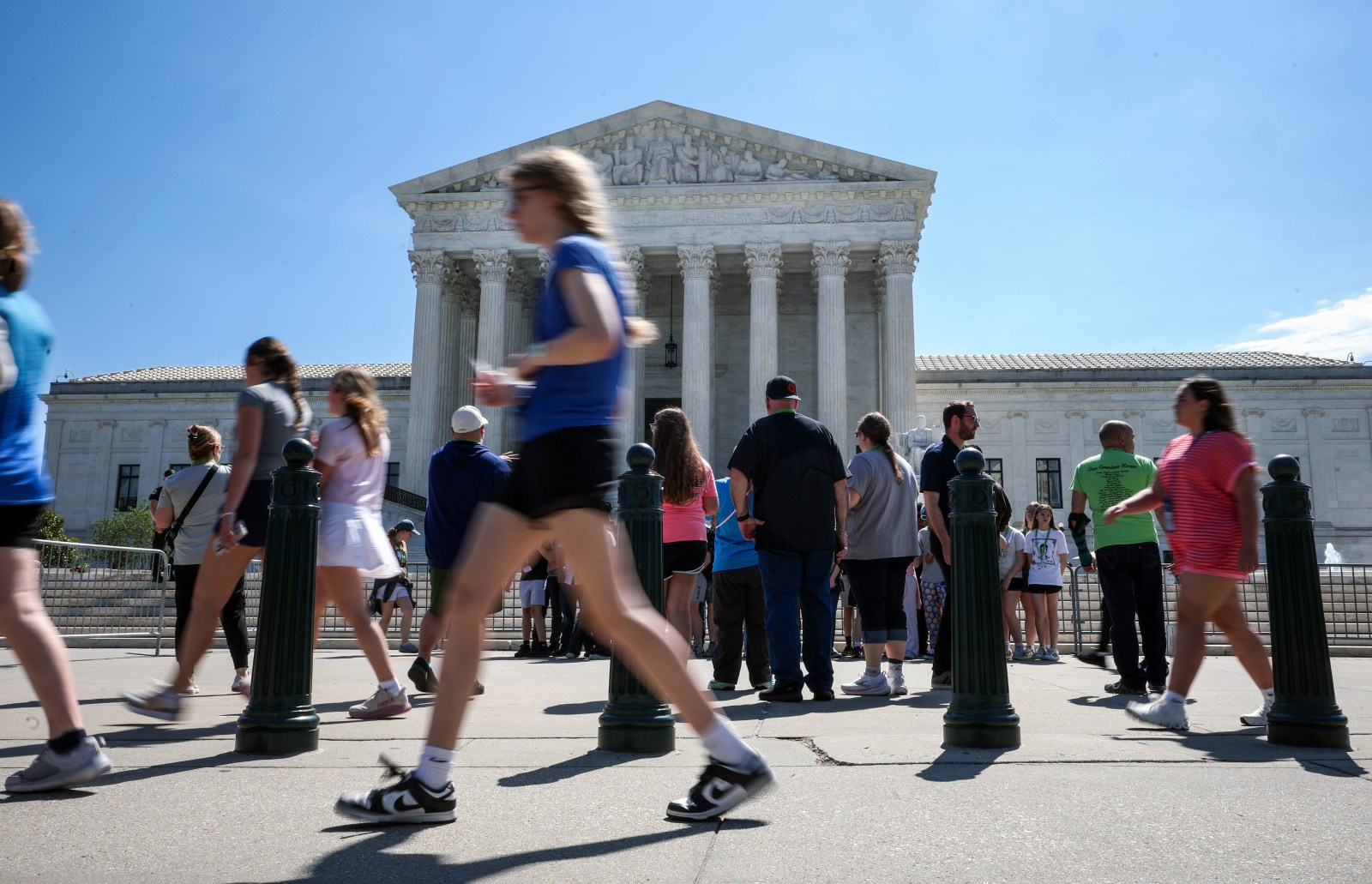
Alabama’s attempt to have its redistricting case considered by the U.S. Supreme Court faced a setback when Justice Clarence Thomas declined to issue a stay on the block imposed by a lower court on redrawing the state’s congressional map. Known for his skepticism of the Voting Rights Act provisions often invoked in such cases, Thomas denied Alabama officials’ request for immediate intervention, urging those opposing the changes to justify why the map should be employed. This development is part of Alabama’s protracted redistricting battle and comes amid broader Republican efforts to introduce new maps nationwide ahead of the 2026 midterms, pivotal for President Donald Trump’s party to maintain control of the House of Representatives.
Alabama Redistricting: Key Details
A federal panel of three judges issued a preliminary injunction against the map’s usage, a map first designed in 2023. Alabama promptly declared its intention to challenge this decision at the U.S. Supreme Court, a body that has previously addressed similar issues, including those in Texas. State Attorney General Steve Marshall remarked, “The confusion about Alabama’s congressional district maps seems to stem from the three-judge panel rather than the voters. Our State’s conservative voters having conservative representation signifies democracy.” The District Court ruled that Alabama must adhere to court-ordered districts utilized in the 2024 election after attorneys representing Black voters claimed the state’s proposed map was discriminatorily aimed against them. “Ultimately, we cannot mandate Alabamians to cast votes in 2026 elections under a plan tainted by intentional race-based discrimination,” the judges stated.
The case, evolving since 2021, has shifted between the legislature, district court, and Supreme Court, culminating in a landmark 2023 ruling by the Supreme Court that confirmed the ban on the new map under the Voting Rights Act, a stance opposed by Thomas.
An April ruling in Louisiana v. Callais altered the interpretation of Section 2 of the Voting Rights Act, reopening the case for challenge, steering it back to the District Court recently. In supporting Alabama state officials’ present Supreme Court appeal, the Trump administration’s Solicitor General, D. John Sauer, criticized the district court’s approach to disentangling race and politics, and condemned the injunction issued deep within the election calendar. Plans were already underway to conduct primaries using the proposed new map.
“Federal district courts do not have the same license to interfere with election rules at the eleventh hour, particularly on such dubious merits theories,” Sauer stated.
Thomas’ Perspective on Redistricting Challenges
For decades, Thomas has held one of the court’s most skeptical views regarding the application of the Voting Rights Act (VRA) in redistricting cases, repeatedly contending that federal law should minimally influence states’ drafting of congressional maps. His stance is anchored in a constitutional philosophy advocating a “colorblind” perception of the Equal Protection Clause and dismissing the notion that courts should enforce or encourage race-based districting. Throughout Thomas’s tenure, he has been a steadfast voice advocating for a fundamental reassessment—and sometimes complete abandonment—of the legal criteria used to contest electoral maps under Section 2 of the VRA. From the 1990s forward, Thomas has consistently argued Section 2’s misinterpretation by courts to address “vote dilution” issues linked to district boundaries. In a 1994 concurrence in Holder v. Hall, he claimed that the statute’s text pertains solely to voting procedures—not districting.
He has reiterated this viewpoint in recent cases, asserting that Section 2 “cannot provide a basis for invalidating any district” as it governs “access to the ballot or the processes for counting a ballot,” not “a State’s choice of one districting scheme over another.” This argument prominently appeared during his dissent in the 2023 case Allen v. Milligan, upholding the challenge to Alabama’s congressional map and revisiting the court in 2026.
In 2023, Thomas criticized the majority for, in his opinion, mandating states to engage in race-conscious line drawing. He rejected the notion that the VRA obliges states to establish majority-minority districts reflecting population proportions, stating Section 2 doesn’t demand proportional representation and would be unconstitutional if interpreted thus. More broadly, he depicted the Court’s redistricting jurisprudence as conflicting with the Constitution’s commitment to race neutrality.
Thomas has bolstered this critique in subsequent redistricting disputes, including in the court’s April 2026 decision in Louisiana v. Callais. In concurrence, he argued the court should progress further than the majority and declare that Section 2 “does not regulate districting at all.” Across his opinions, a recurrent theme emerges: Thomas views the VRA’s usage in redistricting as encouraging racial sorting prohibited by the Constitution. He argues modern interpretations of Section 2 essentially regard racial groups as entitled to political representation proportional to their population, a premise he dismisses as legally unsupported and constitutionally dubious. Conversely, proponents of the existing framework contend that Section 2 remains vital in preventing the weakening of minority voting power through district design.
Upcoming Developments
Attorneys countering the new map must submit their arguments to the Supreme Court by June 1, 4 p.m. Subsequently, the court will decide whether to uphold the state’s appeal.