
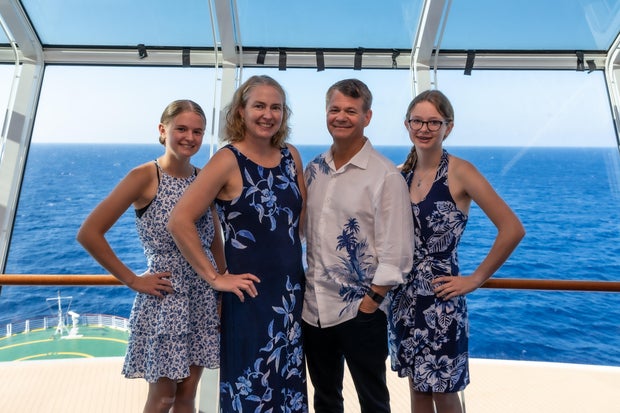
Dr. Sara Whittingham, an Air Force veteran and anesthesiologist, initially dismissed her forgetfulness and tendency to trail off mid-sentence. With her family moving from Utah to Ohio and the COVID-19 pandemic unfolding, her occasional lapses seemed normal. However, during a family movie night in November 2020, her husband noticed her arm shaking.
Concerned, Whittingham searched online and discovered information about Parkinson’s disease. Though she thought she was too young for such a diagnosis, her symptoms aligned. She consulted a neurologist at the Cleveland Clinic, who confirmed the diagnosis, drastically altering her perception of her future.
Understanding Parkinson’s Disease
Parkinson’s is a progressive nervous system disorder. Symptoms start mild, like Whittingham’s tremors, and worsen over time. Initially, Whittingham battled anxiety and depression, contemplating worst-case scenarios. Eventually, she learned about a study exploring cycling’s impact on Parkinson’s progress.
The Role of Exercise
The study was run by Dr. Jay Alberts, who found that cycling could positively affect Parkinson’s progression. Consistent aerobic exercise at 75 rotations per minute for 30 to 40 minutes multiple times a week showed promising results.
“If you think about this disease, this is a disease that robs individuals of control,” Alberts explained.
Whittingham embraced this exercise regimen, joining the study, and found cycling to be therapeutic.
A Journey of Resilience
By participating in the research, Whittingham felt reinvigorated. She joined her husband in triathlon training, eventually surpassing him in a race. Her journey peaked in 2023, when she competed in the Ironman World Championship.
“To cross the finish line and hear my name — ‘Sara Whittingham, you’re an Ironman’ — was just unreal,” she said.
Continuing the Fight
Whittingham joined additional research on communal exercise environments for Parkinson’s patients. The camaraderie and shared enthusiasm bolstered her spirit and reinforced the benefits of exercise.
“Seeing how the community inspires each other has been really powerful for me,” Whittingham remarked.
Beyond racing, she advocates for Parkinson’s awareness, serving on advisory councils and speaking at forums.
The potential of human resilience and adaptability inspires Whittingham’s efforts. She believes that setting ambitious goals can strengthen and motivate individuals.
Empowering Others
In her advocacy, Whittingham encourages others to harness the brain’s adaptability. “You don’t need to finish an Ironman, but set the most outrageous goal you can think of,” she advises.
Her unwavering spirit and dedication to awareness underscore the importance of proactive approaches to managing Parkinson’s.