
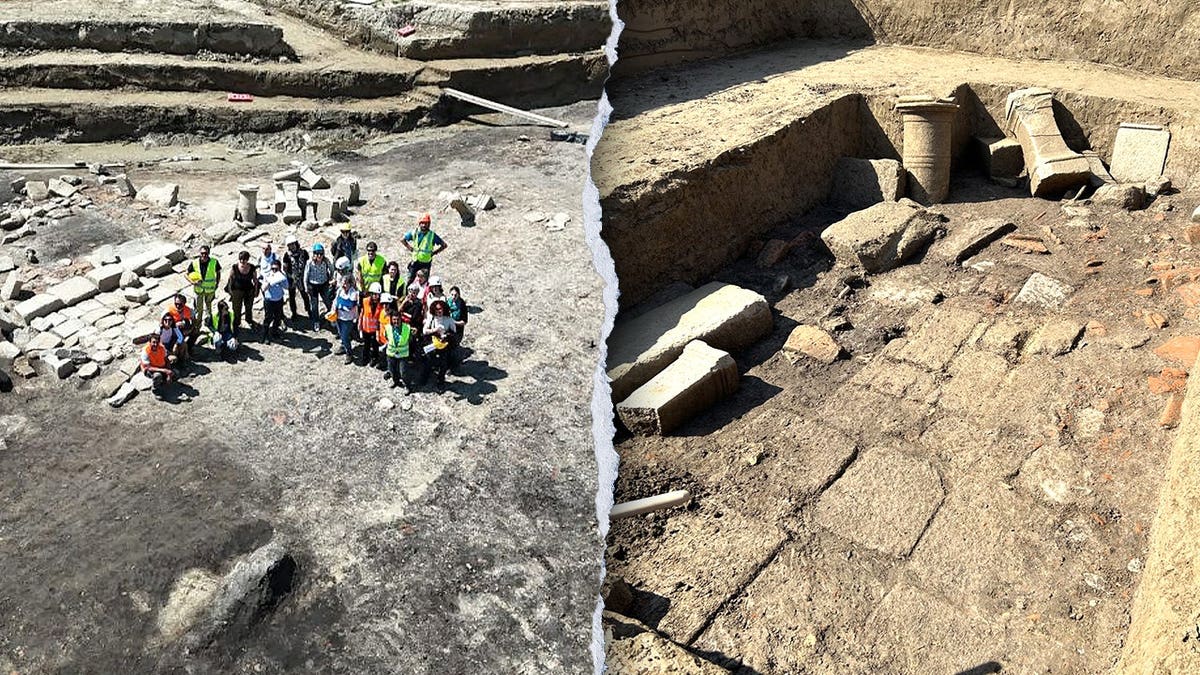
Construction crews working on a highway in Italy have uncovered the remains of an ancient sanctuary, prompting an archaeological investigation. The Italian Superintendency of Archaeology, Fine Arts and Landscape announced the discovery on May 19. The site was found in Ponso, about 45 miles southwest of Venice.
The sanctuary was unearthed during the construction of a new road by Veneto Strade S.p.A., linking Borgo Veneto to Carceri. The discovery occurred as workers were conducting wartime ordnance clearance operations, revealing artifacts that date back to the fifth century B.C.
Archaeologists have since uncovered large rectangular foundations believed to be temples, with one structure surrounded by a row of columns. Although some inscriptions were in Latin, many were written in Venetic script, an ancient language of the Veneti people before Roman rule.
The inscribed stones seem to have been repurposed in a paved flooring structure, whose original function is unclear. Some stones remain in their initial position. Current studies suggest the paving was constructed during the 1st century A.D.
Images from the site reveal Venetic inscriptions, alongside partially buried columns and stone blocks thought to belong to the temple complex. Numerous inscriptions have a “votive character,” indicating a religious purpose.
Archaeologists suspect a branch of the Adige River may have flooded the area in ancient times. The sanctuary complex could provide insights into religious practices in ancient northeastern Italy. Evidence points to a “continuity of use and transformation over time, rather than abandonment,” according to officials.
The site maintained significance during Roman times, albeit within different cultural frameworks. Researchers continue to investigate the area, contributing to a series of recent archaeological finds across Italy. Not long ago, a massive Iron Age necropolis was found in Trento. Additionally, an ancient Roman city was uncovered near the Appian Way, a UNESCO World Heritage site.