
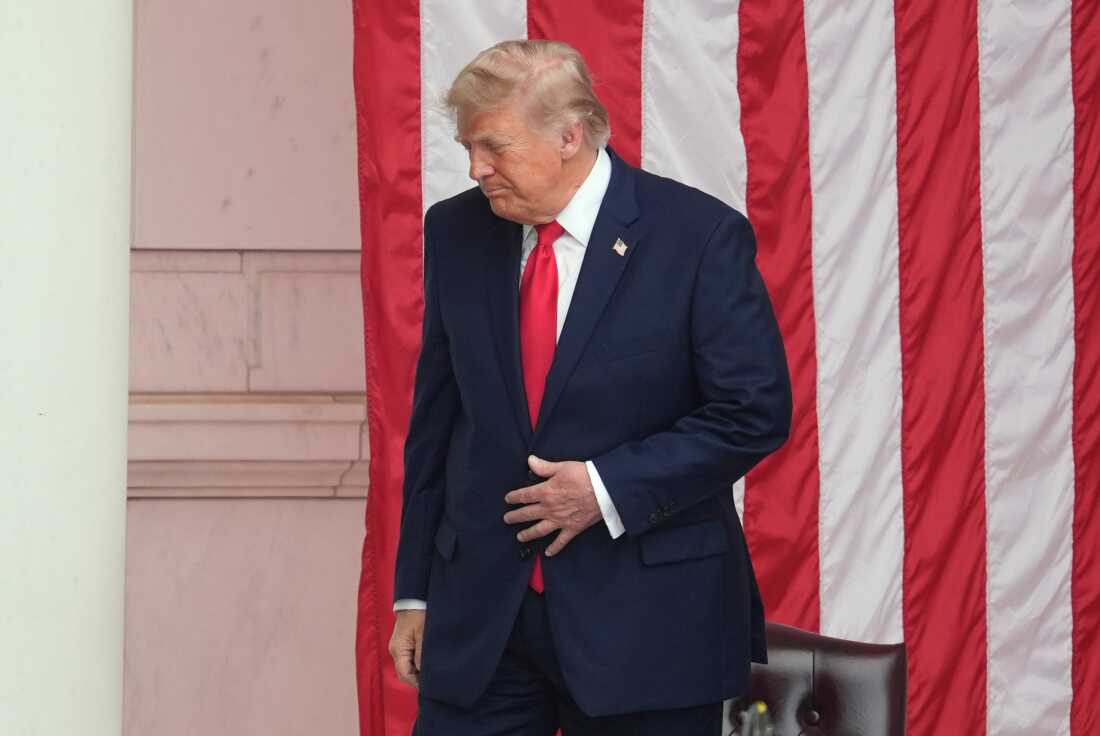
President Donald Trump departed following his speech at the 158th National Memorial Day Observance, which coincided with the nation’s 250th anniversary. This event occurred at the Memorial Amphitheater in Arlington National Cemetery on Monday, May 25, 2026.
Trump will attend a doctor’s appointment on Tuesday at Walter Reed National Military Medical Center. This visit marks his third in 13 months, raising questions about his health. The White House previously described the visit as a ‘routine annual dental and medical assessment,’ emphasizing it as part of Trump’s preventive health care.
Turning 80 years old in June, Trump is the oldest person to assume the presidency and second in age among U.S. presidents, following Joe Biden. Concerns about Trump’s swollen ankles and bruised hands have been a constant topic, questioning his health and fitness.
Following his last physical examination in April of the previous year, Trump narrated his ‘success’ on the cognitive test, and the White House confirmed his ‘excellent health.’ Yet, the October follow-up visit to Walter Reed ignited renewed speculation, emphasized by a subsequent CT scan focused on his cardiovascular and abdominal health.
White House physician Capt. Sean Barbabella affirmed Trump’s ‘excellent overall health.’ However, the President’s visible lethargy and makeup-covered bruises continued to fuel speculation.
In January, Trump openly expressed regret for the October CT scan, attributing hand bruising to excessive aspirin intake. Trump’s campaign emphasized mental and physical acuity, where he ridiculed Biden’s capability as Commander-in-Chief, calling him ‘Sleepy Joe.’ Biden, facing visible challenges, withdrew from the presidential race shortly thereafter.
The White House strongly backed Trump’s vitality, highlighting his rigorous schedule, including a recent negotiation of a U.S.-Iran peace deal. Communications Director Steven Cheung notably commented on X, affirming Trump’s determination.
Cabinet members weighed in, with HHS Secretary Robert F. Kennedy Jr. mentioning Dr. Mehmet Oz’s observation of Trump’s exceptionally high testosterone level.
Presidents benefit from superb preventive care and continuous access to White House physicians.
Walter Reed visits typically comprise annual physicals, imaging appointments, and serious illnesses, similar to Trump’s COVID-19 case in 2020.
Trump’s Medical Records Overview
Trump’s reticence with health records parallels selective medical disclosures from the White House. Trump’s chronic venous insufficiency diagnosis was detailed in a summer memo. Trump maintained ‘excellent cardiovascular health’ despite the condition.
The April 2025 medical report remains the last comprehensive public health detail. The exam identified ‘abnormalities,’ including ear scarring from a past gunshot wound incident and benign polyp discovery during a colonoscopy. Trump’s weight was reported at 224 pounds, a notable reduction, with optimal LDL cholesterol levels.
Following an assassination attempt in 2024, Dr. Ronny Jackson affirmed Trump’s recovery via a CT scan.
In 2023, Trump offered a brief doctor’s letter, showing weight loss and exceptional cognitive test performance. During Trump’s first term, Dr. Jackson commended Trump’s genetic blessing and lifespan prospects.
NPR’s inquiries regarding Tuesday’s examination went unanswered by the White House.
External Opinion: Dr. Byron Lee’s Perspective
Stanford University professor of cardiovascular medicine, Dr. Byron Lee, commented on the commonality of annual physicals among Trump’s age group. Lee noted increased heart attack and stroke risks but observed that active individuals like Trump manage fine.
Lee found Trump’s schedule advantageous for his overall health and queried Trump’s aspirin usage, noting it causes bruising.
Lee advised further investigation into Trump’s chronic venous insufficiency, acknowledging potential links to other conditions.
Dr. Lee expressed optimism regarding Trump’s weight loss and emphasized the importance of maintaining activity to mitigate heart disease risks.
Lee hinted at prescribing GLP-1 drugs like Ozempic for patients with similar profiles for weight management benefits.