
President Trump’s decision to delay a $14 billion arms package to Taiwan is advantageous to China. This move may prompt China to consider strategies to prolong the hold on the weapons.
The U.S. president’s approach has reshaped arms sales to Taiwan into a bargaining tool in negotiations with China. President Trump made comments that suggested these arms negotiations are opportune for China’s leader, Xi Jinping, in his endeavors against Taiwan’s government.
Chinese state media reacted on Monday, conveying a message to both domestic audiences and Taiwan: the unreliability of the United States in defending Taiwan. China claims Taiwan as part of its territory, and this stance emphasizes their assertion.
Taiwan’s President Lai Ching-te, and his Democratic Progressive Party, may face renewed skepticism of the U.S. commitment. Citing a Chinese researcher, the Global Times highlighted a shift away from “unconditional indulgence” when it comes to U.S.-Taiwan relations.
Colonel Jiang Bin, spokesperson for China’s Ministry of National Defense, emphasized that security cannot be solely reliant on military acquisitions. He warned Taiwan that dependence could lead to exploitation.
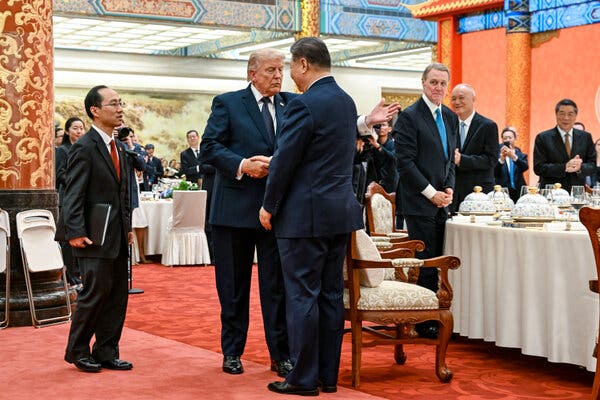
The remarks from President Trump followed a summit with Xi Jinping in Beijing. The American president openly stated that he was withholding a decision on the arms deal, labeling the package as a “very good negotiating chip” with Beijing.
He explained this stance in an interview on Fox News but did not specify what concessions or actions he expected from China in exchange.