
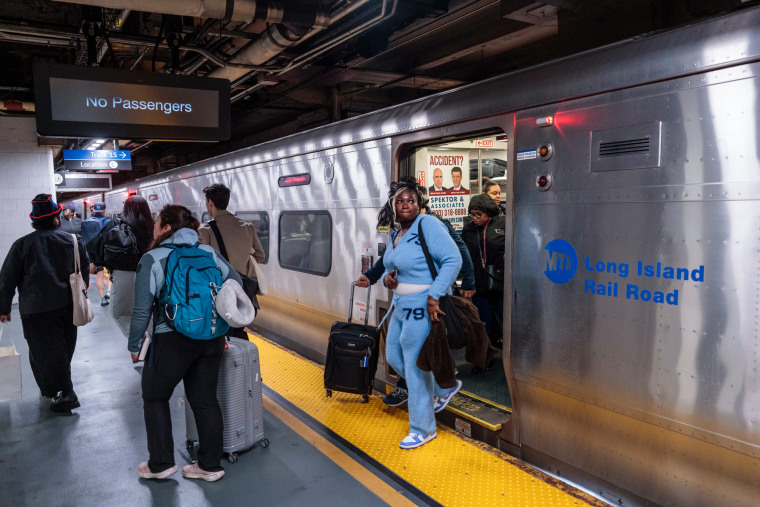
New York officials have advised commuters to work from home on Monday due to a strike by Long Island Rail Road (LIRR) workers, which has disrupted travel for hundreds of thousands of people in the region. Governor Kathy Hochul announced that the state and the Metropolitan Transportation Authority (MTA) are setting up emergency transit options. These include shuttle buses from Long Island to Queens and increased subway service. This follows a breakdown in talks between the MTA and rail unions, leading to workers walking off the job and the cessation of railroad operations on Saturday.
Governor Hochul stated, “Let’s face the facts: It’s impossible to fully replace LIRR service.” This is the first strike LIRR has faced in about 30 years, affecting the nation’s busiest commuter rail system that connects Long Island with New York City.
“It might take a couple of days, but the end result is we will come to a resolution,” noted Eric Martin, a longstanding union member and locomotive engineer.
The LIRR union coalition resumed discussions with MTA and LIRR management on Sunday evening, as shared by the unions on social media. Mayor Zohran Mamdani stated on X that LIRR service remained suspended amidst ongoing negotiations, and advised that the city is bracing for more travel issues.
Shuttle bus operations for essential workers commenced around 4:30 a.m. Monday, originating from six locations in Nassau and Suffolk counties, providing connections to subway lines in Queens. Officials have consistently urged workers who can operate remotely to do so during this period.
At a picket line beside Penn Station in Manhattan on Sunday, union workers expressed determination. Eric Martin, a locomotive engineer with 24 years of experience, emphasized their fight to maintain a fair wage for themselves and their families. Jim Louis, national vice president of the Brotherhood of Locomotive Engineers and Trainmen, remained hopeful, noting the strength of the coalition comprising five unions.
Michael Sanchez, representing the Transportation Communications Union (TCU), estimated that 100 people were picketing outside Penn Station, with about 2,000 others striking across MTA properties on the LIRR system. He appealed to the affected commuters, stating that the strike also aims to uphold the quality of service provided by LIRR employees. He emphasized the necessity for fair wages to attract and retain skilled professionals.
MTA officials accused union leaders of ending negotiations and emphasized their willingness to continue talks. Janno Lieber, MTA CEO, stated, “They walked out and went on strike.”
“New York is a pro-labor state,” Hochul remarked. “We believe in workers receiving fair wages, but we cannot accept a contract that may lead to an 8% fare increase and higher taxes.”
The coalition, representing about 3,500 LIRR workers, blamed MTA leaders for the shutdown by rejecting wage increases despite rising living costs. They argued that the two parties were close to an agreement before talks stalled and claimed the strike could have been avoided.
IAM Union International President Brian Bryant reiterated that LIRR workers wish to serve the public efficiently but require a fair contract. They plan to return to negotiations if MTA management becomes more cooperative.