
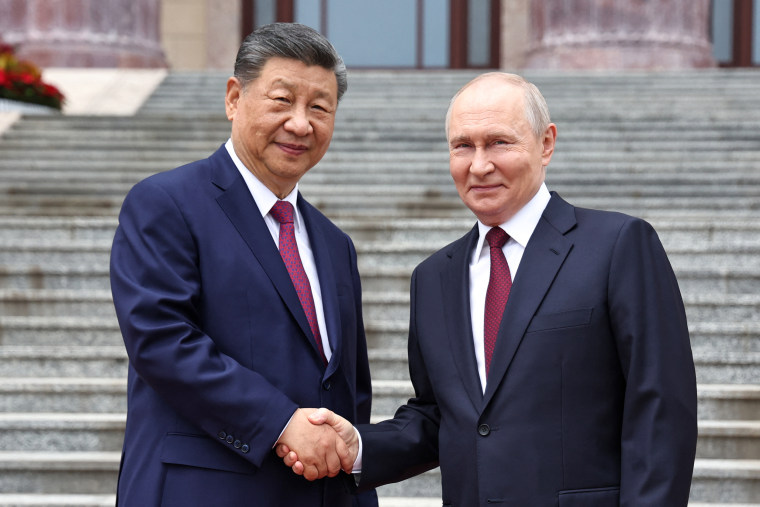
HONG KONG — China-Russia relations have reached a “historic high,” according to Chinese leader Xi Jinping. This statement came during his meeting with Russian President Vladimir Putin in Beijing, just days following U.S. President Donald Trump’s visit. Xi emphasized that the global landscape is changing profoundly, highlighting the cooperation between China and Russia as a stabilizing force against a world potentially sliding into chaos.
A welcoming event for Putin was held at the Great Hall of the People. The ceremony was similar to the one for Trump the previous week, featuring a military band, national anthems, and a 21-gun salute in Tiananmen Square. The purpose of Putin’s two-day visit to Beijing was to reinforce the bond between trusted allies after a perceived renewal in China’s relationship with the U.S. during Trump’s visit.
Though Xi and Putin did not prominently mention the U.S. in their public statements, Xi commented on the rising unilateral influences worldwide, hinting at the recent U.S.-Israeli conflicts involving Iran, which he cited as violations of international law. Putin praised the relationship between the two nations, calling China a “reliable energy partner” amid Middle East tensions. During this meeting, he invited Xi to visit Russia, using a Chinese idiom to express his sentiment, likening a day apart to three autumns.
The leaders signed multiple agreements covering economics, trade, education, science, technology, and other areas. Discussions on a second gas pipeline, Power of Siberia 2, from Russia to China were acknowledged, but specific timelines were not set. Furthermore, Xi and Putin declared intentions to strengthen their countries’ strategic partnership and promote a multipolar world. They extended the Sino-Russian Treaty of Friendship, initially signed in 2001, and criticized a U.S. missile defense project as destabilizing. Issues over the New START nuclear arms control treaty were also addressed.
Putin pointed out the strengthening trade ties between Russia and China, especially highlighted post-Russia’s Ukraine invasion. Although he frequently visits China, his current trip comes amidst home pressures due to the ongoing uncertainty in Ukraine. Despite China’s neutral stance publicly, it continues to lend diplomatic and economic support to Russia. The Chinese Foreign Affairs Ministry dismissed reports of Xi expressing regret to Trump over Russia’s invasion, labeling them as fabrications.
Russia appreciated China’s willingness to play a constructive role in resolving the Ukraine conflict, as noted in a joint statement.
On the same day, details about U.S.-China agreements were confirmed by the Chinese Commerce Ministry, including China’s intent to purchase 200 planes from Boeing, a significant deal not seen for nearly a decade. The U.S. agreed to ensure supply chains for jet engines and airplane parts. China planned to restore market access for U.S. beef and resume poultry imports where bird flu is not present. Additionally, two boards were established to facilitate tariff reductions and investment discussions.
Treasury Secretary Scott Bessent informed Reuters that the U.S. is not hastily extending a tariff and trade truce with China due to current stability. The agreement to buy $17 billion in U.S. agricultural products annually through 2028 remained unconfirmed by Chinese ministries.
United Nations Secretary-General António Guterres remarked on the recent Trump-Xi summit, stating no major breakthroughs occurred, increasing the significance of Xi’s potential U.S. visit in September. Potential meetings with Trump at the Group of 20 summit in Miami and the APEC summit in Shenzhen were mentioned. Russian officials hinted at a possible Trump-Putin meeting at APEC, noting such discussions are likely if both leaders attend.