
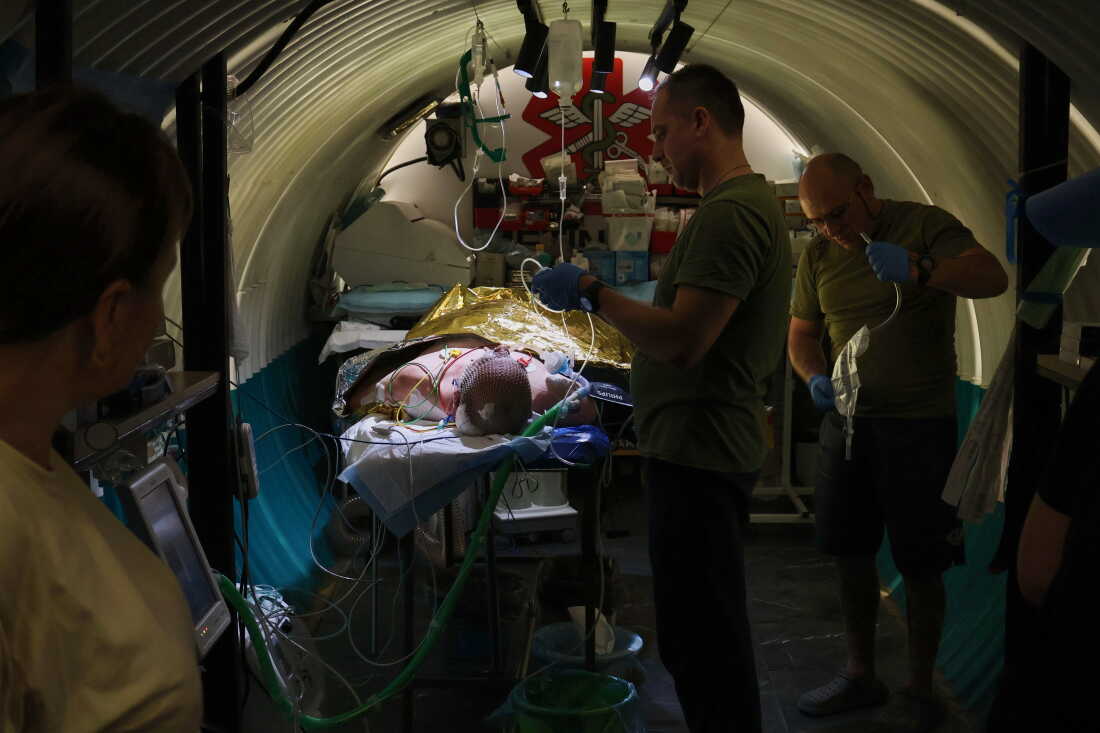
Ukrainian military medics treated a wounded soldier at a field hospital near the front line in Zaporizhzhia on September 12. Most casualties occur in the kill zone, a band about 10 to 20 miles wide on each side of the front line, stretching over 700 miles from north to south.
The front line between Russia and Ukraine spans the entire length of Ukraine, remaining largely unchanged for four years. This situation resembles the trench warfare of World War I. The kill zone, however, is dominated by evolving drone technology, changing the nature of the conflict and future warfare.
Ukraine’s Senior Lt. Taras Myshak described this territory as filled with Russian drones, mines, and artillery, involving non-stop reconnaissance and surveillance. Speaking near the front line, Myshak explained that any movement, even minor ones, attracts drone attacks. Routine troop rotations are complicated, as soldiers must hide from drones and move cautiously, often traveling just one kilometer in four hours.
Night operations present additional risks since drones equipped with thermal cameras can detect body heat. Even bicycles are used to navigate the area, as military vehicles are easily targeted.
“This kill zone is a belt of territory full of Russian drones, Russian mines, and artillery. It’s nonstop reconnaissance and surveillance,” said Myshak.
The front line remains static since Russia’s full-scale invasion in February 2022 and Ukraine’s subsequent counteroffensive. Drones now control the kill zone, affecting movement and tactics.
Rob Lee, a U.S. Marine veteran monitoring the war, noted that Ukraine’s low troop density helps conceal soldiers and rely on drones for spotting enemy movements. With drones saturating the area, both sides struggle to assemble large ground forces without being detected.
Ukraine has developed ground drones for tasks like ammunition delivery and troop evacuation, mounting machine guns on some for offensive operations.
Ukraine’s drone industry started during the invasion, producing 10 million drones this year. Russia’s drone production includes advanced jet-powered aircraft. The rapid adoption of drones demonstrates their vital role in modern warfare.
Dima Putiata, a sergeant who commanded 26 Ukrainian drone crews, highlighted the need for adaptability in using drones effectively. Training programs now aim to combine skills in drone operation and medical evacuation.
“With drones, this is the cheapest flying munition that can be massively produced. You can destroy a lot of stuff. It’s much cheaper than it used to be to have a war, unfortunately,” said Putiata.
Drones are responsible for 80% of casualties within the kill zone. The technology is expected to influence future conflicts, offering a cost-effective approach to warfare.