
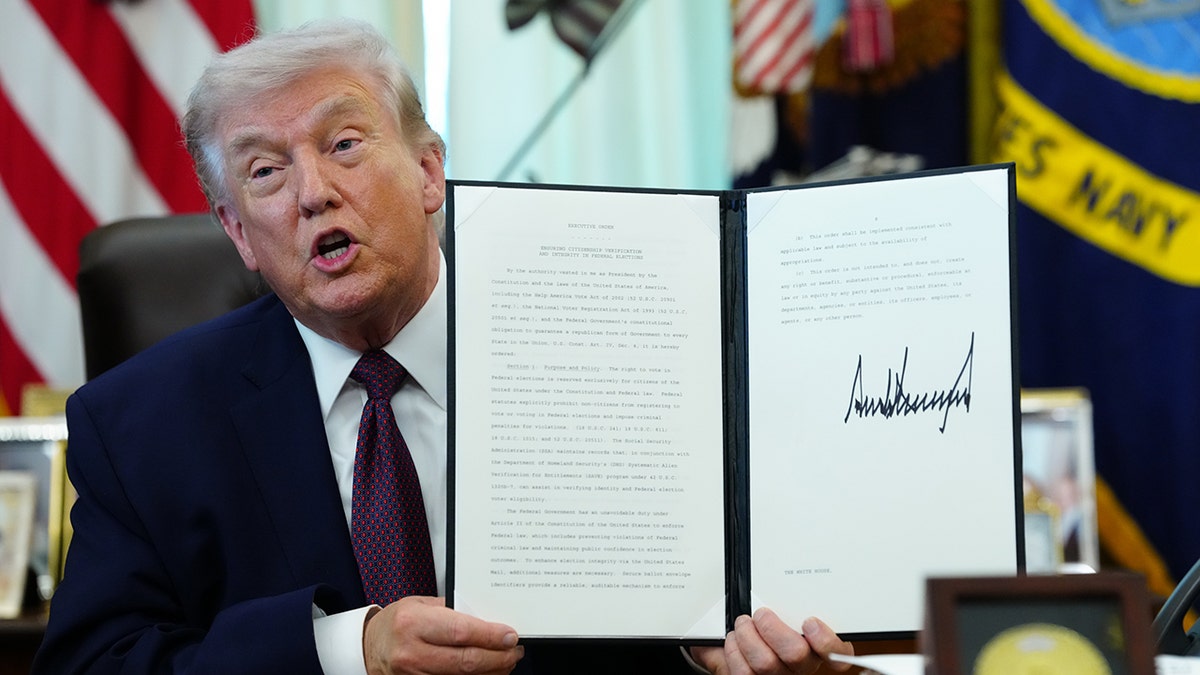
President Donald Trump is facing legal challenges over his administration’s efforts to implement new federal mail ballot rules before the 2028 presidential election. Legal experts have raised concerns about the authority to enforce these changes, as reported by Fox News Digital.
Executive Order and Supreme Court Ruling
In March, Trump issued an executive order directing the Postal Service to establish new rules for federal mail ballots. These changes include standardized ballot envelopes with an Official Election Mail designation and unique barcodes. The Postal Service would have the power to reject ballots that do not comply with these standards or belong to individuals not listed as eligible mail voters by states.
On September 14, the Supreme Court decided not to lift a preliminary injunction that prevents the implementation of these rules ahead of the midterm elections. The focus now is on whether these changes will be possible before the 2028 election. Experts highlighted the Supreme Court’s upcoming challenge in balancing the executive branch’s authority to regulate mail with the states’ rights to conduct elections.
“If the Court views this primarily as an attempt by the President to regulate federal elections, the Court is likely to invalidate it,” stated Michael Morley, a law professor at Florida State University.
Conflicting Perspectives
Opinions vary on the nature of the executive order. If seen as administrative measures for postal operations and mail integrity, the order might be upheld. However, this would depend on whether the Court sees it as a postal service issue rather than election regulation.
The Supreme Court voted 7-2 to maintain the injunction against implementing the executive order. While Justices Clarence Thomas and Samuel Alito dissented, Justice Brett Kavanaugh supported the injunction, noting timing issues close to the elections.
Potential Outcomes and Speculations
Some speculate the Court’s decision hints at a likely negative outcome for the administration. Stephen Richer, a legal fellow at the Cato Institute, suggested that authority to regulate elections belongs to Congress and states, not the president.
Others emphasize the procedural nature of the ruling rather than a definitive stance on policy intent. Chad Mizelle from the America First Policy Institute emphasized the statutory authority of the Postal Service regarding verified voter lists and tamper-resistant envelopes.
Reactions and Implications
President Trump expressed disappointment in the ruling, labeling it a setback for Republicans. He voiced his frustration through Truth Social, criticizing delays and blaming the ruling for potential election fraud vulnerabilities.
Despite isolated incidents of mail-ballot fraud, evidence of widespread fraud in mail voting is lacking. Ilya Shapiro from the Manhattan Institute noted the complexity of the issue, especially regarding which entity—state, Congress, or federal agency—has the authority to set mail voting rules.
The debate continues as officials and analysts assess the implications of the Supreme Court’s decision and its potential impact on future elections.