
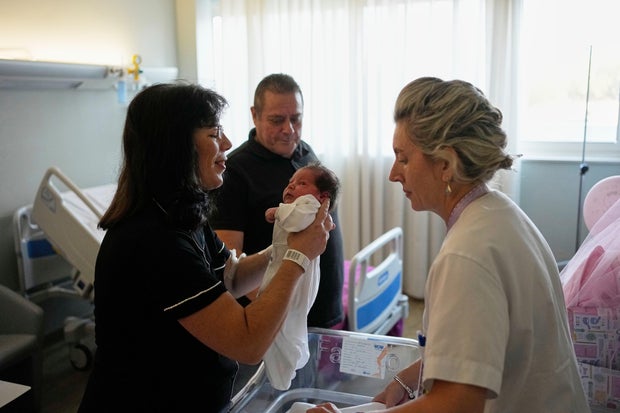
A Greek couple has embraced new beginnings with the birth of their child, following a period of profound loss. Cristina Rapti-Tzelepi, 54, and her husband faced the tragedy of losing their 21-year-old son in a road accident in October. Months later, they chose to attempt another pregnancy using an embryo frozen for 22 years.
Rapti-Tzelepi was close to the Greek legal age limit for women to undergo in vitro fertilization. The law allows this procedure until age 54. She was under intense time pressure, having only a 2.5-month window to proceed.
“I only had a 2½-month window,” she told The Associated Press. “It was stressful, but with inner strength and our doctor and his whole team by our side, we got through every obstacle.”
On a Wednesday in Athens, Rapti-Tzelepi gave birth to a healthy girl weighing 7 pounds, 11 ounces. The parents, surrounded by pink balloons and flowers in the hospital, expressed deep emotion over the new addition to their family.
Rapti-Tzelepi said on her hospital bed, “We decided to give life a second chance, to make a new start, bring new life into our home and keep our family’s story going.” She hopes her daughter grows up healthy and full of joy.
The use of the 22-year-old frozen embryo is rare, illustrating the potential of long-term embryo storage. Previously, an Ohio couple achieved a similar feat using an embryo frozen for over 30 years, setting a record.
Dr. Kostas Pantos, a key figure in the case, questioned Greece’s age limits for IVF, suggesting they need reevaluation to counteract the country’s declining birth rates. He stated, “The law is very strict: 54 plus one day is not allowed. Maybe it’s time for it to change.”
The baby’s father, Constantinos Raptis, 60, expressed deep gratitude toward Dr. Pantos, acknowledging the hope the doctor restored. “He took us by the hand and pulled us out of our deepest darkness,” Raptis said.
Cristina and Constantinos named their daughter Georgia to honor their late son, Giorgos, who was also born via IVF. Although hesitant, the couple is considering having another child, possibly seeking overseas options.
The popularity of embryo donation is growing in the U.S. Frozen donated embryo transfers have increased significantly, as noted in a study by the American Journal of Obstetrics and Gynecology. There are over one million frozen embryos in the U.S., as many retain them after completing IVF cycles.