
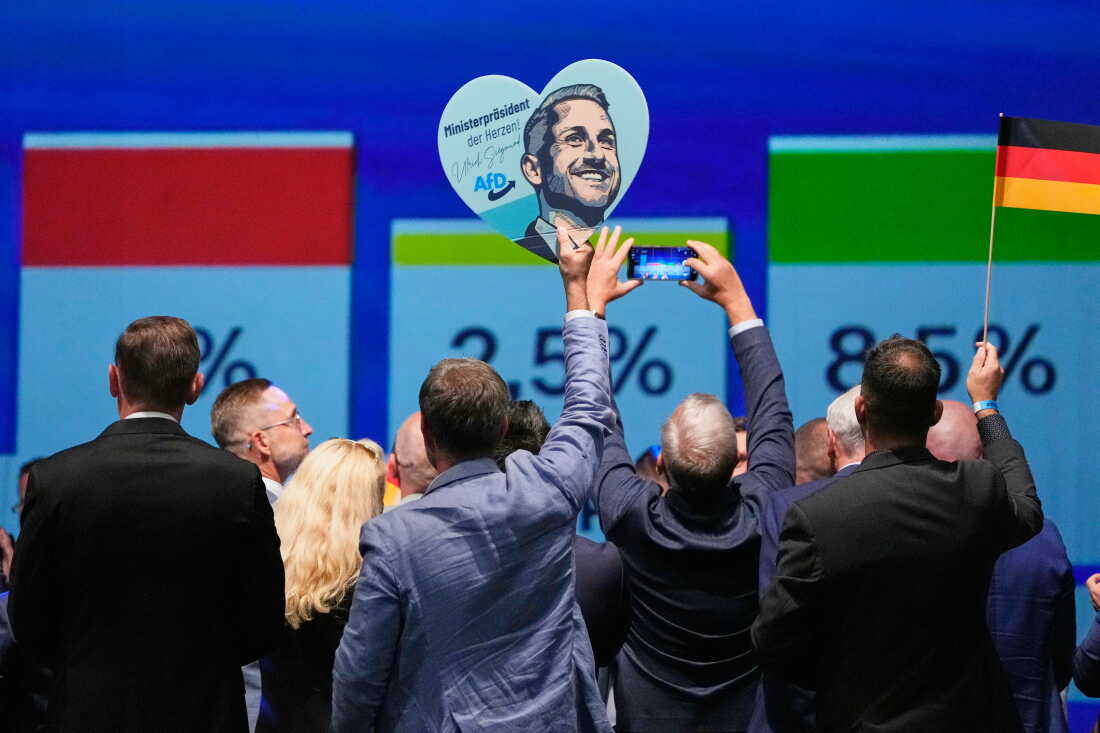
In Germany, the Alternative for Germany (AfD) party celebrated a significant triumph in the Saxony-Anhalt state election. Supporters gathered in Magdeburg to cheer the results, which saw the party more than double its vote share compared to previous elections. This outcome has sparked considerable political discussion, as the AfD fell just short of an absolute majority to lead the regional government.
Preliminary results indicate that the AfD secured 43.8% of the vote. This represents the party’s strongest performance in any German state. This result puts the far-right party on the brink of power, a position not held since the era of Nazi Germany. Traditional parties like the Christian Democratic Union (CDU) witnessed a dramatic decline, collecting only 17.2% of the vote. Meanwhile, the Social Democrats (SPD), Greens, and Left party garnered 9.3%, 8.9%, and 8.6% respectively—all parties that oppose forming coalitions with AfD.
Despite this resistance, the AfD might collaborate with BSW, a smaller anti-immigration left-wing party that received 5.3% of the vote. This partnership could potentially allow them to command a parliamentary majority. Ulrich Siegmund, the AfD’s candidate for state governor, emphasized this sentiment by stating that the election result sends a clear message to Berlin, signaling a desire for a return to a ‘secure Germany’.
The CDU’s Sven Schulze publicly congratulated the AfD, acknowledging the challenges faced by his party. Although pre-election polls predicted a lead for AfD, Schulze expressed doubts about forming alliances to exclude the far-right party. Achieving such a ‘firewall’ coalition would necessitate collaboration with Die Linke, a far-left party, a scenario currently resisted by the conservatives.
Alice Weidel, federal co-chair of the AfD, asserted that the CDU’s election prospects might be bleak moving forward. The AfD attributes their momentum to figures like 35-year-old Siegmund, who has leveraged modern campaign techniques and social media, notably TikTok, to effectively promote the party’s policies. Unlike the typical demeanor associated with the AfD, Siegmund’s personable style has resonated with voters.
The AfD in Saxony-Anhalt is classified as extremist by domestic intelligence. Its platform is notably radical, focusing on policies like ‘remigration’, which advocates for mass deportations of non-contributors to society, including jobless Ukrainian refugees. Siegmund elaborated on these policies, emphasizing a segregated education system and a revised history curriculum.
Reflecting on the election’s impact, Siegmund lauded the event as historic, suggesting it signals a shift for all of Germany. The election results attracted international observers, including former US President Donald Trump and Tesla CEO Elon Musk, both of whom expressed approval of the outcome. However, reactions from neighboring countries varied, with Poland’s Prime Minister Donald Tusk and France’s Europe minister, Benjamin Haddad, expressing concern about the implications of AfD’s ascent.