
Mario Perez cheered from the curb as dancers in vibrant dresses twirled down the street. Ribbons and ruffles gleamed in the sunlight. Amid the spectacle, he almost missed a face looking down from a window above. ‘They’re still afraid to celebrate,’ said Perez, 54. ‘People want to come out, but they’re fearful of getting arrested.’
Perez was among many immigrants gathering in Pilsen for the neighborhood’s 25th annual Mexican Independence Day Parade. This event fills 18th Street with vintage cars, folk dancers, and lively musicians heading towards Harrison Park. It is a staple in the historic Latino neighborhood. Mexican American culture is evident in the restaurants, shops, and murals lining the parade route.
However, locals noticed a lighter crowd, similar to last year’s parade. This came after the Department of Homeland Security launched Operation Midway Blitz, a 64-day immigration enforcement action across Chicago and its suburbs. Edwin Barrera, observing from a bench outside an antique shop, remarked that Saturday felt reminiscent of when the Trump administration threatened to send federal agents into Chicago. ‘Usually, there would already be chairs out, and people sitting around,’ said Barrera, 50, a Pilsen resident for two decades. ‘It’s not surprising that many people are not here.’
While El Grito, a downtown Mexican Independence Day festival, was postponed last year due to threats of increased immigration enforcement, organizers of the 2025 Pilsen parade proceeded as planned. Vicky Lugo, secretary of the United Merchants of Pilsen Chamber of Commerce, reported no incidents involving federal immigration agents during the event.
Yet, some locals had different memories. Ramon Lopez, 61, watched dancers from his apartment doorway. A lifelong Pilsen resident, Lopez attended the celebration since its inception. He pointed to an intersection near his home where he recalled immigration agents in full body armor during last year’s parade. ‘It’s more comfortable now,’ said Lopez. ‘You see police officers, but you don’t see ICE.’ Yet, some neighbors stayed home, fearing that federal agents might blend into the crowd.
Even after the blitz ended, immigration arrests have continued. Esmeralda Velasco mentioned residents’ fears, including hesitations to drop children at school. Her social media feeds frequently feature community sightings of ICE activity across Chicago, alarming neighborhoods and raising concerns among officials.
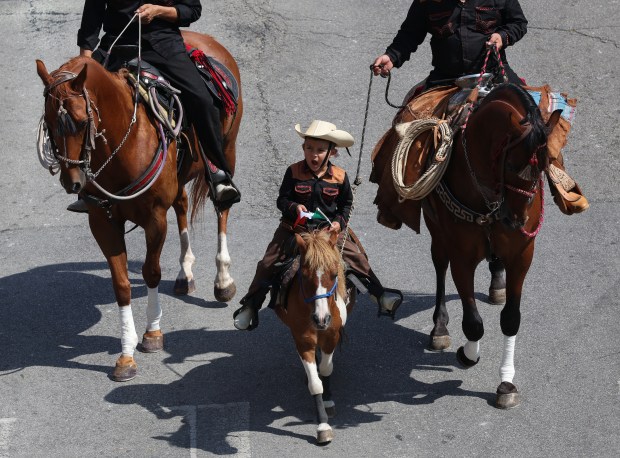
‘We’re still standing up for them,’ said Velasco, 42, about neighbors who avoided the parade. ‘We’re their voice, even if they can’t be here.’ These fears make participation even more vital for Velasco. Mexican Independence Day, celebrated annually on September 16, serves as a reminder of cultural pride. She hoped Mexican American Chicagoans who stayed home would see photos and videos of the parade online, reinforcing community pride. Among the parade highlights was a toddler trotting past on a small horse, followed by three Xoloitzcuintles, Mexico’s national dog breed.
The parade attracted attendees across generations. Liliana Baiman moved to Pilsen from Ohio, where such cultural experiences were scarce for her son. ‘We don’t get to see this where we’re from,’ said Baiman, 40. ‘We’re actually in a neighborhood where people look like me, and that feels really nice.’
Residents of Pilsen, like many neighborhoods, established an online group to alert one another of potential ICE activity. Baiman noted the network offered some safety, though some locals remain hesitant to attend public gatherings. ‘Everywhere got hit pretty hard, but people are realizing this is ongoing,’ she said. ‘We have to figure out how to support one another.’
Saturday’s celebration included older spectators waving Mexican flags from wheelchairs. Benjamin Raya, who immigrated from Mexico in his teens, enjoyed the music as a drumming group passed. ‘This lets me go back to my country,’ said Raya, 29. ‘It makes me feel like I’m home.’