
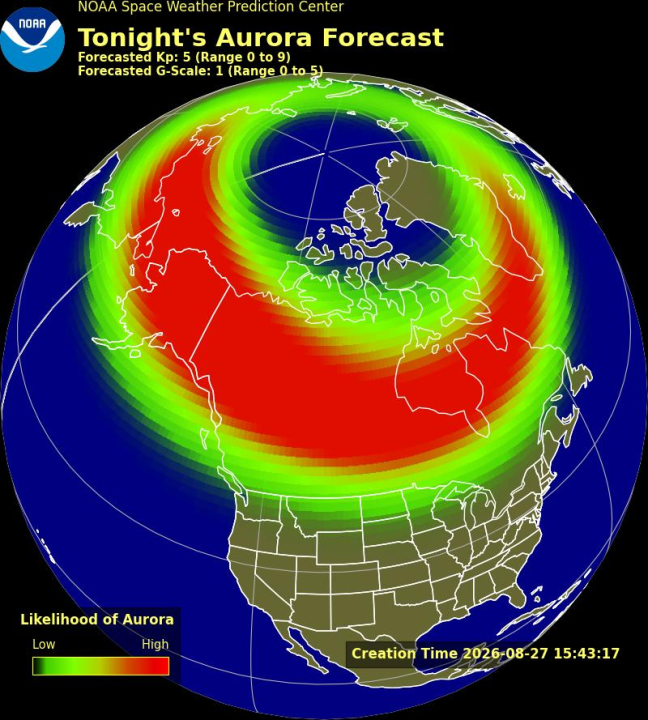
You have a chance to witness the northern lights this week, thanks to recent solar activity. The sun’s ejection of material interacting with Earth’s atmosphere can produce these luminous displays, accompanied by geomagnetic storms.
The National Weather Service’s Space Weather Prediction Center (SWPC) has issued geomagnetic storm watches for Thursday and Friday because of a high-speed stream known as a coronal hole high-speed stream (CH HSS). On Wednesday, the forecast expanded to include Saturday due to coronal mass ejections (CMEs) from the sun. Strong conditions are anticipated on Friday and Saturday.
The influx of solar material might hit the northern parts of the U.S., potentially energizing the northern lights. According to the SWPC’s three-day forecast, the geomagnetic storm conditions may intensify around 5 p.m. EDT Thursday and last beyond sunset, offering optimal viewing opportunities at night.
The conditions could reach a moderate G2 level on Thursday evening, potentially making the lights visible as far south as New York and Idaho. The aurora forecast indicates Canada and Alaska hold the highest likelihood for spotting the lights, with a slight chance for observers along the Canadian border to see them on the horizon.
Thursday night’s storms might weaken by Friday morning. However, the SWPC suggests they could regain strength by 5 p.m. EDT, peaking again between 8 p.m. and 11 p.m. EDT, much like the previous day.
The forecast extends only to 11 p.m. EDT on Saturday, so it’s uncertain if conditions will strengthen that night. Geomagnetic storm activity can vary, making it challenging to predict their precise impact on auroras. Atmospheric conditions must also align for the phenomenon to be visible.
To improve your chances of seeing the aurora, focus on the northern horizon. If visibility is poor, try using your smartphone’s digital camera, which may capture the colors more effectively due to its light sensitivity.