
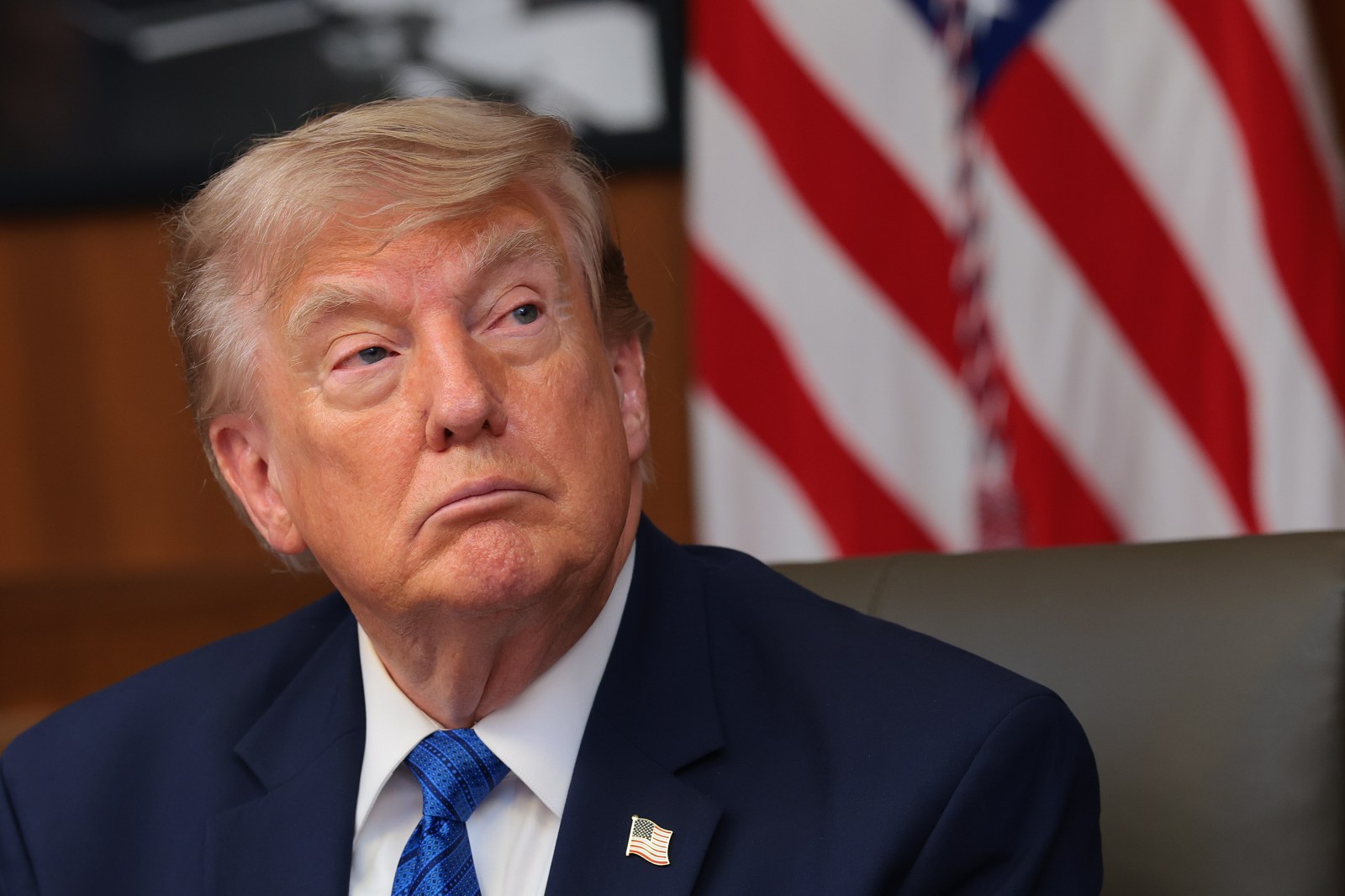
President Donald Trump faces a new warning about Americans’ confidence in the economy just 70 days before the 2026 midterm elections. Recent polls reveal growing voter frustration with his administration. The Conference Board announced that its Consumer Confidence Index fell to 89.4 in August from 90.2 in July. Chief Economist Dana M. Peterson noted consumers are more pessimistic about business conditions and the labor market in the coming months.
Economic concerns are central to the midterms, often serving as a referendum on a president’s popularity. This year, issues like inflation and cost-of-living are highlighted by respondents. Democrats believe Trump’s declining approval rating could lead to reduced support for Republicans, allowing Democrats to compete in traditionally conservative areas. Negative economic polling could signal trouble for Republicans aiming to resist a potential “blue wave” in November.
Kush Desai, a White House spokesperson, told Newsweek that consumer spending and retail sales data consistently show resilience due to the president’s economic agenda of tax cuts and deregulation. He stated that ongoing economic policies, new trade deals, and significant investments are expected to yield more progress.
Drop in Consumer Confidence
The Consumer Confidence Index decreased by 0.8 points as inflation concerns persist. The report noted that consumers’ economic outlook was more pessimistic, with elevated references to general prices and specifically oil and gas. Comments on war, groceries, trade, and jobs increased.
The Expectations Index declined, with softer forecasts for business, labor, and income. However, the Present Situation Index improved, partly due to better employment perceptions. More consumers reported jobs as “plentiful,” while fewer said jobs were “hard to get.”
Columbia University Professor Robert Y. Shapiro emphasized that public economic perceptions are solidifying. He suggested that Trump and Republicans need to make real changes, not exacerbate conditions. Lowering tariffs, not raising them, controls inflation. Keeping immigrant workers is essential for employment growth. Reopening the Strait of Hormuz could lower gasoline prices and mitigate war impacts, making it less damaging for Republicans.
Trump’s Approval Ratings
Polls indicate a decline in Trump’s approval. A YouGov and The Economist poll found 36% of Americans approve of Trump, while 57% disapprove. Conducted from August 21 to August 24, it surveyed 1,536 adults with a margin of error of 3.5 percentage points. It noted that 67% of Americans think the country is on the wrong track.
A Reuters/Ipsos poll showed record-high disapproval at 65%, with 33% approval. This poll surveyed 1,215 adults between August 21 and August 24, with a 3 percentage point margin of error.
A poll by Echelon Insights found Trump’s approval at 40%, with 59% disapproving. It surveyed 1,002 likely voters from August 13 to 17, with a 3.4 percentage point margin of error.
A Morning Consult poll reported similar negative figures, with 54% disapproval and 43% approval. It covered 2,201 registered voters from August 14 to 17.
Trump called these “fake polls” on Truth Social, describing them as demoralization tactics against Republicans. He claimed internal polls were favorable and public spirit high.
Midterm Implications
Americans’ economic views weigh heavily on the midterms. Democrats highlight economic and affordability issues, whereas Trump portrays the economy as robust. In early August, he stated the economy was performing well from Wall Street’s perspective, also highlighting job growth.
However, many Americans remain dissatisfied. The YouGov poll identified economic issues as voters’ primary concerns. Twenty-six percent cited inflation and prices, while 15% pointed to jobs and the economy. Only 3% rated the economy as excellent, 21% as good, 33% as fair, and 40% as poor.
Regarding party performance, 39% felt Democrats handle the economy better, compared to 32% for Republicans. Fifteen percent saw no difference, and 15% were unsure. A majority, 57%, felt the economy is worsening, while 14% noted improvement.
Analysts see Democrats as favorites to retake the House due to a narrow Republican majority of 218-212. The Senate presents a tougher challenge, with Republicans holding a 53-47 majority. Democrats need to flip four seats to capture the Senate majority. With key seats in play in states like Georgia and Michigan, Democrats also target traditionally Republican states like Alaska, Texas, Iowa, and Ohio due to Trump’s waning popularity.
Future Outlook
Consumer confidence and Trump’s approval rating will remain important metrics before midterms. Economic issues might play a pivotal role in shaping opinions of Trump and potentially improving his approval.
For additional details, contact Newsweek editors Jason Lemon and Geoffrey Rowland.