
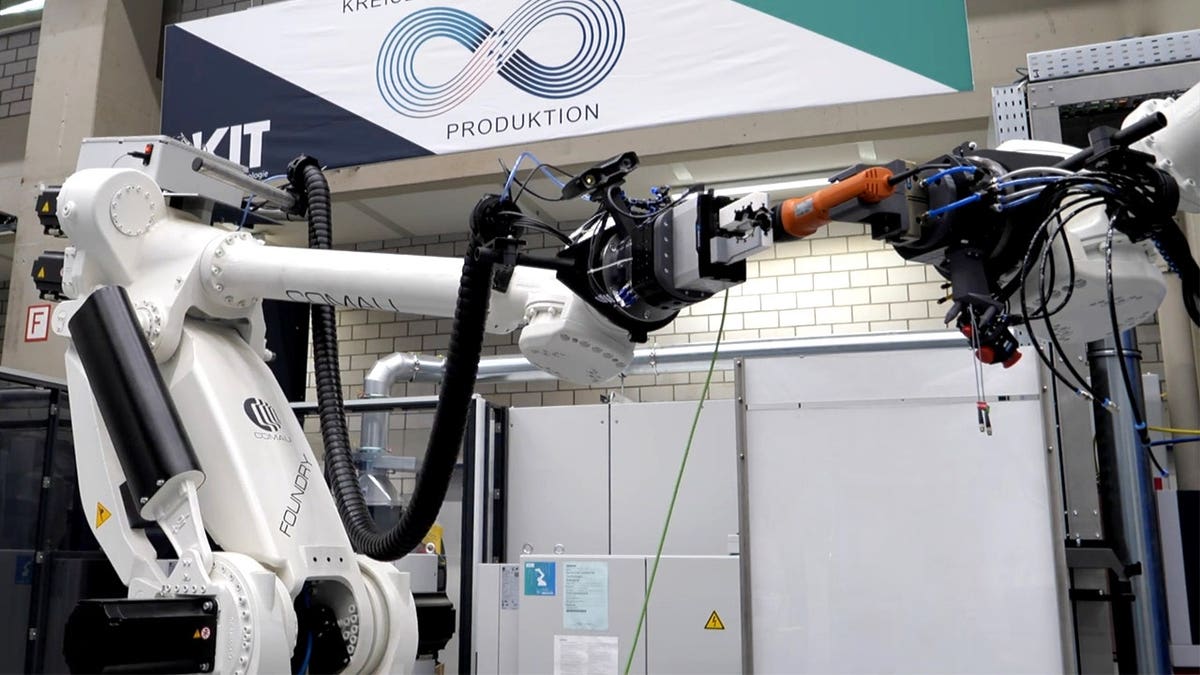
Robots have long assisted in constructing the products surrounding us. Researchers are now exploring a new ability for robots: taking apart these products when they falter. With over 4.6 million industrial robots globally, and their numbers growing as more manufacturers automate processes, a critical question arises. What happens when these machines or parts within them fail?
“A robotic disassembly system uses probabilistic planning to change tactics when damaged or aging machinery creates unexpected obstacles.” – Jan Baumgärtner and research team/KIT
Researchers at Germany’s Karlsruhe Institute of Technology (KIT) have developed a robotic disassembly system to address this issue. Rather than presuming all components will perform flawlessly, the system prepares for the unpredictable nature of aging machinery. Screws might be jammed, parts missing, or the machine might not align with its original design. The robot can identify these discrepancies and adapt its strategy accordingly.
Building products in a factory offers predictability. Robots follow a set sequence, knowing which part goes where. However, dismantling an aged machine is different. It presents uncertainties like corroded or broken parts and modifications from past repairs. This unpredictability poses significant challenges for traditional automation, where one unexpected issue can halt the disassembly process.
Jan Baumgärtner emphasizes the practicalities. Assembling something new is straightforward; deconstructing a broken item involves numerous potential pitfalls. Hence, robots require more than mere instructions—they need to understand and adjust to unfolding realities.
Robotic Disassembly Process
The process commences with a CAD model indicating the product’s original construction. The robot then assesses how each part behaves. It evaluates if components move as anticipated. If deviations occur, the system updates its understanding, modifying its strategy accordingly.
This approach utilizes a Partially Observable Markov Decision Process (POMDP), indicating that the robot acknowledges its lack of perfect information. Instead of adhering to one inflexible plan, it assigns probabilities to potential issues and revises these assumptions as it gathers new data. By integrating CAD information, inspection data, and the robot’s own capabilities, the system adapts effectively.
Baumgärtner’s system showcases flexibility in tests involving electric motor screws and an angle grinder. When a screw proved stubborn, the robot opted for a milling tool to bypass it, demonstrating adaptability crucial for handling unexpected challenges. The probabilistic system excelled, especially when traditional methods faltered against unforeseen obstacles.
While the research currently applies to specific components, Baumgärtner envisions scaling this technology for more extensive applications. Facilities might feature multiple robotic arms, each with specialized tools, enhancing disassembly efficiency.
Implications for Repair and Recycling
One ambitious goal of this research is fostering a circular economy. Manufacturers could recover valuable parts from older products instead of discarding the entire device. Robots could prioritize preserving specific components with economic value, revolutionizing repair processes by making them cost-effective.
Though not ready for retail environments, this concept shifts how manufacturers think about products post-failure. Robots adept at handling damaged goods could increase component recovery, making refurbishment more viable. Additionally, designing products with robotic disassembly in mind could simplify future repairs.
Kurt Knutsson highlights the robot’s ability to handle uncertainties, a critical advancement given the unpredictable nature of broken goods. Teaching robots to adapt to conditions beyond the blueprint could expand their applications to recycling and repairs. While practical use remains future-focused, the concept holds significant potential.
If repair robots could make fixing electronics cheaper than replacing them, would that influence how long you keep your devices, or would manufacturers still push for new sales?
For tech tips, security alerts, and exclusive offers, visit CyberGuy.com. Get insights from award-winning tech journalist Kurt Knutsson, and subscribe to his CyberGuy Newsletter for more engaging content.