
Hurricane Lala shifted into a tropical storm on Sunday after passing close to Hawaii without making landfall. Yet, the storm’s power did not spare the Big Island from harsh winds and severe rainfall. Forecasts indicated rainfall could accumulate to nearly 3 feet on higher windward slopes, posing threats of mudslides as rivers were turning into raging torrents.
Starting Sunday, tropical storm conditions expanded from Maui towards Oahu and Kauai. The National Hurricane Center noted that wind speeds on mountain tops and slopes can exceed near-surface wind speeds by up to 30%. These factors intensified Lala’s classification.
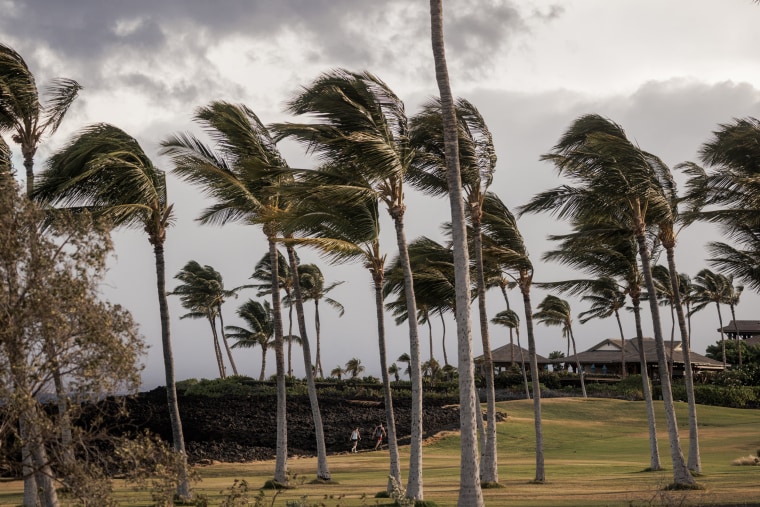
The storm’s slow passage brought powerful waves to the Big Island’s coast. Strong winds whipped palm trees and created fast-moving runoff water due to the relentless rain. Many residents faced nearly horizontal rain as they made their way along pathways at tourist locations like the Waikoloa Beach Resort on Saturday.
By Sunday morning, utility outages left over 130,000 households without power across Hawaii’s three main islands, according to poweroutage.us. At least three hospitals managed operations on generator power, as stated by the Governor, Josh Green. Tragically, a car accident claimed one life in South Point, and the storm caused the loss of 19 roofs.
Search-and-rescue teams, consisting of Civil Defense, the National Guard, and Coast Guard, were mobilized after flash floods displaced several homes in Na’alehu and Wai’ohinu. Hawaii County Mayor Kimo Alameda explained the challenging rescue conditions due to the darkness, rushing water, and debris on roads.
Prospects for Lala
Tropical storm warnings continued for Maui, Molokai, Lanai, Kahoolawe, Oahu, Kauai, and Niihau as the storm’s trajectory headed west, posing risks of worsening floods and potentially wildfire conditions due to strong winds. As of early Sunday, the storm was positioned approximately 105 miles west-northwest of Kailua-Kona and 100 miles south of Honolulu, with a wind circumference reaching up to 175 miles from its core.
Lala maintained winds around 70 mph, moving northwest at roughly 15 mph. Forecasters anticipated a return to hurricane strength midweek as it progressed farther from Hawaii. The storm was expected to drop up to 35 inches of rain in higher altitudes, including those around the Mauna Kea volcano.
Island Preparedness and Community Impact
As the storm approached, emergency shelters opened, events were suspended, and ranchers were advised to leave cattle in open pastures to avoid potential structure collapses. Residents, still reeling from March floods, were vigilant in their preparations.
Bobby Camara, a lifelong resident, expressed hope to maintain power at a care facility near Hilo. He referenced continuous activity at gas stations as residents secured fuel for essentials. “Stocking up and self-reliance is part of life here,” he noted.
Mike Caputo, from Keaau near the east coast, prepared with operational generators and full water tanks. His main concerns included potential flash floods and fallen trees, especially concerning the common weak albizia trees that pose roadway obstacles.
Christine Matsuda, from Waimea in the north, reported frequent strong gusts, causing unexpected leaks in areas usually dry. The hurricane center anticipated rainfall totaling 8 to 12 inches across Maui and lower Big Island elevations, with 4 to 6 inches across the rest of the islands.