
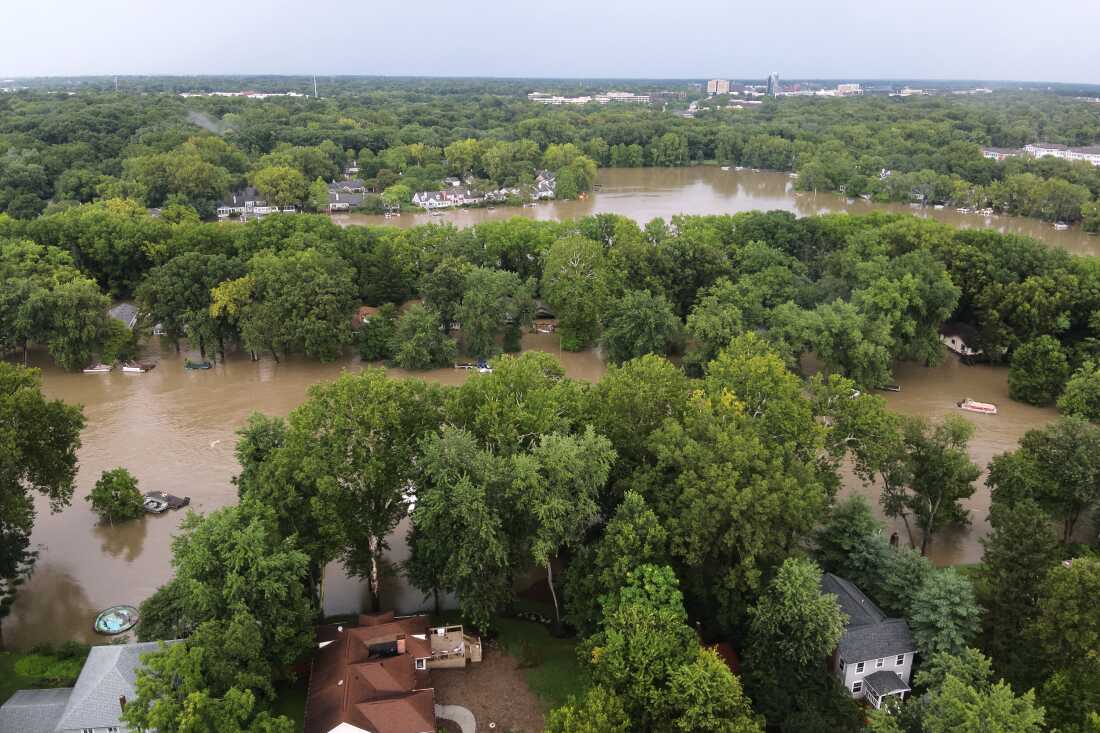
Aerial images from the Indianapolis Fire Department show severe flooding in northern Indianapolis, Indiana, as of August 15, 2026. A relentless series of thunderstorms has caused widespread flooding in the Midwest, with more rainfall predicted through Sunday, according to the National Weather Service (NWS).
The NWS anticipates extensive storms across the Ohio Valley, Midwest, and central Appalachians. These will add further rain to areas where water levels had begun to fall. As of Saturday, at least three people have died, and over 150,000 were without power.
Indiana and Ohio have been severely impacted, with rainfall exceeding 11 inches in parts of these states over the past week. In Anderson, Indiana, the White River reached a historic level of 24.9 feet, breaking a century-old flood record. Currently, flash flood warnings are active in central Illinois and Indiana, with flood watches extending from Iowa to central West Virginia.
Indiana Governor Mike Braun has taken decisive action, declaring a Statewide Disaster Emergency. He mobilized state and local resources, including the Indiana National Guard, and requested a presidential emergency declaration for federal funding through FEMA. He stated, “I will do everything in my power to protect Hoosier lives and livelihoods as we respond to this historic severe weather.”
In addition to the heavy rain, Indiana has faced tornadoes and a derecho recently. Cyndee Gillmore, who operates Cornerstone Campground and Retreat Center in New Castle, Indiana, described severe flooding at her property. “Five feet of water swept across, flooding the kitchen, banquet hall, youth center, and all mobile campers,” she said.
I’m standing in my house right now and it smells to high heaven, but it’s just stuff,” Gillmore said. “Everybody is pitching in and the community is supporting one another and it’s beautiful to see. We’re going to keep our focus on God.”
Despite community support, the financial toll worries Gillmore. Most property owners, including herself, lack flood insurance. “My heart breaks,” she stated. “Nobody has the money to fix all of this. I don’t know how people will make it.”
The lack of flood insurance compounds the problem for many affected homeowners. The majority of flood insurance is administered by FEMA, which requires it in federally identified flood zones. However, NPR found that FEMA’s maps often overlook rainfall and flash flood risks, focusing instead on coastal and large river flood data.
Research from First Street, a climate risk firm, shows that many more Americans live in flood-prone areas than FEMA maps reveal. This oversight leaves many properties unprotected. For example, during Hurricane Helene in 2024, 98% of damaged homes in western North Carolina were outside FEMA’s mapped flood zones.
The Midwest now faces a similar risk. The National Oceanic and Atmospheric Administration predicts potential minor to major flooding, with the National Weather Service recording significant rainfall at Washington Municipal Airport in Iowa, Glouster, Ohio, and Elkhorn Creek, Kentucky. With more storms on the horizon, flood threats to downstream areas increase.