
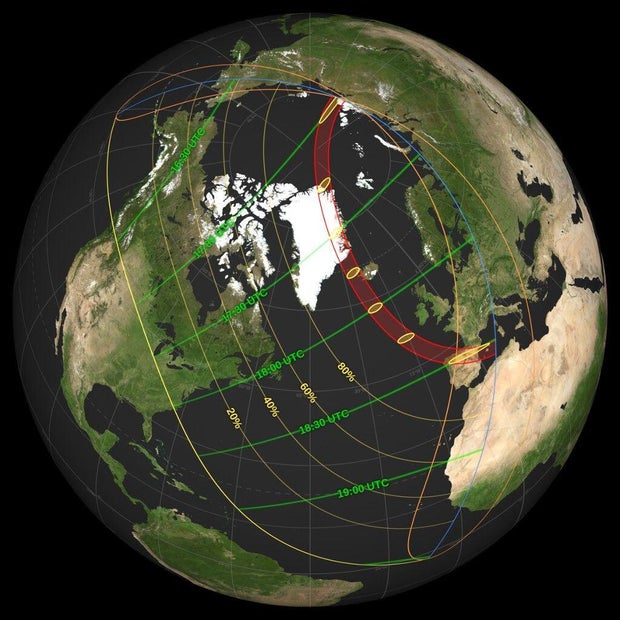
The only total solar eclipse of 2026 is set to captivate observers by casting darkness along its path across parts of the Northern Hemisphere. For those unfamiliar with the event, a solar eclipse occurs when the moon moves in front of the sun, a phenomenon that happens on Earth approximately every 18 months. At any specific location, however, such an eclipse might not occur for several centuries.
Where Will the Solar Eclipse Be Visible?
While some optimal viewing locations, like northern Greenland, are sparsely populated, western Iceland and northern Spain fall within the path of totality, promising a remarkable observation. Notably, Spain has not witnessed a total solar eclipse since 1905.
NASA provides an animation depicting the eclipse’s path, alongside timing details. Although totality will only be witnessed in sparse populated areas, a partial eclipse will be visible over a larger region. An estimated 230 million people will experience 90% totality, including many major European cities such as Madrid, London, and Paris.
Some sections of North America will also observe a partial eclipse. Fairbanks, Alaska, will see the highest totality at 37%, while Boston, New York City, and Philadelphia will note 16%, 9%, and 7% totality, respectively.
What Time Will the Eclipse Occur?
The eclipse’s path is relatively brief, lasting around one hour and 45 minutes from start to finish. It begins in northern Russia at 5:00 PM UTC, which is 1:00 PM Eastern Time.
Totality will reach northeast Greenland by 1:30 PM ET and western Iceland by approximately 1:45 PM ET, where Reykjavík will experience totality precisely at 5:48 PM local time. As the eclipse crosses the northern Atlantic for 45 minutes, optimal visibility will occur in the UK, with London achieving 91% totality at 2:13 PM ET (7:13 PM local time). By 2:30 PM ET, northern Spain will experience totality, occurring exactly at 8:32 PM local time in Valencia.
The process will conclude by 2:45 PM ET. Residents in North America will see the most complete partial eclipse in Toronto at 1:40 PM and New York City at 1:54 PM local time. In Fairbanks, observers should be prepared early, with the peak at 8:27 AM local time.
How to Safely Watch the Eclipse
In locations where the solar eclipse reaches totality, observers can safely view it without glasses for about two minutes. However, wearing solar eclipse glasses is essential when viewing the sun directly to protect your retinas. Outside the path of totality, it is vital to keep glasses on throughout the partial eclipse to avoid eye damage.
A photo captures a woman trying eclipse glasses in Almelo, eastern Netherlands, on the eve of the solar eclipse. © Vincent Jannink / ANP /AFP via Getty Images
Future Total Solar Eclipses in the U.S.
The next chance to see a total solar eclipse in the U.S. happens in 2044, visible only in Montana, North Dakota, and South Dakota. A year later, an eclipse will cross from Northern California to Florida, offering views in various cities, including Reno, Colorado Springs, and Orlando. In 2052, another eclipse will traverse the Southeast.
Northeastern U.S. residents will need to wait until May 1, 2079, for the next total eclipse in that region.
Viewing the 2026 Total Solar Eclipse
The total solar eclipse will occur across parts of the Northern Hemisphere on August 12, 2026. Live coverage will begin at 2 PM ET. CBS News will stream the event from Mallorca, Spain, where totality occurs at about 2:30 PM ET. Check online or mobile devices for live streaming options.