
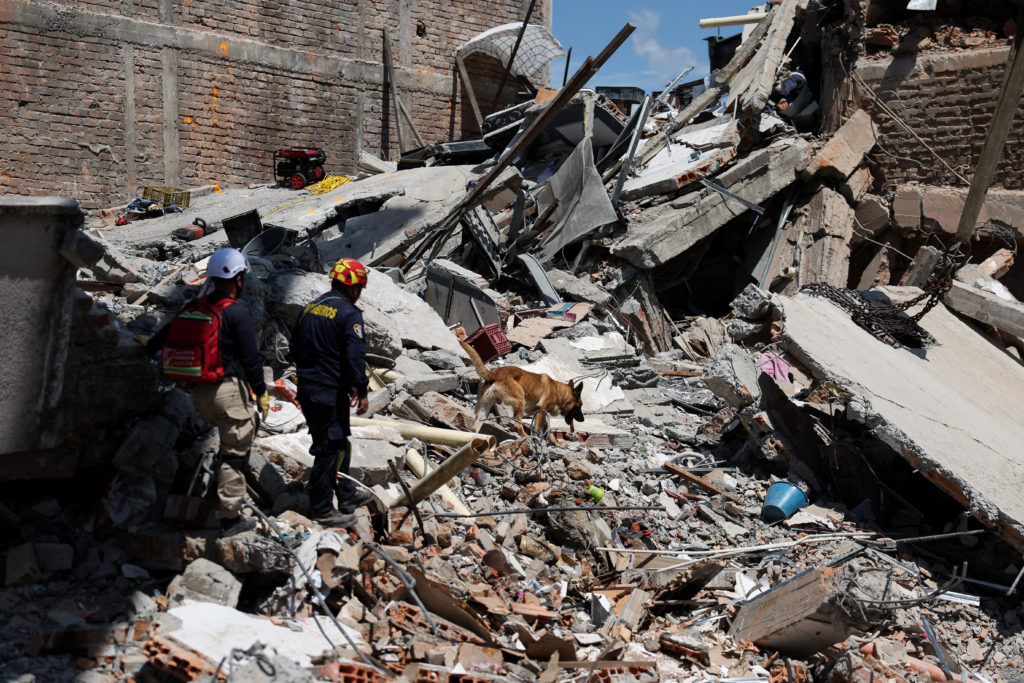
In Pereira, Colombia, rescue teams and local residents are diligently searching through debris, hoping to find survivors after a powerful earthquake struck the western region. The catastrophic 7.4 magnitude quake on Monday resulted in widespread destruction across numerous towns and cities.
Rescue crews and civilians in Colombia painstakingly searched through rubble Tuesday in the hopes of finding survivors trapped under debris.
Buildings have collapsed, roads have been severely damaged, and vehicles have been crushed. Residents, devastated by the loss of their homes, offer comfort to one another amid the ruins. Heavy excavators and machinery are removing large concrete pieces while volunteers pass buckets of rubble along lines of helpers.
Search teams and volunteers are meticulously examining flattened structures for signs of life. Whenever they suspect they hear someone trapped beneath the debris, they raise their hands for silence. This dedication led to the rescue of at least one woman, extracted alive from the wreckage.
Colombian President Abelardo de la Espriella reported that the earthquake claimed at least 181 lives and left 2,595 people injured. Officially, 195 individuals remain missing, though estimates from civilian databases suggest the missing could number closer to 4,000.
Focus on Finding Survivors
Authorities emphasize the importance of the first 48 to 72 hours for rescuing survivors. Survival chances are better if the trapped individuals have access to food and water. De la Espriella announced that over 1,000 homes were completely destroyed, while many more suffered damage.
Standing at the site of a collapsed apartment building in Pereira, Jairo Vargas journeyed 220 kilometers (135 miles) from Medellin. He hopes his brother is alive, as his brother’s car remains parked outside. Vargas fears for his brother’s fate.
Challenges for the New Government
The quake represents a significant challenge for President de la Espriella, who assumed office days before the disaster. He faces the task of unifying a divided country in response to the crisis. This challenge is acute in Choco, the quake’s epicenter and one of Colombia’s poorest regions. Access is often limited to boat or air travel, with armed conflicts complicating efforts.
Sterling Palacios, a prominent religious and environmental figure, stated that Choco’s capital and surrounding areas suffered extensive damage. Homes lay in ruins, and aftershocks continue to frighten residents. The Colombian Geological Service reported over 100 aftershocks since the initial event.
President de la Espriella visited Quibdo, deploying military and police forces along with engineers, rescue workers, and search dogs. Despite concentrated efforts, reaching isolated rural areas presents difficulties due to travel constraints.
Desperate Search for Information
Families are using citizen-operated websites to post information about missing loved ones. Dana Carolina Zamora shared a picture of her uncle, Miguel Ángel Zamora, cradling his dog. Authorities indicate that 80% of El Cairo, where her uncle lived, is damaged.
Residents are on edge following recent quakes in Venezuela that caused massive destruction. Mónica Sánchez, a Pereira resident, narrowly escaped injury when a wall collapsed in her clothing factory, affecting her employees.
Curfews were enforced in Pereira and Cali on Monday night to prevent looting, with restrictions on private vehicles for easier ambulance and emergency service access.
The U.S. State Department announced $15.5 million in aid for emergency shelter, food, and support. Assistance from Latin American countries is forthcoming.
Pereira Mayor Mauricio Salazar expressed the gravity of the tragedy for the city and promised perseverance.