
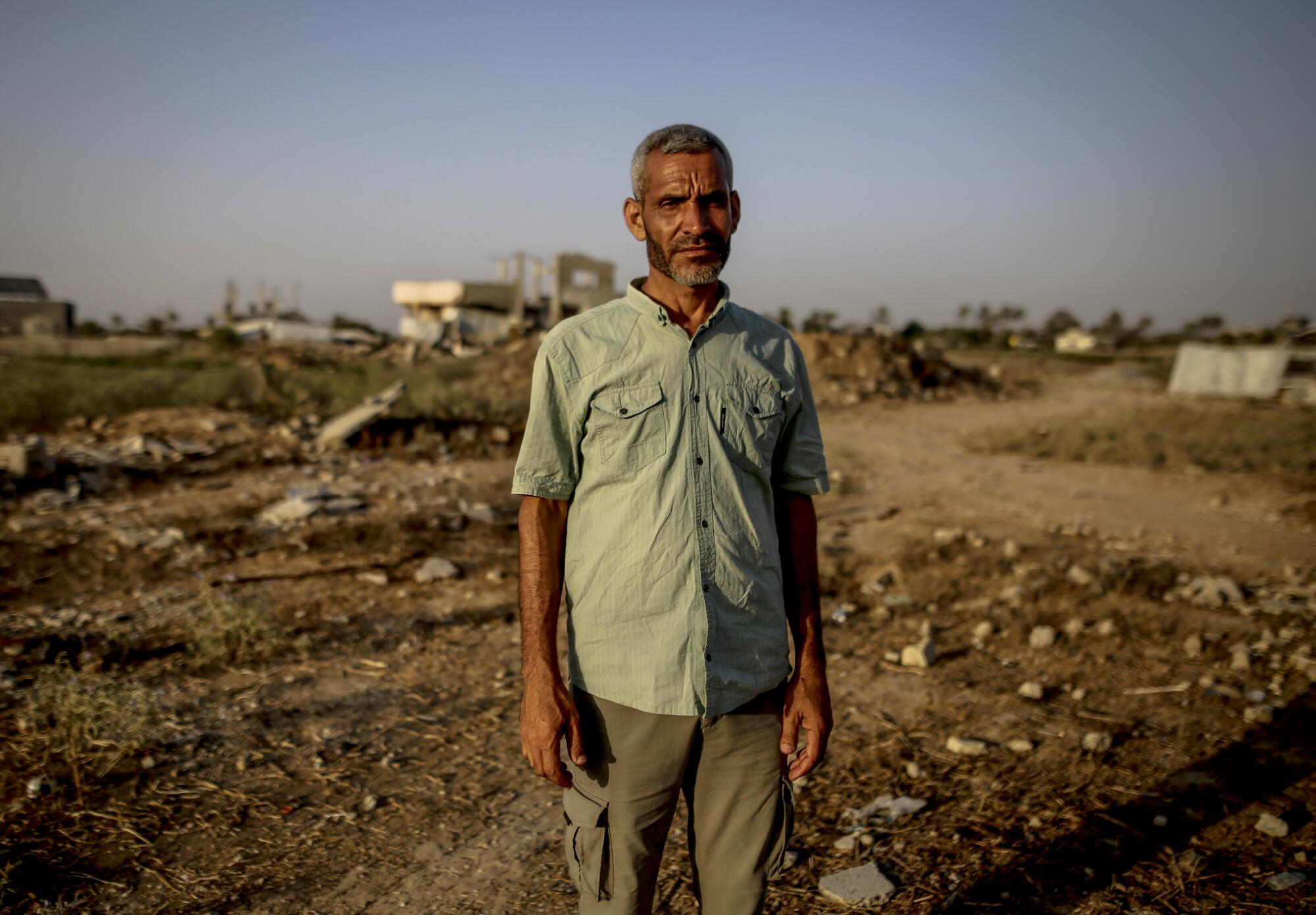
DEIR AL BALAH, Gaza Strip — For three months, Ashraf Al-Louh watched the Yellow Line draw nearer to his shelter. This demarcation, established by Israel’s military, indicated the expansion of their zone in Gaza. At less than 100 yards from his home, Al-Louh realized it was time to leave. Many neighbors in this war-affected area of Deir al Balah had already fled, and the numbers of those departing continued to increase.
The Israeli military marks the Yellow Line with large, yellow-painted cement blocks, progressively moving them westward as they occupy more territory. A donkey cart carrying three elderly women, two elderly men, their belongings wrapped in a mattress cover, and a few cans of beans and sacks of flour, passed by Al-Louh’s shelter. These were all the possessions they could carry.
“We’re exhausted. We’ve already been displaced seven times,” said Al-Louh, 45, as he glanced from the cart to the eastward yellow blocks. Living in a partially destroyed building, Al-Louh worried for his family, which includes his wife and six children.
The Yellow Line emerged in October 2025 when a truce, brokered by the Trump administration, was signed between Israel and Hamas. Israeli troops withdrew from some of the territory as part of the ceasefire. While the line hasn’t been recognized by international bodies as a legal border, it effectively divides Gaza into two zones: the eastern section under Israeli military control and a western section still subject to daily attacks, where most of Gaza’s 2.1 million people reside.
Despite the ceasefire, no aid surge occurred in the enclave, with no further Israeli withdrawal or Hamas disarmament. Israel shifted the Yellow Line westward, displacing thousands and forcing them into the shrinking Palestinian-controlled space.
“The Yellow Line is a quiet thief. It stole my land, my work, and everything I spent my life building.” — Abu Miri, Gaza resident
Initially, Israel controlled 53% of Gaza; now it controls about 64%, excluding an expanded restricted area called the Orange Zone. This area requires aid groups to coordinate delivery with the Israeli military to reach the Palestinian-controlled parts of the enclave.
“A month ago, it was a kilometer away. Back then, we had some sense of safety,” Al-Louh remarked while inspecting his makeshift shelter. The Yellow Line kept advancing, despite hopes it would stop.
Approaching the Yellow Line is perilous. According to the U.N. Office for the Coordinator of Human Affairs, 196 Palestinians, including 18 women and 43 children, were killed near the Yellow Line between the ceasefire and early April. Israel attributes such attacks to self-defense, citing threats to its troops.
Defense Minister Israel Katz stated the Yellow Line blocks serve as a warning to “Hamas terrorists and Gaza residents” that crossing would result in fire. Not far from Al-Louh, his relative Ahmed Al-Louh harvested eggplants, even if unripe, fearing no return to the field before the Line advanced again. He had moved essential belongings to safer areas.
Gunfire often marked the encroaching danger. A military quadcopter filmed Ahmed’s activities in the field before flying away. Last week, Hamas and the Board of Peace, overseeing the ceasefire, announced plans for Hamas to disarm if Israel halted attacks and withdrew from Gaza. However, Prime Minister Benjamin Netanyahu expressed Israel’s refusal to withdraw without full Hamas disarmament.
More than 1,230 Palestinians have died from Israeli fire since the ceasefire, with Israel targeting Hamas reconstruction efforts. Plans for a permanent military occupation, including fortifications across 25 miles, imply long-term control rather than temporary dominance.
In an interview, Netanyahu described gradual territorial acquisition in Gaza, with plans for further expansion. The Yellow Line, initially outlined by disconnected blocks, signifies oppressed regions, inching closer to civilian dwellings each day.
Jamal Abu Miri, a displaced resident, witnessed the line’s approach dismantle his investments of over four decades. His greenhouses, olive groves, and date palms faced destruction as the bulldozers reached his home.
“Everything I worked for, now beyond reach,” he lamented. The Yellow Line, he said, consumed his life’s work.
Al-Louh, now unemployed, packed essentials for another move, expecting aid for new accommodations. The time of uprooting felt imminent, his eyes set on the advancing yellow blocks. “We’re waiting,” he concluded.
Special correspondent Shbeir reported from Deir al Balah; Times staff writer Bulos reported from Beirut.