
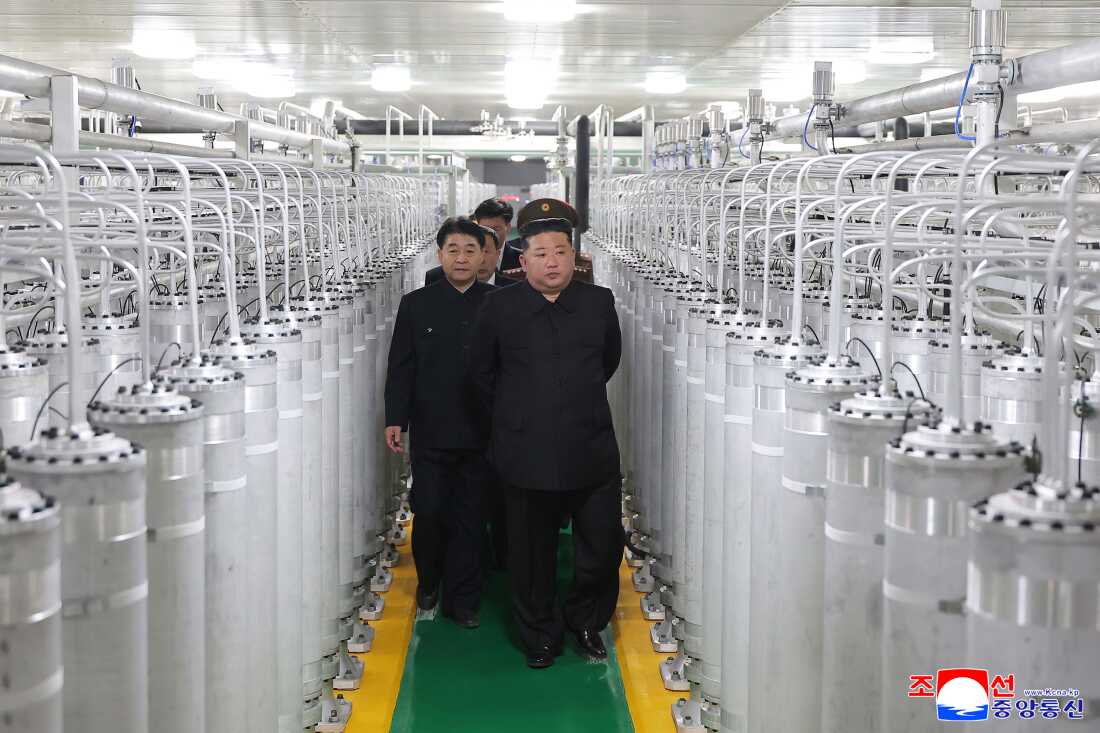
In this image supplied by the North Korean government, leader Kim Jong Un is seen visiting a new facility to produce nuclear bomb fuels. The location remains undisclosed. This image cannot be independently verified.
SEOUL, South Korea — President Lee Jae Myung acknowledged a “harsh reality” as South Korea shifts its approach towards North Korea. Historically, South Korea prioritized immediate denuclearization of its northern neighbor. However, the current strategy involves freezing North Korea’s nuclear program initially, offering concessions for interim measures instead of full disarmament.
Unification Minister Chung Dong-young, on July 23, emphasized a strategic move to focus on halting further production and advancement of nuclear weapons. This contrasted with the earlier demand for dismantling existing weaponry from the outset.
This policy shift aligns with North Korea’s strengthening relations with Moscow and Beijing. On July 25, Ukrainian President Volodymyr Zelenskyy announced Russia’s preparation to receive an additional 30,000 North Korean troops for its war efforts in Ukraine. Meanwhile, global pressure on Pyongyang appears less coordinated. President Trump, since his White House return, has referred to North Korea as a “nuclear power,” differing from the longstanding U.S. policy. The National Security Strategy last year notably omitted any references to North Korea and denuclearization.
Irreversible final conclusion
North Korea’s leadership, notably Kim Jong Un’s sister, Kim Yo Jong, has confidently refuted calls for disarmament. In June, she termed the country’s nuclear ambitions as an “irreversible final conclusion.” Recent statements from her assert that denuclearization has conceptually and practically lost meaning.
According to Lee Ho-ryung, a senior researcher at Korea Institute for Defense Analyses, the cost of reversing North Korea’s nuclear program is immense politically and militarily. Codified in the constitution, North Korea’s nuclear status is a significant achievement for Kim Jong Un, distinguishing him from predecessors.
As international sanctions weaken, maintaining nuclear capabilities becomes less expensive for North Korea. Yang Moo-jin, Professor Emeritus at the University of North Korean Studies, highlights that past denuclearization policies were more feasible due to China and Russia’s participation in sanctions. However, accusations of sanction evasion, such as providing petroleum and importing coal from North Korea, persist against China and Russia. Both countries deny these claims.
North Korea’s capabilities persist in expanding. In June, Kim Jong Un indicated a doubled production capacity for weapons-grade fissile material over five years. Estimates from the Stockholm International Peace Research Institute suggest North Korea holds around 60 nuclear warheads and enough material to produce at least 30 more.
Despite Seoul’s pragmatic approach, experts question Pyongyang’s willingness to engage in negotiations for peace and stability on the Korean Peninsula. The dialogue aims to ease military tension and eventually persuade denuclearization, though KIDA’s Lee Ho-ryung remains skeptical of substantial reforms.
With increasing partnership with Moscow, North Korea feels empowered. Professor Yang Moo-jin questions North Korea’s need to negotiate. North Korea is considered a significant beneficiary of the conflict between Russia and Ukraine. Russia has openly supported North Korea’s nuclear stance, with Foreign Minister Sergey Lavrov stating that denuclearization “no longer makes any sense” and reiterating this stance at recent ASEAN meetings.