
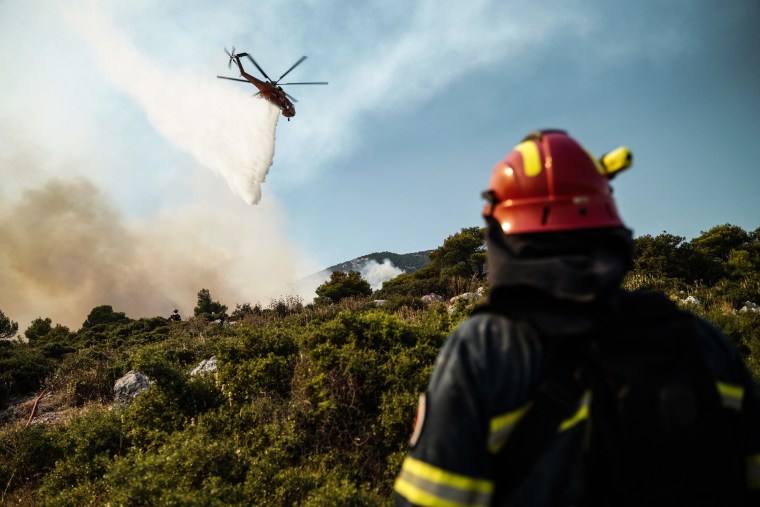
ATHENS, Greece — On Sunday, two Greek firefighting helicopters collided in midair while combating a wind-driven wildfire west of Athens. Footage captured one aircraft crashing to the ground. The Greek fire department reported the recovery of all four crew members. Two were rescued safely, while the other two were found unconscious. Their condition remains undisclosed.
The collision highlights the peril at the forefront of Europe’s wildfire crisis. Strong winds exacerbated the flames in the region surrounding the Greek capital, leading to new evacuations. Meanwhile, France dealt with a persistent scar from a wildfire four times the size of Paris. In Spain, major fires ceased advancing.
Both helicopters involved were Bell models, each housing a two-person crew. Among them, two were Greek nationals, and two were foreigners. Authorities withheld identifying details about the international crew members’ countries.
In western Attica, the fire spread rapidly, threatening communities and an industrial zone near Megara. Violent gusts hindered firefighting aircraft from collecting water from the sea. The blaze resonates tragically with the 2018 Mati wildfire that killed 104 individuals, Europe’s deadliest this century.
Nick Paleologos / SOOC / AFP via Getty Images
In France, containment did not resolve the emergency entirely. The nation’s largest wildfire remained within boundaries, forcing the evacuation of 224,000 individuals in one of the largest non-wartime evacuations. Hot spots continued burning within a vast 420-square-kilometer scar, leaving thousands unable to return home. Close to 3,000 firefighters tackled the Gironde megafire and another still-active blaze in Provence.
Collectively, fires in France and Spain displaced roughly a third of a million residents from homes and vacation spots, emptying communities during the European summer.
Europe’s Growing Wildfire Threat
Mass evacuations in France and Spain exemplify the escalating wildfire threat across Europe, the world’s fastest-warming continent. Since the 1980s, Europe has warmed more than twice the global average, as noted by the European Union’s Copernicus Climate Change Service.
For instance, scientists at World Weather Attribution found that human-induced climate change made the extreme fire-weather conditions that fueled this year’s French blazes twice as probable.
Challenges Faced by Greece’s Firefighting Efforts
In Greece, nearly 500 firefighters and 23 aircraft were deployed. However, gale-force winds drove the flames through dry forests, crippling response efforts and preventing some aircraft from accessing the sea for water.
Evacuations were ordered for Kandili, Agia Skepi, and Toutouli as smoke ascended the mountains. Porto Germeno, a seaside community on the Gulf of Corinth, was a particular concern. Prime Minister Kyriakos Mitsotakis received an update on the operations.
The fire originated near Agios Vasileios on Friday, advancing toward Porto Germeno and into the forested mountains west of Athens. Firefighters resorted to evacuating 254 individuals by sea on Friday, and another 12 on Saturday, sometimes the sole escape when smoke and fire blocked coastal roads.
Wildfire meteorologist Theodore Giannaros estimated the blaze affected 40 to 50 square kilometers, although no official figures were released.
Elsewhere in Greece, fires threatened homes on Kefalonia, requiring inland evacuations while aircraft executed water drops over the Ionian island. Another fire near Nea Tenedos in Halkidiki required attention. Earlier in the week, two firefighters perished battling a fire in Crete, while another died in the Peloponnese.
“A pristine forest, a paradise, was surrendered to the hands of the fire,” local farmer Minas Tzortzanis lamented on Saturday. “There are no words to explain what has happened. Destruction. Total destruction.”
France Battles Vast Megafire Scars and New Threats
In southwestern France, the Gironde megafire remained within established boundaries on Sunday but continued to burn after scorching 420 square kilometers over ten days. The Gironde prefecture stated that while the fire’s advance had been stopped, it was not yet extinguished.
The area stayed under France’s maximum red forest-fire alert. Dry conditions, soaring temperatures near Bordeaux, and afternoon winds posed a risk of reigniting the blaze.
In Le Porge, local officials reported the destruction of approximately 150 homes. Mechanic Matthieu Plessis returned on Saturday to the ruins of a house that had been in his family for seven generations.
“There are places I don’t even recognize anymore,” he remarked. “You don’t even know what was here anymore, or who lived where.”
Reinforcements from Ukraine, Lithuania, and French Polynesia were anticipated on Sunday and Monday to bolster firefighting efforts.
Provence Fire Stabilized
In southeastern France, nearly 1,500 firefighters battled a distinct wildfire in the Var department that ravaged about 18 square kilometers within a day.
The Gros Bessillon fire stabilized on Sunday after holding its perimeter overnight, but remained uncontained. Around 2,500 residents were evacuated as flames threatened nearby areas.
Since July 19, central Var experienced four significant fires. Earlier in the week, a smaller fire near Brignoles prompted the evacuation of about 700 residents, including actor George Clooney and his family, before containment.
Prime Minister Sébastien Lecornu stated that France’s fires were generally under control but cautioned the volatile conditions. He appointed a national coordinator to oversee the reconstruction of fire-afflicted zones.
This year, more than 1,170 square kilometers have burned across France.
Spain’s Fires Ease but Vigilance Remains
On Sunday, Spain’s major fires, part of a season claiming at least 13 lives, causing the largest wildfire in its recorded history, and igniting a national emergency, ceased advancing.
In Zamora province near the Portuguese border, over 20 ground and aerial units monitored the perimeter of the Fermoselle fire against flare-ups in the rugged Arribes del Duero terrain. Most evacuees had returned home, according to local reports.
Prime Minister Pedro Sánchez called for a national agreement to address wildfires, emphasizing climate change’s growing impact.