
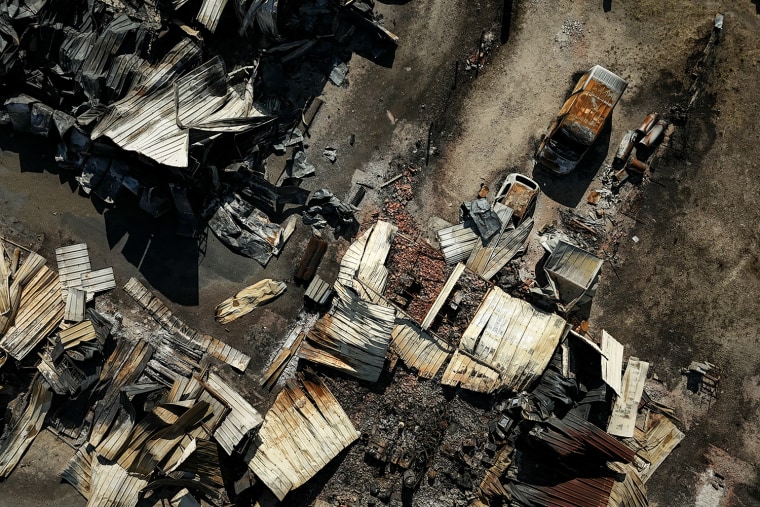
On Tuesday, French authorities ordered the evacuation of around 4,000 people from tourist areas on the Atlantic coast. A resurgence of heat threatened the control over a significant wildfire near Bordeaux. This highlighted a severe wildfire crisis across southwestern Europe.
Fires have led to the evacuation of approximately 330,000 individuals in France and Spain. Spain is preparing for its fourth heat wave this summer, with multiple fires still burning out of control, including the nation’s largest in history.
Firefighters managed to contain the French blaze overnight, controlling flare-ups near coastal dunes. The affected region remains at 420 square kilometers (162 square miles). The Gironde fire is considered stabilized but not fully contained, with risks of spreading due to rising temperatures and falling humidity levels.
Eric Brocardi, the spokesperson for France’s national firefighters federation, stated, “We are at a point of fragility. We will continue attacking this fire despite the forecast rise in temperatures.”
The evacuation order included campsites, holiday resorts, and leisure parks around Lacanau. The national weather service issued a yellow heat warning, anticipating temperatures between 33 to 35 Celsius (91 to 95 Fahrenheit) in Gironde, with changing wind patterns.
This year, France has seen more than 1,160 square kilometers (448 square miles) burned according to the Interior Ministry. Europe, the fastest-warming continent, experienced its hottest June on record, driving fire intensity and spread across France and Spain.
The Gironde fire, compared to four times the size of Paris, has been forcibly unpredictable. It initiated the evacuation of 220,000 people. Military and forest crews are actively building firebreaks to curb the spread, having completed 103 kilometers (64 miles) so far. About 93 firefighters have been injured.
In Landes, neighboring Gironde, thousands returned home after another wildfire halted progress, affecting more than 30,000 individuals. President Emmanuel Macron announced, “The fire is fixed,” indicating no further spread. However, some neighborhoods remain off-limits.
Spain, facing its challenges, deployed hundreds of firefighters supported by military brigades and aircraft. Interior Minister Fernando Grande-Marlaska expressed cautious optimism but noted risks with rising temperatures, expecting excesses of 40 C (104 F).
Spain’s government declared a national emergency, with about 79,000 evacuations and another 30,000 people advised to stay home. A major concern centered on two large fires threatening to merge near Madrid, the largest on record in Ávila, covering more than 500 square kilometers (193 square miles).
David Gonzalez, a local gardener assisting firefighters, stated, “We are feeling a lot of anger and helplessness. It’s something inhuman.”
Spain has reported 1,530 square kilometers (590 square miles) burned this year. Prime Minister Pedro Sánchez is advocating for a national strategy to combat worsening wildfires linked to climate change.