
Consider the situation during World War II if protesters had gathered outside factories, attempting to halt the production of tanks and planes. During times of urgent need for defense infrastructure, such actions would only have benefited hostile forces. Today, the United States faces a new kind of challenge: the fight for artificial intelligence (AI) dominance against China.
The objectives of the U.S. and China in the AI space are starkly different. U.S. companies, alongside the past Trump administration, view AI as a tool to enhance prosperity and individual freedom. China, however, aims to use AI to exert control over its population and expand its influence globally.
Currently, the U.S. and China are the leaders in AI development. Combined, they hold 90% of the global AI compute capacity. The U.S. boasts a 75% share, while China has 15%. China has prioritized AI’s industrial applications and military capabilities, while the U.S. leads in generative AI and innovation. However, the U.S. is striving to strengthen its position in industrial and military AI sectors.
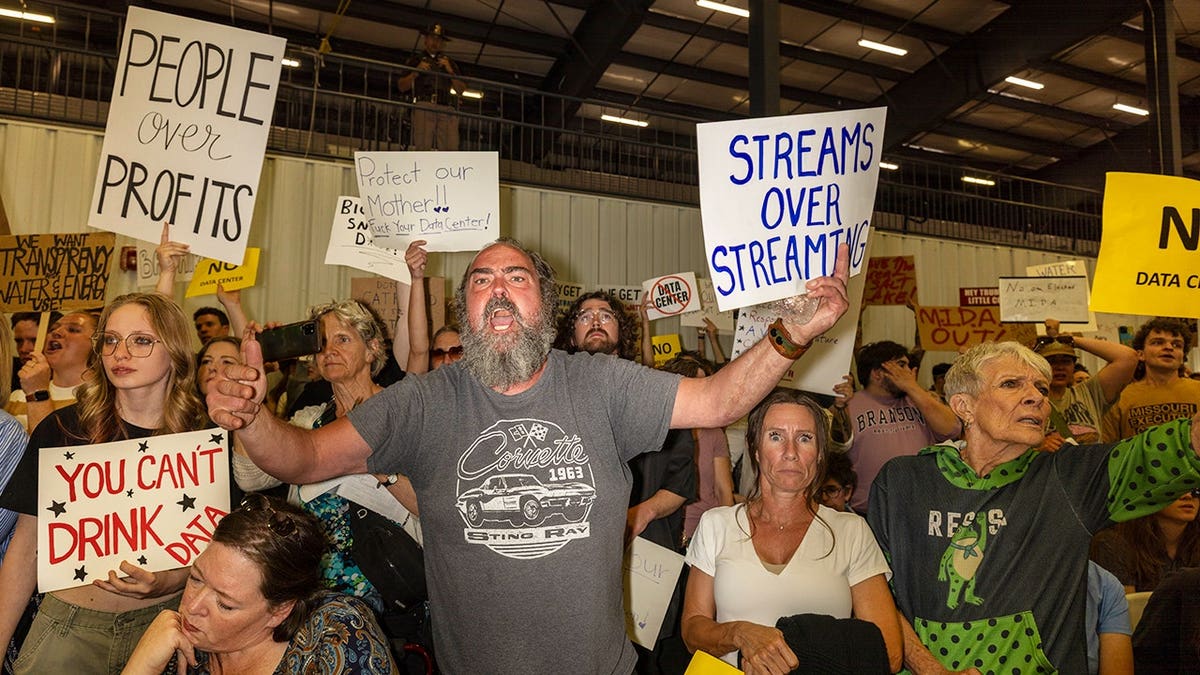
“Protesters gather as the Box Elder County Commission approves a major AI data center project in Tremonton, Utah, in May 2026. Activists expressed concerns about water usage and environmental impact.”—Photo by Natalie Behring/Getty Images
Growing Movement Against Data Centers
The establishment of data centers is crucial for the U.S. to maintain its AI advantage. Yet, a movement against data centers is gaining momentum. Across the nation, 78 jurisdictions have imposed temporary moratoriums or bans on new data centers. While New York remains the sole state to implement a construction halt, 14 other states are contemplating similar measures, including traditionally conservative states such as Florida, Oklahoma, and Georgia.
Economic and National Security Implications
If the opposition to data centers expands and garners political support, particularly from major parties like the Democrats, this could lead to permanent bans. This scenario would advantage China similarly to how halting defense plant construction during World War II would have aided Nazi Germany and Japan.
The stakes are high, not just economically, but for national security. Georgia, for instance, stands to lose 552,000 jobs and $850 million in tax revenue if such bans are enforced. Moreover, AI and its supportive data centers are integral to national defense, providing capabilities to detect cyber threats, manage military logistics, and improve efficiency in defense industries.
Addressing Common Misconceptions
Opponents of data centers cite increased electricity costs and excessive water usage. However, data centers can reduce electricity costs by distributing them across more sales. Most data centers use minimal water, and those that do are outspent by golf courses, which use 500 billion gallons of water annually compared to data centers at 230 billion.
The construction of data centers generates significant employment. A Brookings Institution study revealed that new data centers increase local construction jobs by 11%, and IT-related employment by 22%. This economic activity also boosts wages by 3%-4%.
AI development will significantly impact the U.S. economy, potentially adding trillions of dollars. Some estimates project an annual GDP growth boost of 1.5%-3.7%.
Concluding Thoughts
The choice the U.S. makes regarding data centers will influence national security and economic prosperity. Opting to support AI development aids not only the economy but also strengthens national defenses. In contrast, continued opposition could benefit adversaries like China, influencing future generations’ freedoms.