
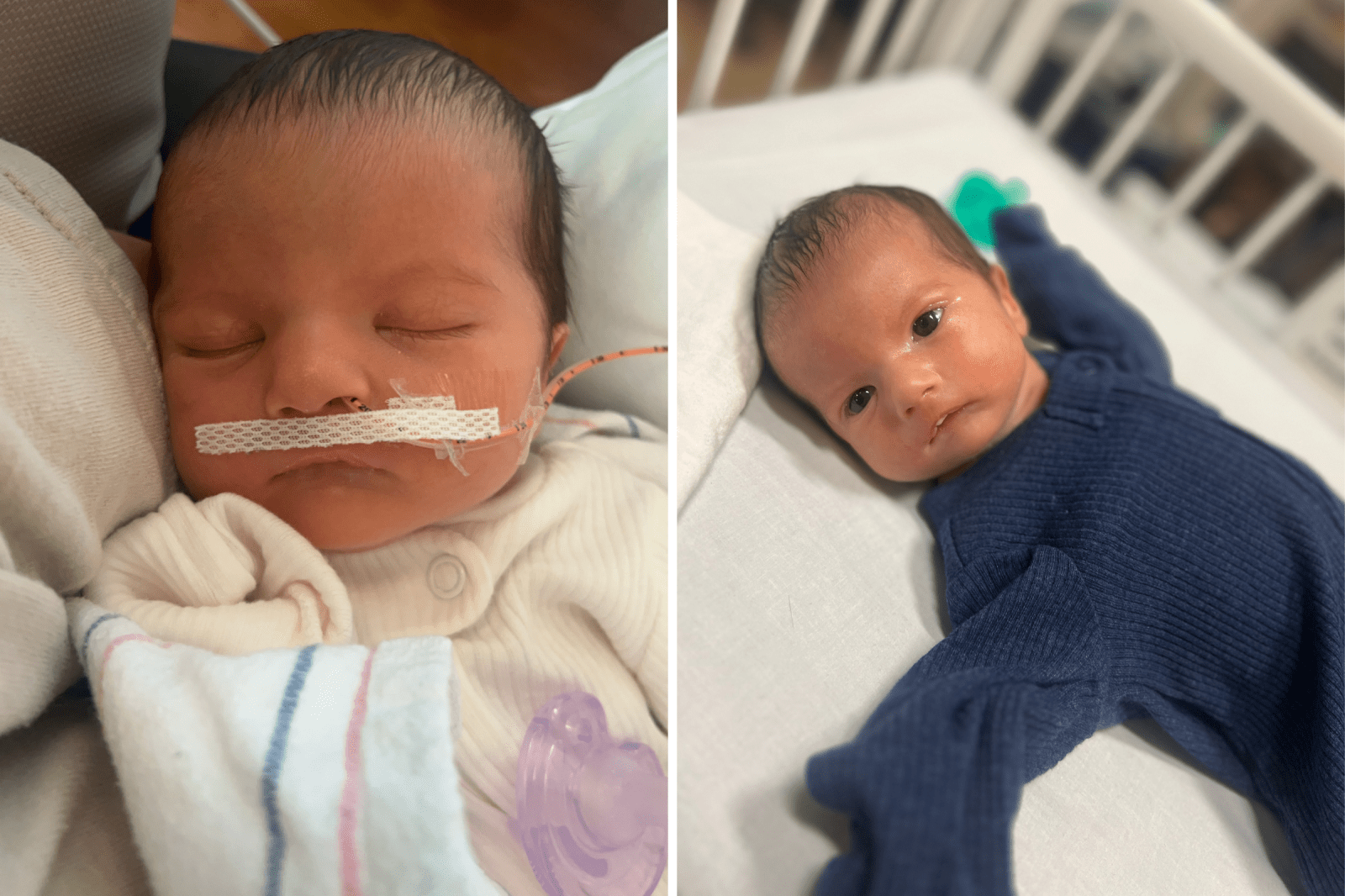
Jeannie Hochstetler from Indiana shared the story of her first child’s diagnosis with a rare condition that gives him a constant “mask-like face,” preventing facial expressions. After a standard pregnancy, Jeannie gave birth to Riley on January 29, 2025. She experienced no concerns during the pregnancy except for a small stomach measurement. Thinking she would have a small baby, this did not raise alarms at the time.
The situation changed dramatically when Riley was born. Jeannie noticed he did not cry at birth, assuming he needed time to adjust. Doctors quickly provided oxygen support, with one doctor observing him closely, suspecting an issue.
Riley was transferred to a nearby hospital’s NICU for more intensive care. Assessments showed Riley had small, webbed hands and a missing right pectoral muscle. He was placed on CPAP for breathing and given an NG tube for feeding while doctors struggled to diagnose him. Riley’s case puzzled doctors until one suggested Poland-Moebius Syndrome, a complex and rare congenital condition.
Poland-Moebius Syndrome leads to facial paralysis and underdeveloped chest muscles. The National Institutes of Health estimates Moebius Syndrome affects about one in 50,000 births. It impacts facial nerve development, causing issues with expressions and eye movements. Symptoms can include difficulties with swallowing, speech, smiling, hearing, and motor skills. Poland Syndrome commonly appears alongside Moebius Syndrome, linked to missing or underdeveloped chest muscles.
At three weeks old, Riley officially received the diagnosis. Jeannie found it overwhelming due to the uncertainty it presented for Riley’s future. She recalled the emotional impact of hearing her baby would never smile at her, a stark divergence from her initial vision of parenthood. Doctors conveyed the unique nature of Moebius Syndrome, with varying degrees of severity among cases. They explained that Riley would face challenges forming facial expressions, blinking, feeding, and reaching developmental milestones.
Although there is no cure for Moebius Syndrome, the family focuses on managing Riley’s symptoms. Missing his seventh cranial nerve and with limited eye movement, Riley adapts by expressing emotions in alternative ways. He currently uses a G-tube for feeding, with plans to transition to oral feedings as his condition strengthens.
Riley underwent surgery at 13 months to correct crossed eyes and adjust eyelashes causing discomfort. He has had MRIs and hearing tests revealing mild hearing loss in one ear. Despite his condition, Riley exhibits a joyful demeanor. Jeannie treasures his laughter and communicates through body language, noting his adaptability and cleverness.
Jeannie shares their experiences on social media to raise awareness about Moebius Syndrome, highlighting the strength and resilience Riley exemplifies. She expresses profound gratitude for Riley, considering him her greatest blessing despite the challenges faced.