
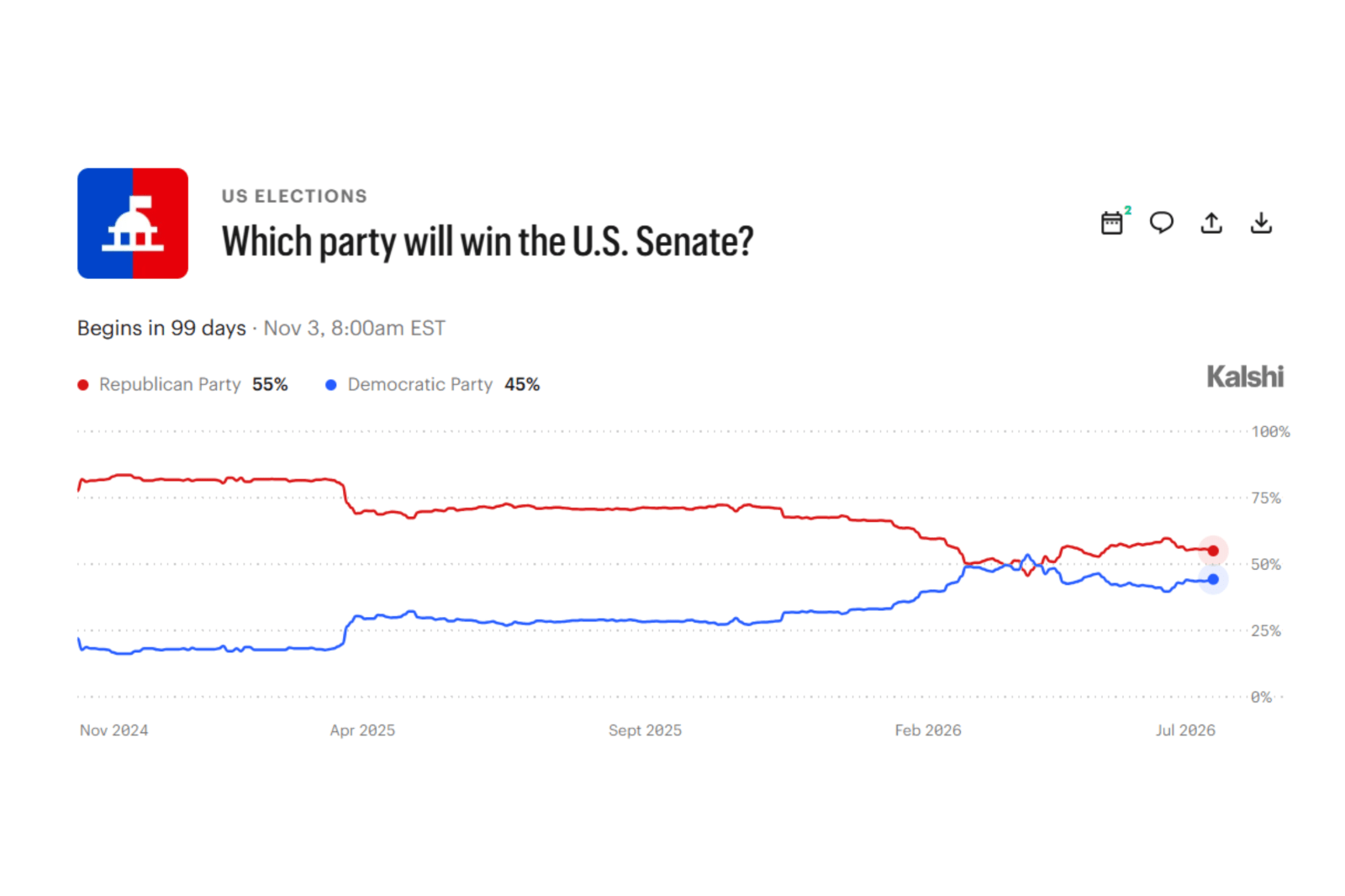
The upcoming 2026 midterm elections present a potential yet challenging opportunity for Democrats to gain control of the Senate. With Republicans currently holding a 55-45 majority, Democrats need to secure a net gain of four seats to control the chamber. This is due to Vice President JD Vance’s role in breaking a 50-50 tie in favor of Republicans.
Key Battleground States
Democrats’ path to victory involves targeting four Republican-held seats: Alaska, Maine, North Carolina, and Ohio. These states could be pivotal for Democrats to reach the necessary 51 seats for majority control, according to Kalshi’s 2026 Senate election guide.
The Cook Political Report categorizes Alaska, Maine, and Ohio as ‘Toss Ups,’ indicating that either party could realistically win. North Carolina is labeled as ‘Lean Democrat,’ providing a competitive edge for Democrats, even though it’s currently a GOP-held open seat. Conversely, Michigan, a Democrat-held open seat, also falls into the ‘Toss Up’ category, posing a risk that Democrats could still fall short if they lose this seat.
Prediction Markets’ Analysis
Prediction markets, which reflect investor sentiment and trading activity, align with some of these assessments. Kalshi’s Senate markets predict Democrats as the favorites in Alaska, Maine, and North Carolina, while Ohio remains a tight race with equal possibilities for both parties. Polymarket mirrors this sentiment, showing Democrats ahead in Maine and Alaska, with North Carolina and Ohio Senate races considered dead heats.
For overall Senate control, Polymarket predicts a 56 percent chance for Republicans to retain the chamber compared to Democrats’ 44 percent, highlighting the close competition between the parties.
State-Specific Insights
Alaska: Kalshi gives Democrats a 55 percent chance of winning in Alaska, while Polymarket suggests a slightly higher 57 percent chance. Polls, however, paint a competitive picture, with varying results showing Democrat Mary Peltola and Republican Senator Dan Sullivan neck and neck.
Maine: In Maine, Democrats hold a perceived advantage with Kalshi placing their chances at 64 percent and Polymarket showing similar figures. Recent polls reveal a close race between Democrat Troy Jackson and Republican Senator Susan Collins.
North Carolina: North Carolina stands out as a significant Democratic opportunity. Despite Kalshi’s optimistic 90.5 percent chance for Democrat Roy Cooper, Polymarket lists it as a ‘Toss Up.’ Polls consistently show Cooper ahead, with Cook rating the seat as ‘Lean Democrat,’ though the state historically poses challenges for Democrats in federal contests.
Ohio: Ohio is highly uncertain with Kalshi and Polymarket assigning a 50-50 chance to both parties. Contrasting poll results illustrate the unpredictable nature, with Democrat Sherrod Brown’s chances hinging on his established statewide presence despite a Republican-leaning electorate.
Michigan as a Potential Barrier
Even if Democrats manage to flip seats in all four targeted states, Michigan presents a potential obstacle. Currently held by Democrats and rated as a ‘Toss Up’ by Cook, losing Michigan would leave Democrats with only a three-seat net gain, insufficient under the 53-47 Senate split. Kalshi and Polymarket give Democrats a 70 percent chance of retaining Michigan, though the race remains tense with close polling margins between Democrat Abdul El-Sayed and Republican Mike Rogers.
Overall Outlook
The prediction markets indicate a highly competitive Senate landscape. Despite individual race markets showing Democrats leading in key states, the overall Senate-control market continues to favor Republicans. Democrats must navigate these challenges with precision, as any missteps could impede their pathway to a Senate majority. The situation remains dynamic, requiring Democrats to not only win in Republican-held battlegrounds but also secure vulnerable seats to tilt the balance in their favor.