
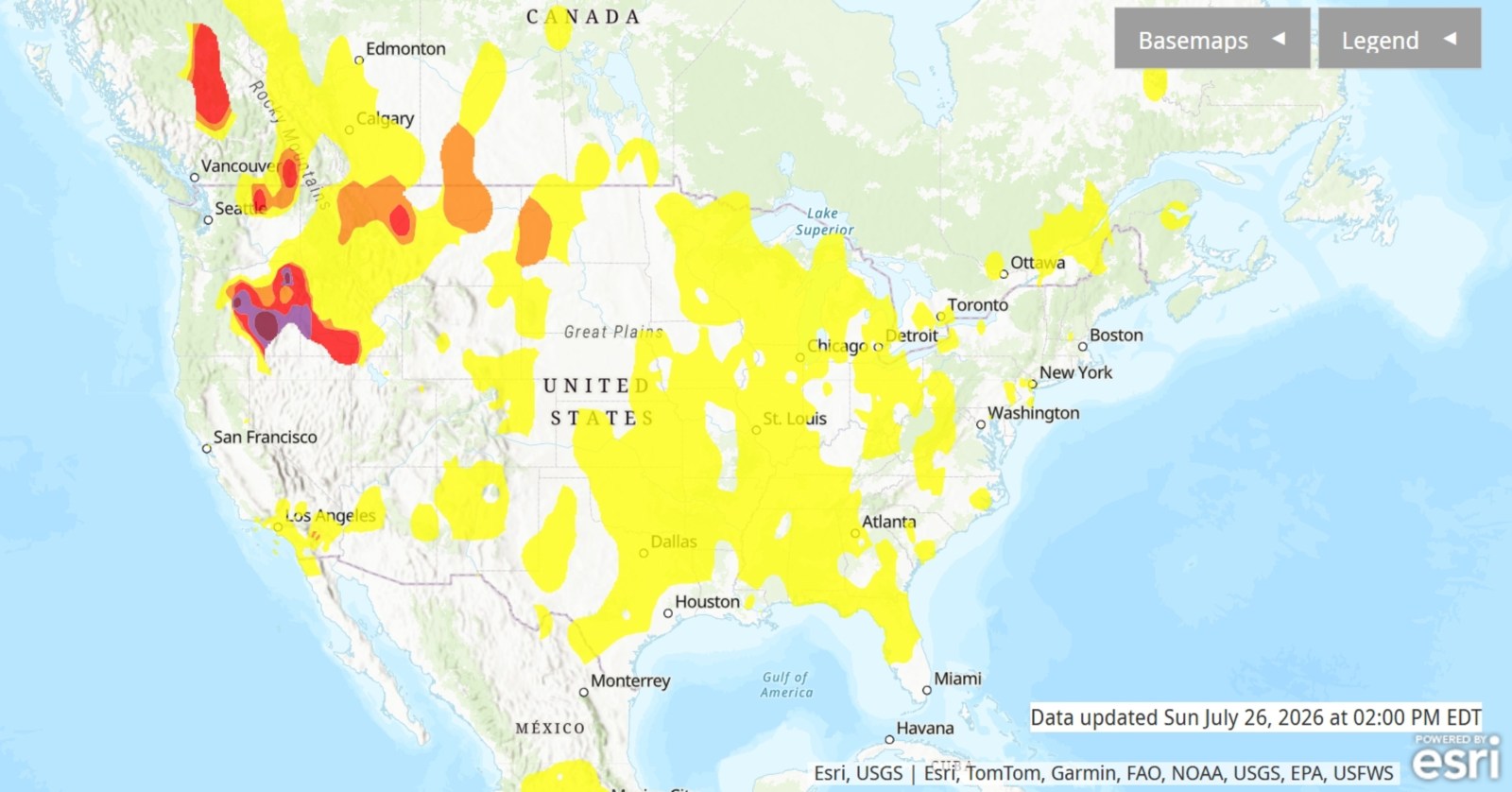
Air quality alerts were issued across much of the western United States on Sunday due to wildfire smoke and high ozone levels. These alerts affected areas in Oregon, Idaho, Washington, Montana, Colorado, and California, causing unhealthy breathing conditions.
The Environmental Protection Agency’s (EPA) monitoring platform, AirNow, provided data indicating extensive regions of “unhealthy” air quality. This situation resulted primarily from smoke originating from ongoing fires in Canada and the Pacific Northwest. Officials advised people in impacted areas to stay indoors, reduce outdoor physical activities, and take precautionary measures, especially if they have asthma, heart disease, or other respiratory problems.
The main health hazard involves fine particulate matter, PM2.5, which is small enough to reach deep into the lung tissue.
Air Quality Warning Maps
According to AirNow maps, central and eastern Oregon experienced severe pollution levels, with some locations reaching “Hazardous” levels on the Air Quality Index (AQI). This represents the highest warning level, signifying emergency conditions posing heightened health risks for everyone. The Oregon Department of Environmental Quality issued a warning for Baker County, advising its 16,000-plus residents to remain indoors with doors and windows closed. This warning remains effective through late Monday.
Particulate concentrations can change quickly depending on wind and weather patterns, Oregon officials noted.
In Idaho, air quality worsened to “unhealthy” and “very unhealthy” levels. The Idaho Department of Environmental Quality (DEQ) issued an advisory for several counties, including Ada, Adams, Boise, and others, lasting through Tuesday afternoon. Additional warnings extended across northern Idaho and the Nez Perce Reservation, cautioning sensitive individuals to avoid outdoor activities.
“Air pollutants can cause breathing difficulties for children, the elderly, as well as persons with respiratory problems,” stated the Idaho DEQ. Those sensitive to particulates are urged to avoid strenuous activities outdoors.
Smoke affected Washington state as well, with north-central regions experiencing “unhealthy” air and northeast regions encountering air “unhealthy for sensitive groups.”
In Montana, the DEQ issued alerts for several counties due to elevated particulate levels from wildfire smoke, set to expire at 9 a.m. on Monday.
Colorado and California faced air quality issues related to ground-level smog instead of smoke. Denver and the Front Range Urban Corridor were under an Ozone Action Day Alert due to weather conditions elevating ozone levels. In California, elevated smog persisted in parts of Los Angeles County.
What Happens Next
Officials at federal and state levels recommended that residents under alerts monitor local AQI readings closely, as conditions could change rapidly with the weather. According to Monday forecasts, heavy smoke is expected to move further into Idaho and Washington, while air quality in Oregon might improve. Public health agencies urge vulnerable populations, including children, older adults, and those with heart or lung conditions, to limit outdoor exertion and use air filtration systems indoors while alerts are active.
For more information, residents can contact the editors at Newsweek for updates on the evolving situation.