
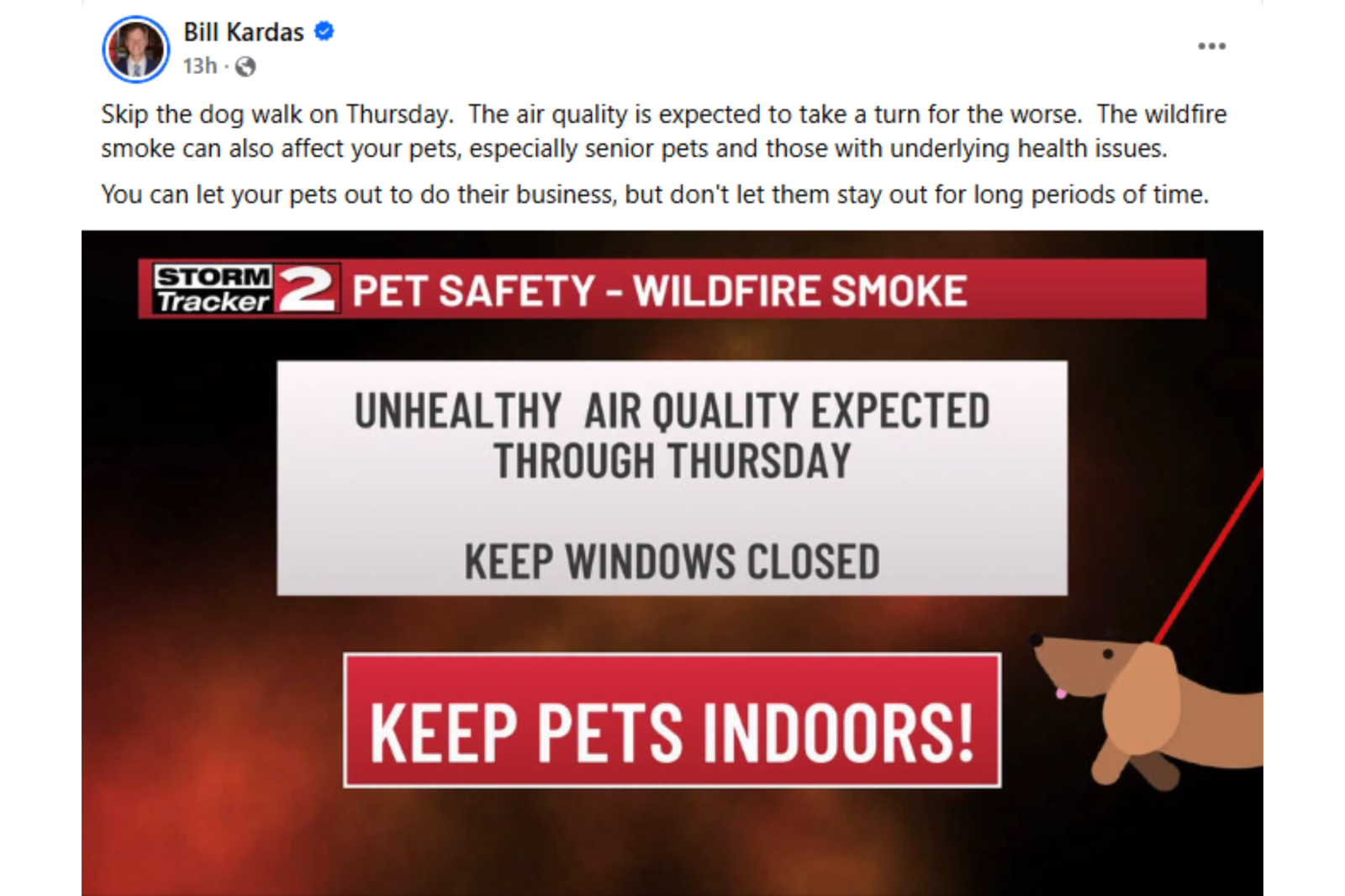
New Yorkers should remain indoors, reduce outdoor activities, and even postpone routine tasks like dog walking. A dangerous mix of extreme heat and Canadian wildfire smoke increases air pollution across the state.
Air Quality Advisory
An Air Quality Health Advisory is in place across New York. Smoke from Canadian wildfires has drifted south, covering parts of the state with haze and increasing fine particulate pollution, known as PM2.5.
The National Weather Service (NWS) reports that smoky conditions coincide with a heat wave, raising temperatures close to 100 degrees Fahrenheit in the New York City region. Heat index values surpass 100 degrees in some areas.
The NWS advises: “Temperatures will reach 100°F in some areas today. A Heat Advisory stays until 9:00 PM. Smoke may cause hazy skies and reduced visibility.”
Statewide Impact and Forecast
The New York State Department of Environmental Conservation and Department of Health have expanded advisories statewide. Smoke is spreading eastward, with major impacts expected in Western New York, Central New York, and the Eastern Lake Ontario region.
New York City, Long Island, and nearby areas are forecast to face air quality conditions “unhealthy for sensitive groups,” while some upstate regions enter the “unhealthy” category. New York City Emergency Management predicts that air quality readings could reach unhealthy levels, and the Air Quality Index (AQI) could rise to around 200, affecting everyone’s health.
Health Risks
Wildfire smoke’s fine particle pollution can cause coughing, dizziness, fatigue, and breathing issues, while worsening asthma, heart disease, and other chronic conditions.
The NWS and health officials urge residents to minimize outdoor activities. They recommend keeping windows closed, using air purifiers, and wearing N95 or KN95 masks if going outside.
Meteorologists warn that everyday activities like outdoor exercise or walking pets may increase smoke exposure in poor air quality.
City’s Emergency Measures
New York City officials have activated efforts to help residents cope. The city’s heat emergency plan includes keeping “hundreds of cooling centers” open. Residents can find nearby centers through the city’s online resources or by calling 311.
Distribution of free KN95 masks has expanded. Masks are available at public library branches in Brooklyn and Queens, select libraries in Manhattan, the Bronx, and Staten Island, and at subway and train stations.
New York Mayor Zohran Mamdani announced increased outreach for vulnerable residents. Schools, parks, and other departments have moved activities indoors and modified schedules. Mamdani advises staying in cool, air-conditioned places, staying hydrated, and avoiding outdoor exertions.
Mayor Mamdani states: “Tomorrow’s combination of dangerous heat and unhealthy air threatens New Yorkers’ health. Stay in cool places with air conditioning, limit outdoor time, and check on neighbors.”
Residents are encouraged to sign up for Notify NYC emergency alerts and check on elderly neighbors and others at higher risk. The combination of heat and smoke poses a severe public health threat. Officials emphasize staying in air-conditioned environments, maintaining hydration, and monitoring conditions closely.