
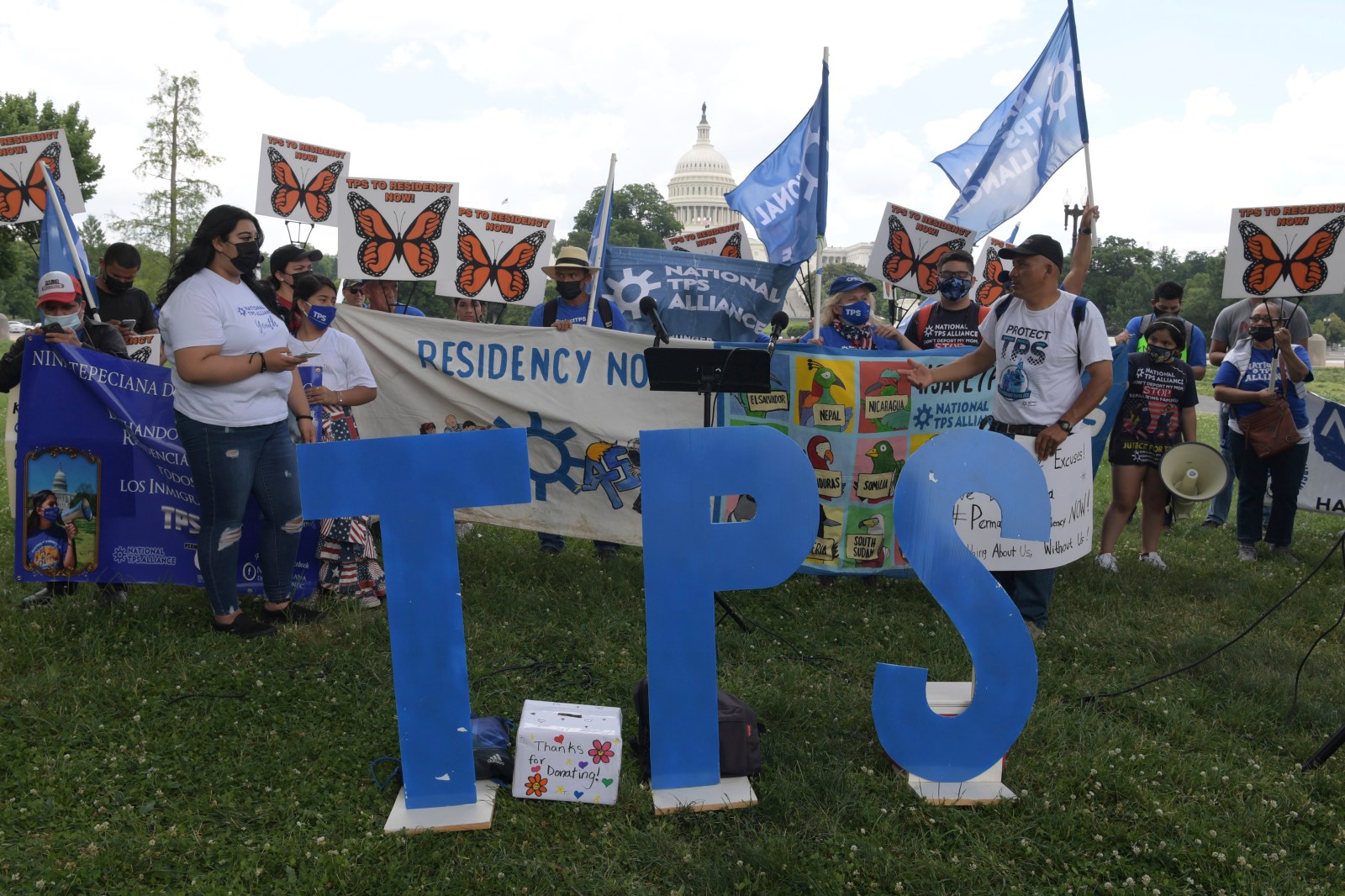
The Trump administration’s Department of Homeland Security (DHS) is facing criticism from its own supporters. The Supreme Court has allowed the Trump administration to terminate Temporary Protected Status (TPS) for around 350,000 Haitians and 6,000 Syrians. This decision, in a 6-3 ruling, states that courts cannot review a Homeland Security secretary’s decision to end a TPS designation. Justice Samuel Alito wrote the majority opinion, while Justice Elena Kagan dissented, with progressive justices Sonia Sotomayor and Ketanji Brown Jackson joining her.
Following the ruling, DHS Secretary Markwayne Mullin outlined the next steps on CNN’s State of the Union. He suggested that TPS holders have options like applying for temporary visas or permanent residency. Alternatively, DHS would offer them a plane ticket and about $2,100 to assist with returning home. Mullin emphasized that TPS is not equivalent to permanent status.
The term “backdoor amnesty” is used by critics to describe temporary programs that become de facto permanent without Congressional approval. Critics argue this allows TPS to function similarly to amnesty without legislative accountability.
Reactions Within the Party
Mullin’s comments sparked immediate backlash from the right. Critics like Fox News host Laura Ingraham and conservative commentator Nick Sortor opposed the notion of offering TPS holders a path to residency. They argue that these individuals had ample time to secure legal status.
Secretary Mullin later clarified his stance, asserting that TPS remains temporary. He accused Democrats of attempting to convert TPS into an amnesty program, a claim he linked to President Trump’s halting of such efforts. Mullin stated that individuals without legal status must either accept a $2,600 stipend and self-deport or face removal.
The use of “backdoor amnesty” isn’t new but has gained prominence. Congressman Brandon Gill organized a House Oversight hearing on the issue, while others, like Rep. Andrew Clyde, introduced legislation to repeal TPS. The White House has also co-opted this term, critiquing Biden’s use of TPS.
Policy Analyst Perspectives
Some immigration policy experts question whether Mullin’s comments introduce anything novel. Mark Krikorian from the Center for Immigration Studies explained that TPS holders have long been able to apply for other legal statuses, though acceptance isn’t guaranteed. The DHS’s incentive strategy aims to cut deportation costs, which average $17,121 per individual.
The core contention isn’t about finances but concerns whether the self-deportation offer, paired with permanent residency pathways, undermines the administration’s immigration goals. Geoff Pipoly, a lead counsel at BCLP, argues that few TPS recipients are likely to secure permanent status due to narrow legal pathways.
Pipoly also challenged claims that TPS holders could return to the U.S. after taking the stipend, citing immigration laws that bar reentry. He emphasized that the stipend is solely for departure and questioned whether any immigrant has received such compensation.
Meanwhile, work authorizations for Haitian and Syrian TPS holders were set to expire on July 10, regardless of ongoing political debates and the interpretation of Mullin’s comments.