
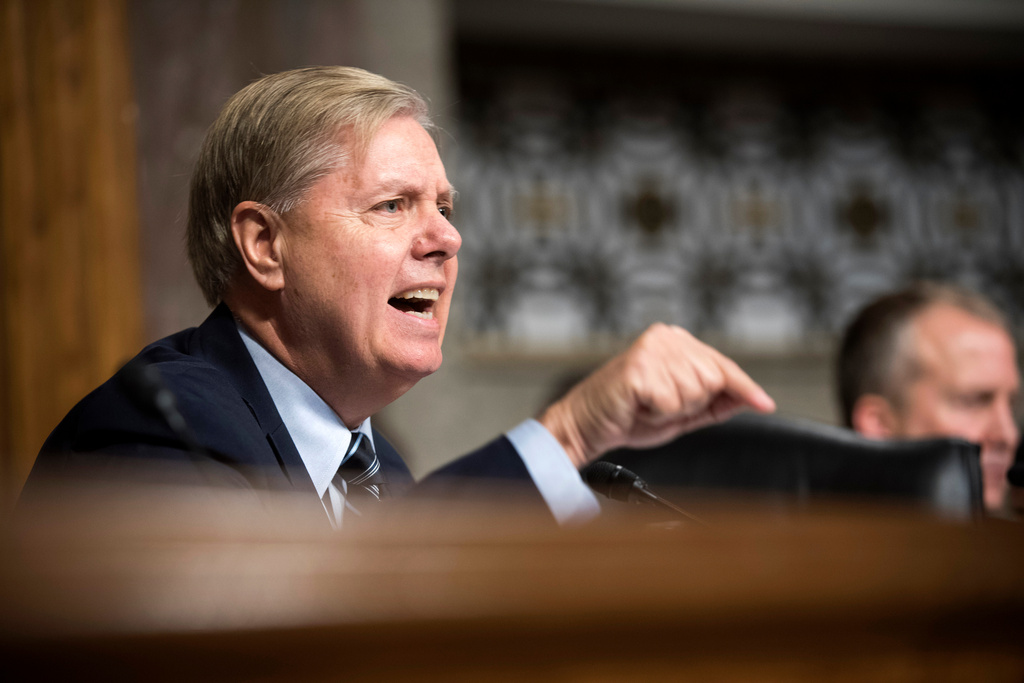
The unexpected death of Senator Lindsey Graham (R-S.C.) represents a significant shift in the Senate. Known for his role as a leading advocate of hawkish interventionism, Graham was influential in bridging traditional Republican foreign policy with the populist ‘America First’ stance of the current administration.
Graham’s legacy is marked by his ability to present prolonged military engagement as both morally necessary and practically essential for managing alliances. He consistently argued that issues with Moscow and Tehran were interconnected, framing them as parts of a unified threat to Western interests.
Institutionally, Graham played a crucial role, often collaborating with Secretary of State Marco Rubio to steer President Trump toward a more assertive stance on Iran and Russia. His approach was characterized by treating these diverse challenges as a single conflict, employing a binary moral perspective that simplified complex geopolitical scenarios into narratives of ‘good vs. evil’. This perspective made diplomatic restraint equivalent to appeasement.
One notable example was when Graham advised Israeli leaders to address Iran’s nuclear ambitions aggressively. This was confirmed by his office in exchanges reported by Axios in November 2024. Graham’s philosophy viewed conflict as a potentially constructive aspect of achieving regional stability.
As the U.S.-Iran conflict resurfaces in 2026, following the breakdown of diplomatic agreements such as the Islamabad Memorandum, Graham’s doctrine faces a rigorous test. The resumption of military strikes, announced by President Trump, highlights the void left by Graham’s absence, removing a voice that articulated aggressive military strategies through the lens of responsibility and alliance solidarity.
Graham’s death prompts a political reshuffle within the Senate. His successor’s race quickly gains momentum with figures like Nancy Mace and Ralph Norman showing interest. However, they lack Graham’s extensive experience and unique ability to bridge the gap between establishment views and presidential inclinations.
The Trump administration, amidst the unfolding chaos of the 2026 conflict, grapples with a significant communication challenge. Without Graham, there is a loss of the institutional narrative that balanced transactional decisions with American values and global security rhetoric.
Although the alliance between Trump and Benjamin Netanyahu remains intact, its portrayal as a model of statesmanship, facilitated by Graham, becomes vulnerable. The administration faces the daunting task of defending its Middle Eastern strategies as reactive decisions to an increasingly skeptical public.
The mechanisms of intervention persist, but they are devoid of Graham’s capability to present them as prudent diplomacy. The crucial question now is whether, in the absence of his translation, these strategies can continue to be marketed effectively.
Charbel A. Antoun, a journalist specializing in U.S. foreign policy, explores the implications of these developments, especially concerning the Middle East and North Africa.