
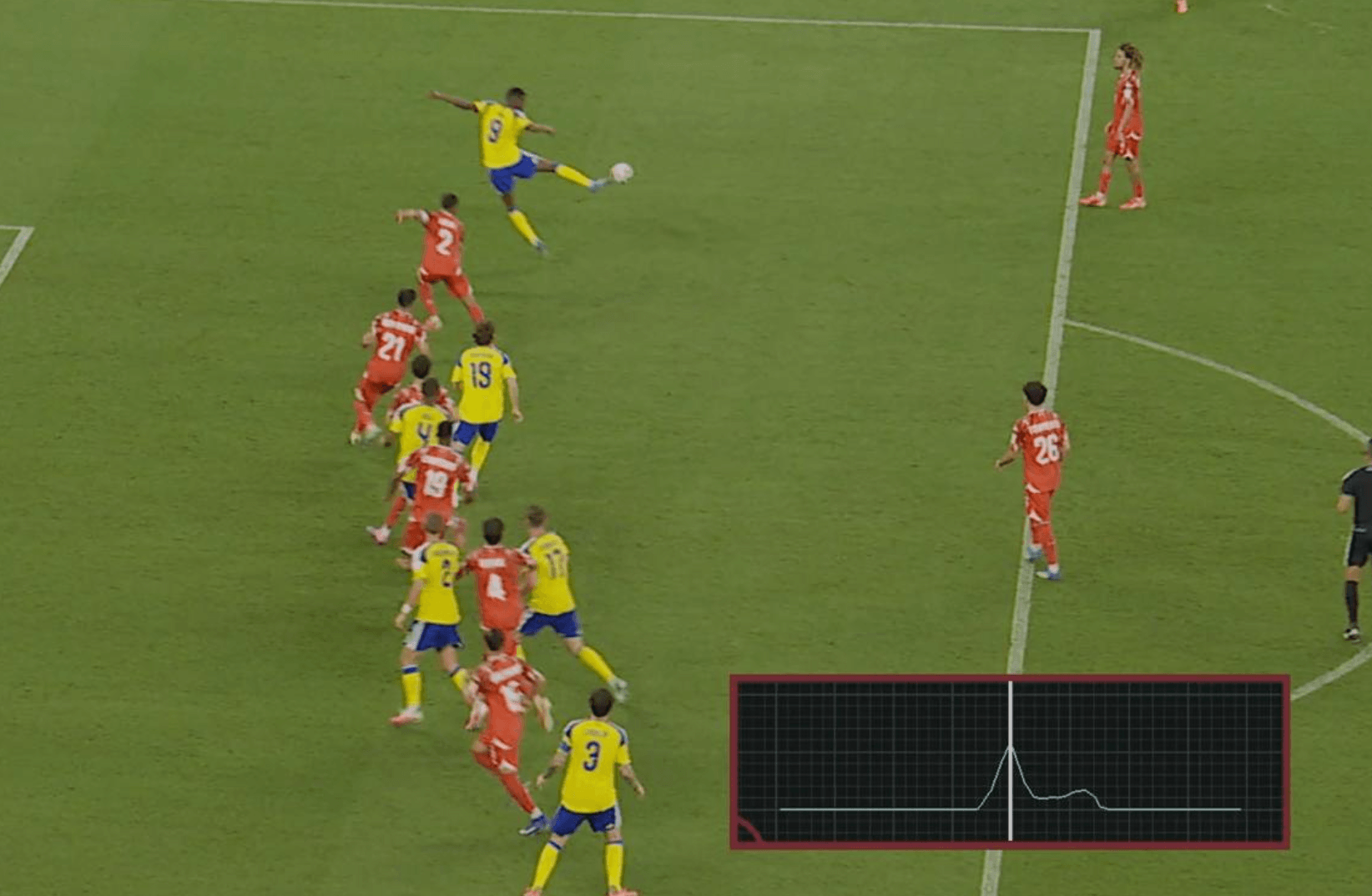
During a critical match between Croatia and Portugal, a potential equalizing goal by Josko Gvardiol was ruled offside due to a VAR check. Mario Pasalic assisted Gvardiol but was offside when the ball touched Igor Matanovic, as revealed by a ‘snick-o-meter’ like technology. This technology is familiar in cricket, indicating whether a player has made contact with the ball.
After confirmation through the Video Assistant Referee review, referee Espen Eskas disallowed the goal, maintaining Portugal’s 2-1 lead, allowing them progression to the last 16. The technology in question uses cricket’s techniques to ensure accuracy in football calls.
Similar Cases in Previous Matches
Such technology has been used in other World Cup matches. In the group stage, Mattias Svanberg scored in Sweden’s 5-1 win against Tunisia. Initially flagged offside, the intervention of technology overturned this decision. The VAR team confirmed Alexander Isak’s touch on the ball, allowing the goal. The decision used a graphic similar to cricket’s, showing a spike indicating contact.
Technological Advances in Football
Recent advancements in football technology are evident, notably in match balls. Adidas, alongside FIFA, embeds a 500Hz inertial measurement unit sensor in World Cup balls. This ‘Connected Ball Technology’ integrates with player data and artificial intelligence for real-time information.
This innovation provides precise offside decisions and player contact detection, delivering data 500 times per second. Although it helps primarily in offside rulings, it has broader applications, as seen in Cristiano Ronaldo’s case four years ago when he was denied a goal due to no measurable external force on the ball.
The Trionda World Cup ball, developed by Adidas, FIFA, and Kinexon, can detect touch force, ensuring correct offside calls, as demonstrated in Svanberg’s goal. CBT also measures ball speed, with Ayari’s goals against Tunisia recorded as the fastest in the tournament at over 70 mph.
This technology featured in the 2024 European Championship, but the Premier League has yet to adopt it, as its match balls are partnered with Puma.
Parallels with Cricket Technology
The graphic used by FIFA resembles cricket’s decision review process, like Ultra Edge and Snickometer. These technologies show a ball’s contact with a bat, using microphones rather than ball sensors, to determine catches and leg before wicket decisions.
During the Ashes series between Australia and England, ‘Snicko’ faced scrutiny for inconsistencies when graphical spikes didn’t match the footage. FIFA’s effort for transparency resulted in using similar visuals when confirming Isak’s touch, though it lacked cricket’s in-the-moment drama.