
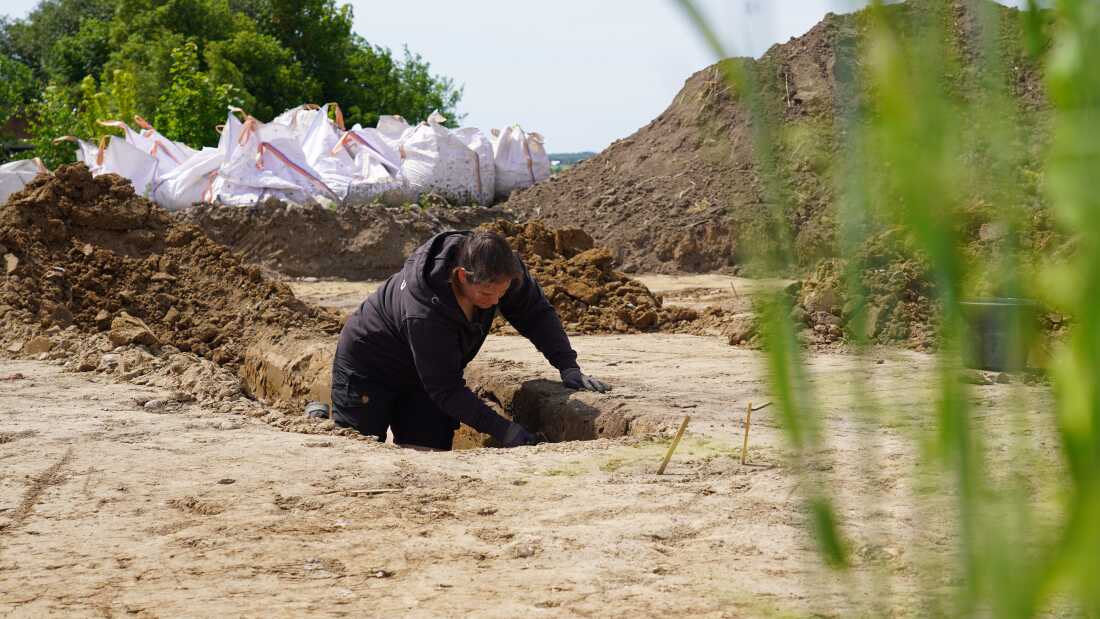
Archaeologists have uncovered a significant Viking Age textile production site in Denmark, dating back over 1,000 years. The discovery highlights the advanced nature of Viking society.
The site, found by experts from the Moesgaard Museum, covers a sprawling 100,000 square meters (over 1 million square feet). It features areas for flax processing and more than 80 pit houses. These semisubmerged huts served as workshops and dwellings during Viking times. Located in Søften, 10 kilometers (6 miles) north of Aarhus on the Jutland peninsula, the site dates from the late Iron Age to the early Viking Age, between A.D. 600 and 950.
Leading the 10-month excavation, archaeologist Liv Stidsing Reher-Langberg emphasized the settlement’s focus on textile production. “We have spindle whorls and weight looms, indicating the site’s activities,” she stated. Silver coins, glass beads, and pottery were also discovered. Separate zones for production and crafts, along with a single residential home, suggest a powerful individual supervised the operation, controlling resources and production.
Coin discoveries by metal detector enthusiasts in recent decades began the site’s exploration. Interest spiked after a trial excavation 1½ years ago, ahead of construction work for a new road and industrial area. “The trenches revealed continuous houses, pit houses, and textile production elements,” Reher-Langberg remarked.
Moesgaard Museum historian Kasper Andersen described the Søften discovery as key to understanding the local economic, cultural, and political structures of the time. Aarhus, known as Aros during the Viking era, was a hub for royalty and trade. Recent findings in Lisbjerg, 4 kilometers (2½ miles) away, suggest it was home to nobility. Goods from areas like Søften likely entered an extensive international trade network.
“A production site of this scale can’t be solely for the local area. It’s part of a larger international network,” Andersen explained.
Future carbon dating and pollen analysis may reveal more about the textile production specifics. During the Viking Age, Norsemen engaged in raiding, colonization, conquest, and trade, even reaching North America. Andersen affirmed that findings at Søften demonstrate Vikings as organized, with a production line supporting a broader market, not merely local demand. “Søften’s textiles participated in a market much larger than just the local area,” he concluded.