
As the national Republican Party contemplates its future post-Trump, Utah offers potential guidance. This predominantly Republican state hasn’t supported a Democratic president since Lyndon B. Johnson in 1964. However, Utah’s relationship with Trump has been complex. In 2016, Utahns gave Trump the smallest victory margin among Republican states with less than 50% of the vote. Although his support grew, he never surpassed 60% in subsequent elections.
Currently, Republican candidates in Utah’s congressional primaries avoid emphasizing Trump, focusing on local issues instead. Chris Karpowitz, a political science professor at Brigham Young University, explains that this strategy might be deliberate, as touting Trump might not resonate with Utah voters as it does in other Republican states. “Many Republicans in Utah have accepted Trump enough to vote for him,” says Karpowitz. “But they don’t necessarily endorse his political style or certain policies.”
Utah features a fiscally and socially conservative electorate, often at odds with Trump’s handling of topics like immigration. His remarks on Islam and other religions have alienated voters in a state closely tied to the Church of Jesus Christ of Latter-day Saints, founded on religious freedom.
Upon completing his term, Trump’s approval in Utah dropped to an all-time low of 44% as of April, indicated by a Deseret News/Hinckley Institute poll. Support among Utah Republicans has dwindled by 10 points.
A Traditional Campaign Approach
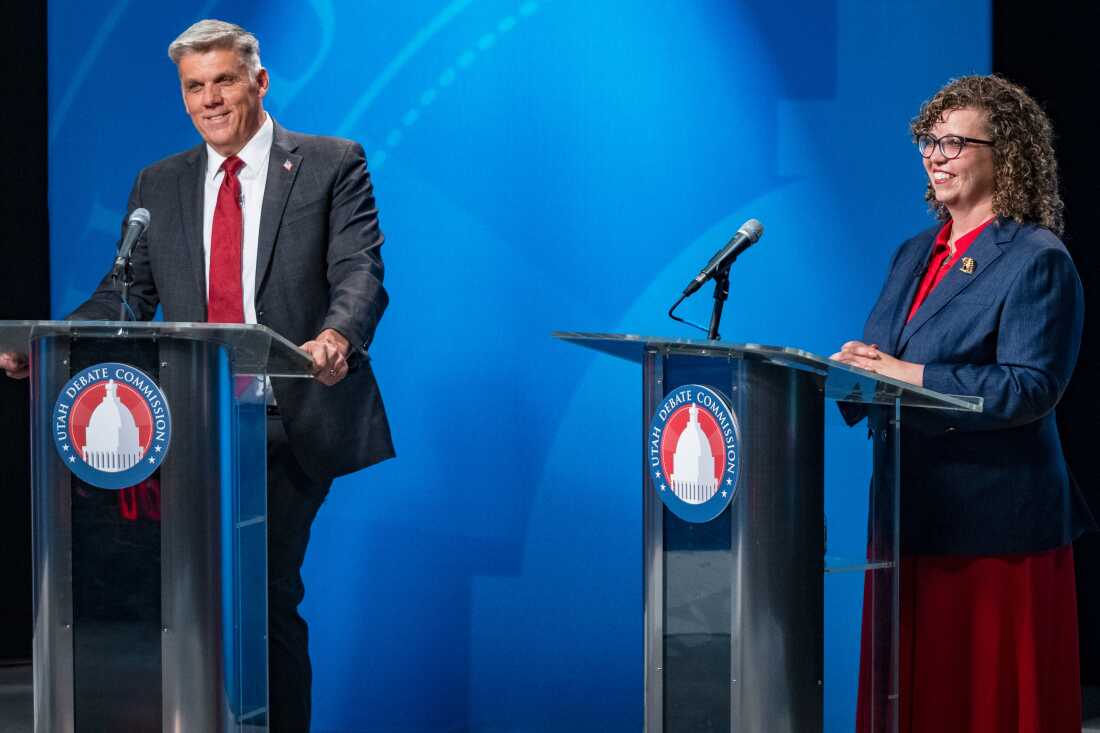
In Utah’s 3rd Congressional District, both Republican primary candidates support Trump but don’t highlight him in their campaigns. Instead, they employ traditional strategies focusing on district-specific issues. Rep. Celeste Maloy and Phil Lyman represent different segments of the party – Maloy is policy-driven and aligned with the establishment, while Lyman embodies the Freedom Caucus ethos.
The district emerged from mid-decade redistricting following a court decision on congressional map violations. It stretches from the north to the Arizona border, encompassing rural areas, national parks, and parts of urban centers like Salt Lake City and Provo.
According to the Cook Political Report, it is among the most Republican districts in the U.S. Despite gaining Trump’s endorsement, Maloy faced lukewarm support, narrowly winning past elections.
Campaign Messages Devoid of Trump
Phil Lyman aims to leverage his Utah visibility, having previously run for governor. He shifted his strategy, focusing on challenging establishment norms, bolstering rural communities, and promoting electoral transparency. Lyman emphasizes governmental limitations and autonomy, aligning with the Freedom Caucus, though avoids explicitly endorsing Trump on the campaign trail.
In Utah County, Lyman’s campaign focused on transparency and combating government corruption, bypassing any mention of Trump. Campaign volunteer Natalie Clawson highlighted Lyman’s commitment to transparency and national-level governance.
Maloy’s Legislative Focus
During a primary debate, Maloy highlighted legislative achievements without referencing Trump or his administration’s policies. She touted her work on tax cuts and committee efforts beneficial to the district.
Maloy’s primary success underscored her capability to address district issues nationally. In debates, she avoided discussing Trump unless questioned directly, preferring to position herself as a pragmatic problem-solver.
Although Trump endorsed Maloy, Karpowitz notes that his support may not heavily sway Utah voters like it does in Texas or Kentucky. “Utah Republicans are ambivalent about Trump,” he explains, suggesting that support for him varies within the state.