
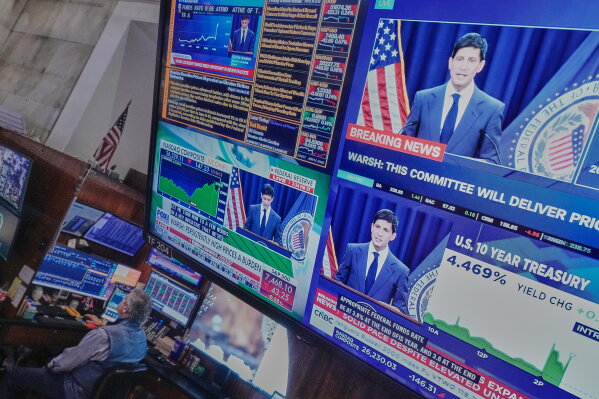
The Federal Reserve has evolved from a secretive agency to a more open institution, offering insights into its decision-making and economic outlook. However, new chair Kevin Warsh appears to be reversing some of this transparency. In his first press conference, Warsh highlighted his belief that financial markets are overly reliant on Fed guidance, which he sees as more useful during crises or downturns.
Warsh swiftly implemented changes: the Fed’s statement on interest-rate decisions was reduced from 341 words in April to just 132 words. Additionally, he emphasized the absence of any “forward guidance” in the statement regarding future Fed actions. Warsh’s goal is to reduce the Fed’s communication with financial markets about its upcoming interest-rate decisions. Yet analysts warn this could lead to more fluctuations in stock and bond prices, potentially increasing interest rates for consumers and businesses.
George Pearkes, global macro strategist at Bespoke Investment Group, noted that forward guidance typically reduces market volatility and stabilizes expectations. This stability often leads to lower borrowing rates compared to alternatives. Despite potential repercussions, Pearkes suggests that the impact on consumers might be limited, with mortgage rates rising only slightly.
Following Warsh’s statements, financial markets experienced volatility. The 10-year Treasury yield, which greatly affects mortgage rates, rose from 4.43% to 4.49% on Wednesday but later decreased. The 2-year Treasury yield, closely watched for insights into Fed actions, increased to 4.16% from 4.05% prior to the meeting. The S&P 500 index fell by 1.2% on Wednesday.
Warsh is likened to former chair Alan Greenspan, known for his cautious comments that kept investors unsure. Greenspan helped initiate the statements the Fed now issues post-meeting, starting with a rate increase announcement in 1994 that surprised investors. The Dow Jones dropped 2.4% that day.
Warsh’s communication changes are part of a broader reform effort. He announced the formation of five task forces to examine the Fed’s communications, balance sheet management, data analysis, AI impact on jobs and productivity, and inflation assessment frameworks. The communications task force will consider revisions to the Fed’s quarterly economic projections and other recent innovations like press conferences.
During the 1990s, Greenspan refrained from explaining Fed decisions on the record. Warsh may scale back the transparency gains since the 2008-2009 global financial crisis. Matthew Luzzetti, chief U.S. economist at Deutsche Bank, said Warsh’s actions reverse the trend toward greater communication and forward guidance initiated by previous chairs.
Bernanke and subsequent chairs saw forward guidance as beneficial, aligning market movements with Fed intentions. Although the Fed sets short-term interest rates, longer-term rates, like the 10-year Treasury yield, depend heavily on investor expectations for inflation and economic growth. Forward guidance influences these expectations, impacting longer-term rates before Fed actions.
Warsh insists financial markets should use economic data to predict Fed moves, which the Fed can consider in its assessments. “Financial market prices are probably the most important source of information to guide central bankers,” Warsh said.
Economics professor David Andolfatto agrees with Warsh’s critique of forward guidance, noting it can be disrupted by unforeseen events such as geopolitical conflicts. However, Andolfatto stresses the need for a contingency plan in lieu of forward guidance.
Dropping forward guidance might increase the prominence of the other 18 members of the Fed’s rate-setting committee. These officials frequently make public speeches, garnering more attention as markets seek clues about Fed decisions.
Warsh’s approach faces a test in case of a financial downturn or crisis, where forward guidance can stabilize markets. Pearkes questioned whether Warsh’s methods will persist, acknowledging that time and events will provide the answer.