
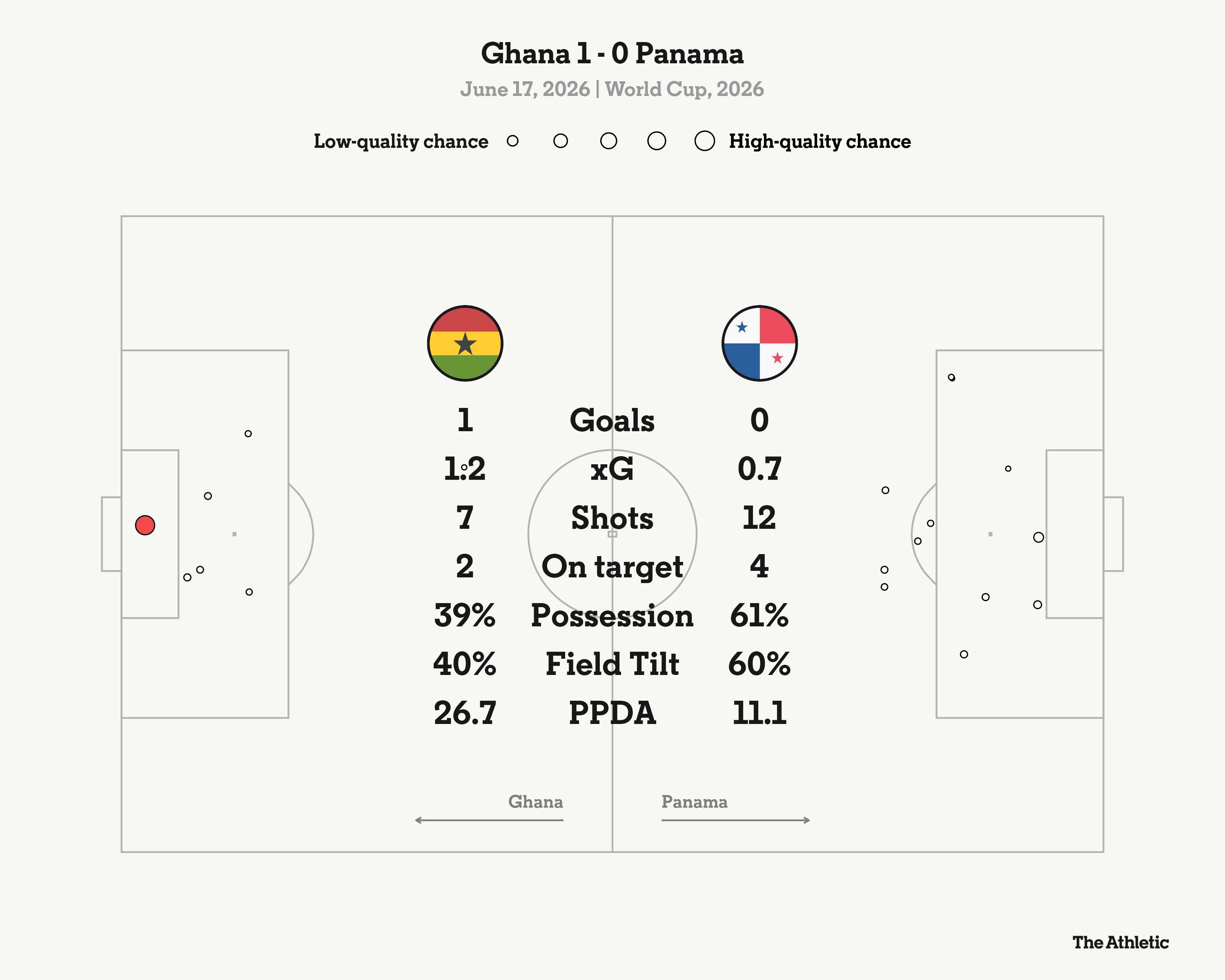
Ghana’s 1-0 victory over Panama in World Cup Group L suggests limited threats to England and Croatia. Following England’s 4-2 win against Croatia at AT&T Stadium in Arlington, Texas, Ghana and Panama engaged in a low-quality, low-chance game amid rain in Toronto.
Match Analysis
Ghana’s finishing lacked precision at BMO Field, requiring a close-range chance in the 95th minute to defeat Panama. Caleb Yirenkyi scored the latest winning goal of this World Cup when the ball pinged off his foot into the net.
Rainy conditions prompted hydration breaks but drew booing from fans. Many spectators and photographers wore ponchos to stay dry. Despite some empty seats, FIFA reported the stadium was nearly full with 42,942 of 43,036 seats occupied.
Performance Concerns
“In a nutshell, not on this evidence.”
England and Croatia likely face little challenge based on Ghana’s current performance. Ranked 72nd by FIFA, Ghana showed an inability to upset stronger teams, even if vice-captain Thomas Partey rejoins after missing the game due to visa issues.
At the last minute, Antoine Semenyo’s play enabled Brandon Thomas-Asante to pass to Yirenkyi for the decisive goal.
Shooting Woes
Ghana struggled to convert opportunities, entering the match’s final minutes with an expected goals (xG) of 0.24 and xG on target (xGOT) of 0.05. They attempted seven shots, only two landing on target, a similar inefficiency matched by Panama’s eight attempts with two on target.
Yirenkyi redeemed his poor start-of-half attempt, which flew wide, by seizing a straightforward chance to secure victory in the closing seconds.
Hydration Breaks Debate
Hydration breaks, typical in high temperatures, became a topic of discussion due to their persistence despite the rainy weather throughout the tournament. In Toronto, the breaks, while not weather-related, were booed by the crowd. Broadcasters, like TSN in Canada, used these as ad slots, indicating a potential lasting change in how football is watched globally.
Off-Pitch Connections
A Ghanaian and Panamanian cross-cultural mingling was evident throughout Toronto, suggesting a different experience from success on the field. Despite low expectations of advancing, supporters reflected national pride. For Ghana and Panama fans, the World Cup provides a rare chance to showcase their culture and cheer alongside fellow nationals abroad.
With many Ghana supporters locally based due to travel restraints, smaller yet vibrant gatherings embraced their national heritage. Panama fans sang “Patria,” resonating with diaspora across various nations.
Though the game lacked excitement, the event itself celebrated cultural unity and national identity.