
Adam Van Voorhees frequently ate orange chicken until a persistent white patch on his arm made him reconsider his diet. Like many young adults, he didn’t pay much attention to his food choices. However, the alarm on his continuous glucose monitor (CGM) alerted him that his blood sugar had spiked into the prediabetic range after a meal at Panda Express. Since then, he has started bringing his own lunch.
Although Van Voorhees is not diabetic, he uses a monitor commonly worn by people with Type 1 diabetes as part of a class at UC San Diego. These monitors, once available only by prescription, are now offered over-the-counter. Mary Boyle, a cognitive science professor at UCSD, believed this technology could transform how individuals understand their bodies. With the introduction of Stelo, Dexcom’s over-the-counter monitor aimed at health-conscious users, Boyle enlisted students to study how CGMs might promote healthier habits.
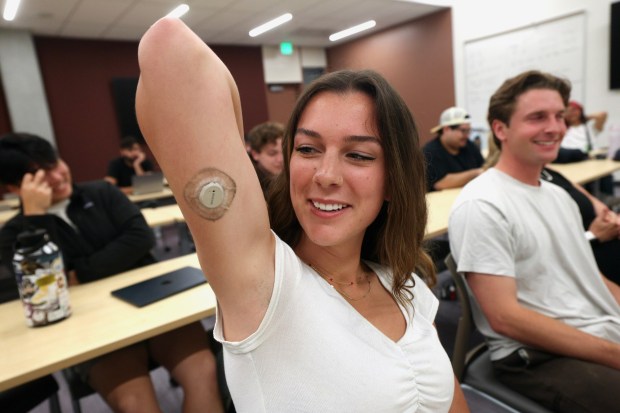
Student Rylan Breneman demonstrates her Dexcom monitor during UCSD’s Metabolic Health Analytics class. CGMs allow users to view how their bodies respond to different environmental and lifestyle choices. Real-time data helps illustrate how certain activities, like walking for a few minutes, affect blood sugar levels. CGMs have proven highly effective for diabetics, where behavior changes can lead to significant health outcomes.
Boyle’s class is gathering pilot data for a potential clinical study to assess if similar logic applies to healthy individuals. Surprisingly, even some unexpected results emerged from this data collection. Boyle noted the intuitive nature of much of the information, reflecting on common knowledge about dietary choices. Still, many were shocked to see tangible evidence of their unhealthy decisions.
Insulin resistance in brain cells can mimic Alzheimer’s disease, explained Boyle. She emphasized the importance of resources to properly absorb glucose. External factors, such as sleep and stress, also impact metabolism and brain function. Although these variables have been studied in diabetics, research on healthy individuals is lacking, according to Dr. Robert Thomas, an academic endocrinologist at UCSD.
Students received three monitors each to test personal hypotheses through N-of-1 experiments. This personalized approach contrasted with conventional population studies. In class, one student demonstrated applying the Stelo monitor to her arm, allowing her phone to sync in moments for a 14-day sugar level tracking. The devices, normally retailing at $99 for a pair, were provided at no cost thanks to Boyle’s grant from Dexcom.
Boyle prompted the students to share their experiences. Several students reported blood sugar dips in the afternoon, often manifesting as hunger before they consciously felt it. Student Katie Lam discussed how stress affected her glucose levels, especially when facing exams and interviews. Her CGM offered visual confirmation of her anxiety, prompting her to take steps to relax.
Hormones and metabolism are closely linked, Boyle explained. Morning glucose increases are due to the body’s cortisol production. Apart from her students, Boyle also monitored hormonal effects on perimenopausal and postmenopausal women. She highlighted how crucial understanding blood sugar is, likening it to staying aware of a bank statement to avoid debt.
In another experiment, student Jaidy Leyva ate various chocolate cakes, finding only one brand caused a sugar spike. This learning opportunity helped many students reconsider their habits, changing views on seemingly harmless choices like smoothies.
However, not all students reacted positively to the continuous data stream. The constant monitoring led to anxiety for some, such as Rithika Muttukuru, who noted the stress induced by nighttime alarms. This highlights what Dr. Thomas calls ‘device burden.’ He advised against using such devices without actionable plans. Thomas suggested that an annual monitor trial could benefit health-conscious and prediabetic individuals.
Exposure to a CGM allowed students to observe firsthand the real-time impact of their lifestyle choices. Leyva noted that seeing how actions directly influenced her body was far more impactful than external advice alone.