
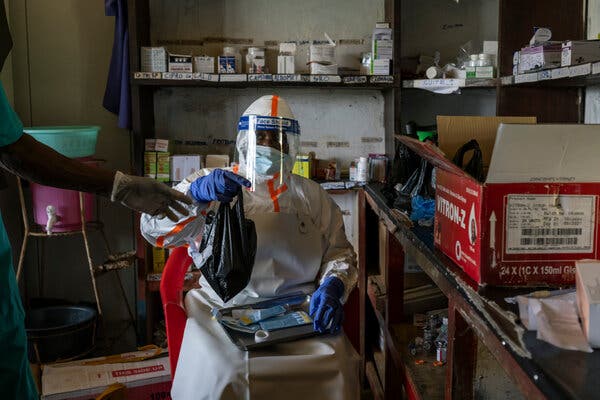
In the town of Mongbwalu, located in the Democratic Republic of Congo, healthcare workers are actively distributing medication to patients suspected of having the Bundibugyo virus. Recent trials have commenced on a number of drugs that have demonstrated potential effectiveness in preliminary studies against the virus currently responsible for the outbreak.
At an Ebola treatment center hastily set up in Rwampara, within the Democratic Republic of Congo, Dr. Papys Lame and his team are working tirelessly. They treat patients suffering various severe symptoms such as severe diarrhea, vomiting, relentless bleeding, and respiratory distress. The team employs rehydration methods, transfusions, and oxygen therapy as they monitor vital signs and manage patients’ severe pain.
Dr. Lame, an Ebola response coordinator for the Alliance for International Medical Action, noted that the response to the current outbreak represents a marked improvement compared to efforts five years earlier. He highlighted the greater availability of treatment options contributing to increased survival rates. Despite this progress, a targeted treatment for the Bundibugyo virus remains elusive. This virus is the cause of the current outbreak affecting East Africa, with at least 695 reported infections and 138 deaths.
Scientists are rigorously working to identify effective treatments for the Bundibugyo virus. Historically, most Ebola outbreaks have been linked to the Ebola virus, a different viral species. The World Health Organization endorses two drugs following clinical trials as treatments for the Ebola virus. However, a drug’s efficacy against one virus does not guarantee effectiveness against another due to significant evolutionary differences.
Efforts continue, as healthcare providers and researchers strive to find a solution to combat the Bundibugyo virus, ultimately aiming to reduce the toll of the current outbreak.