
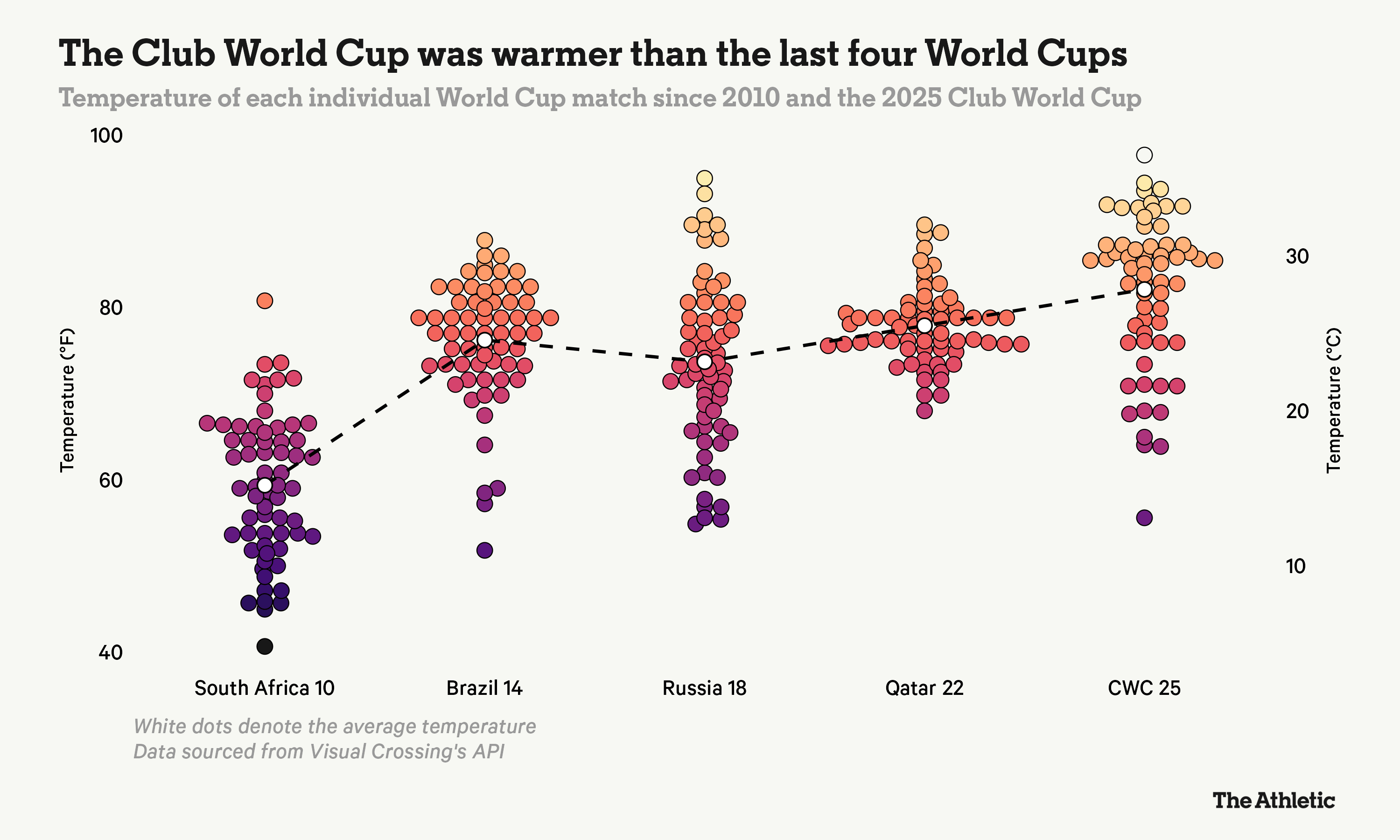
The upcoming World Cup is expected to be marked by intense heat, with many games predicted to occur in temperatures exceeding 90°F (32°C). This may be the hottest edition since the 1994 World Cup in the United States, which was known for its challenging conditions, particularly with matches played early in the day under the harsh sun. One notable match was Mexico’s win over Ireland in Orlando, where pitch-level temperatures reached 117°F.
Concerns about similar heat conditions persist. The Club World Cup held in the U.S. last summer demonstrated warmer temperatures than the past four World Cups. Although only five stadiums from that tournament are being used, the current World Cup spans the U.S., Mexico, and Canada. The Athletic conducted extensive weather data analysis over ten years for each game’s location and timing. This included the scheduled kick-off time plus an hour either side over a weeklong window near the match date.
Results show that AT&T Stadium in Dallas could see average temperatures of 90°F (32°C), with Estadio BBVA in Monterrey following closely. Dallas will host a semi-final on July 14, expected to reach 93°F (34°C). Though venues like Dallas maintain closed roofs and air conditioning, open-air stadiums present greater challenges. In half of the 16 host stadiums, temperatures have exceeded 100°F near kick-off in the last ten years.
Aaron Mentkowski, chief meteorologist for WKBW-TV Buffalo, notes that heat at pitch level can be severe, especially on sunny days with minimal wind. He explains that fields absorb and radiate heat while stadium structures block wind that could otherwise mitigate conditions. Mentkowski will provide live forecasts and analyses for The Athletic throughout the World Cup.
Extreme heat impacts players’ performance, making it tough to maintain high energy levels. Germany’s win against Bolivia in 1994, for example, showcased how difficult it was to find rhythm under such taxing conditions. Some teams are acclimatizing by training in warm environments; Norway’s players were seen practicing in high temperatures in North Carolina to prepare.
Mentkowski states that acclimatization takes a week or two, negating significant disadvantages for players from cooler climates. Additionally, most players from colder countries already play in environments with similar heat due to their club commitments abroad. Analyzed data shows similar climatic conditions across many teams based on where their players play.
Beyond heat, thunderstorms pose risks. U.S. protocols dictate match suspensions if lightning is detected within an eight-mile radius, triggering a 30-minute delay countdown that resets with each new strike. Such disruptions can interrupt the flow of play, as seen in Chelsea’s Club World Cup match last year, which was extended by repeated lightning delays.
Venues like Miami and Mexico City could see daily thunderstorms with frequent lightning, while Kansas City might experience severe storms. Increasing heat and humidity are expected in Boston, Philadelphia, and New York, bringing sporadic storms with them. These interruptions can derail a team’s momentum and affect nutrition and hydration plans.
The ability to adjust to these weather elements will be crucial for success in this World Cup, possibly weighing as heavily as player skill, team strategy, or teamwork.