
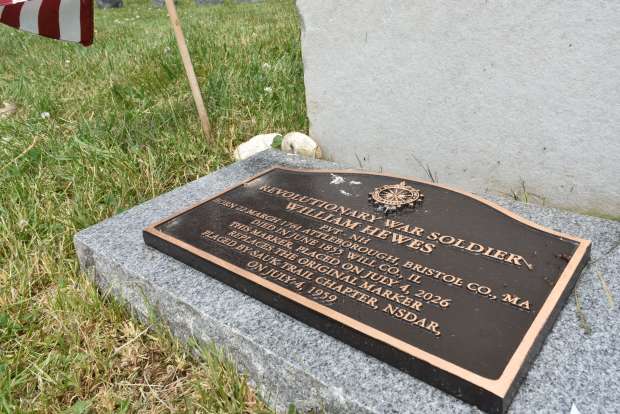
William Hewes was born in 1761, before the United States existed. By his death in 1855, the nation faced division over slavery. In his 94 years, Hewes donned a uniform, battled the British, helped form a new country, and journeyed westward. His final settlement was in Crete, where 29 descendants reside today. Though gone for more years than he lived, his memory persists in Will County.
A new plaque now marks Revolutionary War veteran William Hewes’ grave in Crete. Around three dozen individuals, including descendants, local historians, and members of the National Society Daughters of the American Revolution (DAR), gathered to rededicate this plaque. The first plaque dated back to 1959. Melody Paris-Rush, DAR regent, explained the dual reasons for the event: the 250th nation anniversary and the aging original plaque.
“Over time, exposure to elements, maintenance crews, and mowers led the original marker to discolor and lose attached letters,” Paris-Rush said. “The chapter decided on a new marker to honor his service for the 250th anniversary of the country.”
The metal marker doesn’t provide much detail, only noting his involvement in the Revolutionary War, birth (in Massachusetts), and death. Yet, his legacy extends beyond. Tim DeMuth, a Hewes descendant, spoke at the First Congregational Church ceremony, adjacent to Hewes’ grave.
DeMuth highlighted Hewes’ role as a private during the war. Enlisting at 18 for six months, he witnessed the hanging of John Andre, linked to Benedict Arnold’s betrayal. Hewes also served at West Point, a strategic fort crucial for the Continental Army.
“He wasn’t a soldier in history books, but every soldier was vital to winning the war,” DeMuth stated. “They enabled us to enjoy the blessings of liberty as we celebrate our 250th anniversary.”
After his service, Hewes traveled via the Erie Canal to the Great Lakes, venturing to Detroit, and then journeying on foot until reaching Crete.
DeMuth remarked on the challenge of traveling from Detroit on dirt paths. By that time, Hewes was old and traveled with his son. Five of his twelve children moved to Illinois, establishing homes in the Crete area. Some became politicians, others ministers, farmers, or shopkeepers.
Most of the family remained in Crete. They laid down roots, and those roots endured. DeMuth mentioned that some family members still reside in a Crete house, occupied for five generations.
“The land is just part of our soul,” DeMuth expressed.
This story was reported by Jesse Wright for the Daily Southtown.