
Tax Incentives for Data Centers
States like Washington and Texas are attracting data centers by offering generous tax incentives. Good Jobs First’s Subsidy Tracker identifies 251 instances of such incentives from 2020 to 2026 in 16 states. Washington leads with over 120 awards, followed by Texas with 86. Indiana’s largest subsidy package reached $8.2 billion for Amazon Data Services.
In 2023, Oregon offered a $1 billion subsidy to Amazon, while North Carolina granted $891 million to Apple in 2021. Texas provided $687.6 million to Meta, and Georgia supplied $355 million. A $170 million subsidy was given to Alphabet Inc. in Indiana.
“Megadeals” are significant subsidy packages valued at $100 million or more. These involve multiple state and local subsidies, including Amazon in Oregon and Meta in Georgia.
Major Data Center Hubs
Data center hubs are emerging in select states due to various factors:
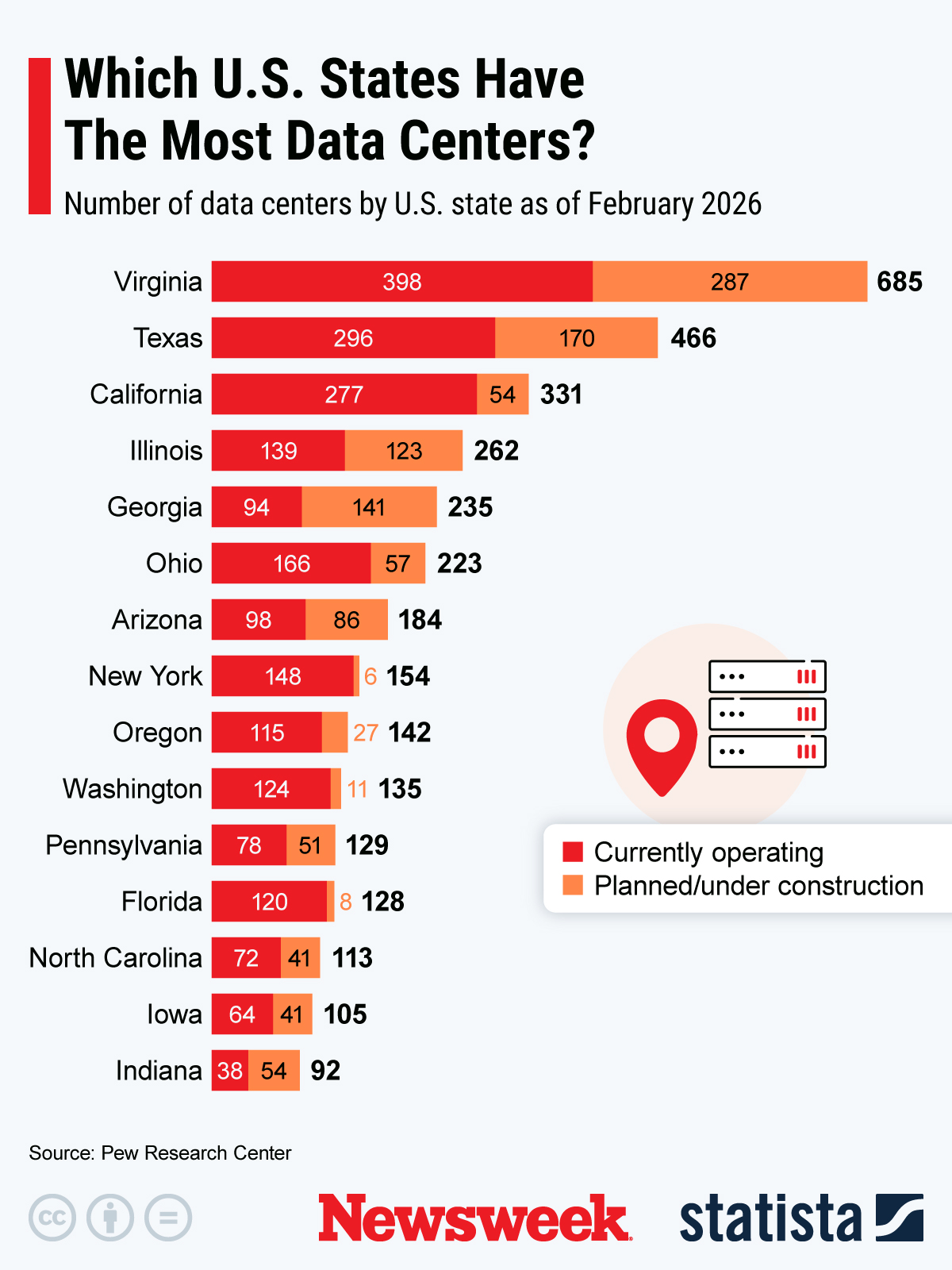
- Virginia: Known for its dense fiber network and proximity to federal agencies, Northern Virginia provides fast build times and scalability.
- Texas: Offers inexpensive land and deregulated energy markets, making cities like Dallas and Austin attractive to tech investors.
- California: Houses around 300 operational centers, with expectations of growing energy demand.
- Ohio: Central access and strong incentives transform industrial sites into competitive data centers.
- Arizona: Provides abundant land, favorable climate for cooling technologies, and economic incentives, with Phoenix being a prime location.
- Georgia: Atlanta acts as a connectivity hub with tax breaks and robust infrastructure.
- Utah: Offers renewable energy sources with a growing tech workforce.
These top 10 data center states account for nearly 60% of centers in the U.S.
Erin Brockovich’s Data Center Tracker
Environmental activist Erin Brockovich has launched a database to track new data center construction. Her database identifies over 50 centers in drought-prone areas of the South.
Brockovich gained fame for her role against PG&E over contamination in the 1990s, highlighted by the 2000 film “Erin Brockovich.” Her tracker shows growing public concern, with over 6,600 contacts received about AI data centers.
Her Facebook post on May 31 reported “6,615 submissions,” demonstrating public worry over data centers’ expansion. Brockovich’s tracker aims to increase facility visibility supporting AI growth.
Community Concerns About Data Centers
A Gallup Poll from early March found that 70% of Americans oppose local AI data centers. Reasons include rising energy and electricity costs, water usage, electronic waste, disaster vulnerability, infrastructure pressure, and noise from cooling systems.
Communities, particularly Monterey Park, California, are passing bans on data centers due to the national backlash against these infrastructures.
Environmental Impacts of Data Centers
Data centers consume large amounts of electricity and water, impacting local resources and causing land use issues. Mid-sized centers use up to 300,000 gallons daily, while larger ones can reach 5 million gallons, according to the Environmental and Energy Study Institute.
Such water use is problematic for communities facing resource scarcity or drought conditions. Energy demands also raise concerns about pollution and reliability. Land acquisition by centers often disrupts agricultural or other development priorities.