
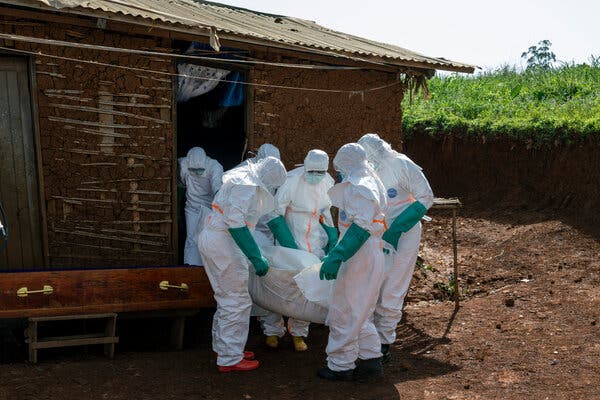
Mining has been crucial to the survival of Mongbwalu, a secluded town in the Democratic Republic of Congo, for many years. However, this industry is now contributing to the spread of a severe Ebola outbreak in the area. Recently, Red Cross workers were seen removing the body of a gold miner, Mumbere Saidi, in Mongbwalu.
The outbreak has been traced back to this region, with health officials identifying Mongbwalu as the starting point. The virus went undetected for months and only came to light on May 15. This delay was partly due to the involvement of a less-known Ebola strain called Bundibugyo, which currently has no available treatment.
Mumbere Saidi is one among many seeking refuge in gold mines after fleeing attacks by local armed groups. After journeying 200 miles through volatile conflict zones, Saidi arrived in the mining town to find work. Despite sending money to support his family when possible, Saidi found himself battling an unseen adversary when Ebola struck him in his home last week. His brother, Kondu Ganda, also a miner, referred to the disease using a euphemism common in Mongbwalu to avoid mentioning Ebola directly.
Gold mining has attracted workers from across Congo and further afield to Mongbwalu for over a century. The town’s economic dependency on mining has now placed it at the heart of the Ebola outbreak, the third largest to date, causing significant concern among health authorities.