
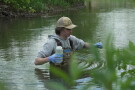
Hannah Ray J Childs is passionate about her time on Iowa’s Maquoketa River. She describes whitewater kayaking as giving her a ‘feeling of flying.’ Her love for water led to meeting her husband during a kayaking event. Despite her enjoyment, Childs takes precautions due to the risk of illness from polluted water by wearing nose and ear plugs. Many question her time spent on the water.
Iowa struggles with significant water pollution. As a major producer of corn, soybeans, and hogs, the state’s agricultural practices lead to nitrate and phosphorus runoff into water bodies. This pollution contributes to a dead zone in the Gulf of Mexico. In the past, the largest city faced water restrictions due to high nitrate levels.
‘People’s first response when I tell them that I like to kayak and be upside down in the river,’ Childs said, ‘is, ‘Ew, that’s disgusting. Why would you do that?’’
Iowa’s waterways are impacted by agricultural runoff and sewage, causing adverse effects on public health and recreation. Algal blooms make beaches dangerous and soil runoff makes water feel unpleasant. Bacteria often keeps the younger population away from streams.
In 2024, more than half of the state’s monitored river and lake sections did not meet standards for safe swimming or drinking. The voluntary approach to reduce pollutants falls short of goals. Environmental groups have taken legal action against policy reversals affecting pollution reduction.
There has been investment and incremental improvements. Governor Kim Reynolds proposed a $320 million package for water infrastructure, adding to the annual $100 million for pollution issues. Improved usage of cover crops and better farming practices have made progress in runoff reduction.
Waterways are a significant part of Iowa’s identity, including the Missouri and Mississippi rivers. These natural spaces are valuable for recreation and community building. Volunteer efforts and local initiatives aim to foster community connection to water resources. Childs has been involved in water testing and promoting a whitewater park.
Mary Swander, once an avid water enthusiast, now avoids water activities due to pollution concerns. Recreational water use has declined, impacting social connections, especially among older adults. Unpredictable runoff contaminates water, with climate change increasing risks.
Nutrients from agricultural runoff fuel algae, leading to advisories and drinking water challenges. Tile drainage systems send water quickly to streams, exacerbating pollution.
Recent efforts to maintain Lake Darling demonstrate ongoing challenges. Despite efforts to improve conditions, bacteria and algae advisories persist. Local initiatives showcase determined conservation efforts.
Policy has not enforced mandates, unlike other states. Iowa relies on voluntary cooperation between agricultural sectors and environmental agencies. Improvement strategies include reducing fertilizer use and managing crop growth.
The EPA emphasizes the role of agriculture in solutions. However, costs and slow returns challenge farmers. Efforts require state and federal aid, with demand for resources far exceeding supply.
David Thoreson highlights effective local conservation efforts near Iowa Great Lakes. Efforts include wetland restoration and sewage treatment improvements, which contribute to economic and property value benefits.
Community cooperation and investment are essential for continued progress in Iowa’s water quality issues.