
Three individuals, known as the “Spokane 3,” were found guilty on federal conspiracy charges related to protests against the U.S. Immigration and Customs Enforcement (ICE) operations in Washington state. These protests occurred last year.
The individuals involved—Jac Archer, Justice Forral, and Bajun Mavalwalla II—were accused of trying to block federal officers from transferring two detained immigrants from Spokane to Tacoma in June 2025. This information was reported by KUOW.
These three were among hundreds of demonstrators who gathered in response to a social media call from former Spokane City Council President Ben Stuckart. He urged supporters to block the transfer bus. Stuckart acted as a sponsor for one of the immigrants seeking asylum in the U.S.
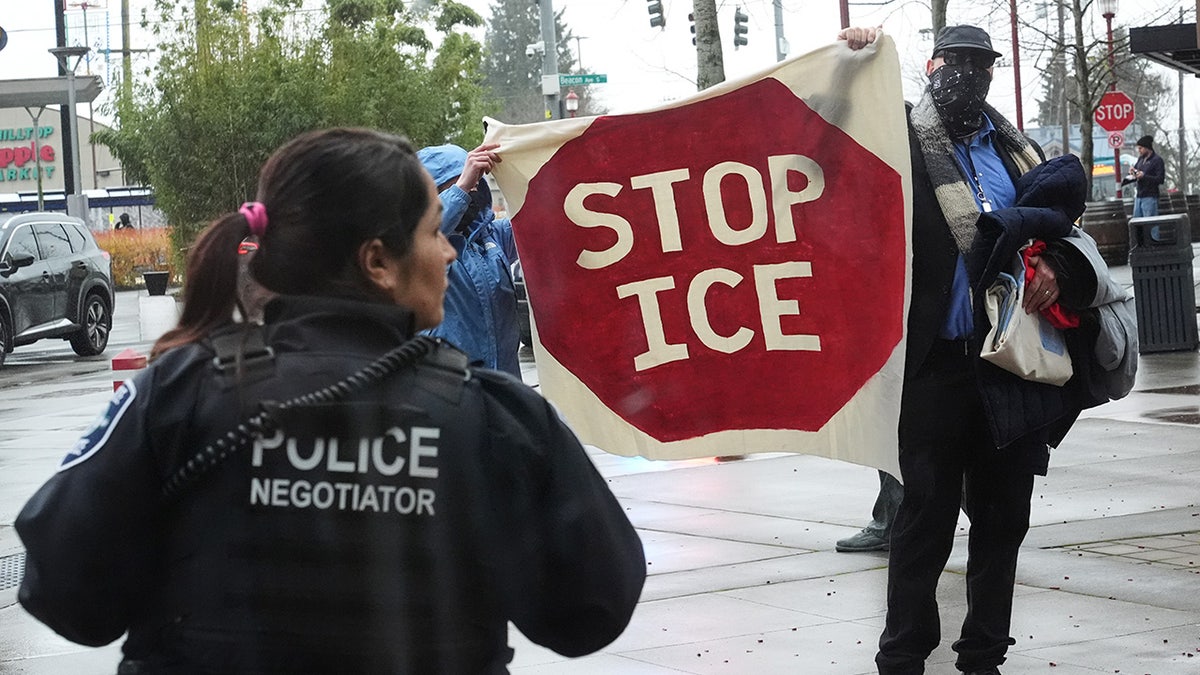
In a related event, a protester holding a “Stop ICE” sign was removed by Seattle police at a bill-signing with Governor Bob Ferguson in March 2026.
Stuckart, along with nine other protesters, faced arrest on conspiracy charges. As reported by KUOW, Stuckart and five others took plea deals for reduced sentences.
After the verdict, Washington state Representative Natasha Hill criticized Stuckart for not attending the trial, highlighting his absence. “You started this and you couldn’t even show up to finish it,” Hill stated, urging others to continue supporting the community.
Stuckart explained on Facebook that attending the trial would’ve violated his parole terms. He expressed remorse over the verdict and extended his support to those involved in both the plea deals and the trial.
Moreover, he referred to the detained immigrants, committing to assist them. “I am trying my best to finish what I started by taking care of the guys the government wrongfully took,” he mentioned.
Bajun Mavalwalla Sr., the father of one of the convicted protesters and also a congressional candidate, claimed that federal prosecutors intended to make an example of his son. According to KUOW, Mavalwalla accused the government of an attempt to silence opposition to immigration enforcement policies.
He asserted that rights to protest, dissent, and assembly are under threat due to this case, contrasting it with others around the country where cases were dismissed without jury bias.