
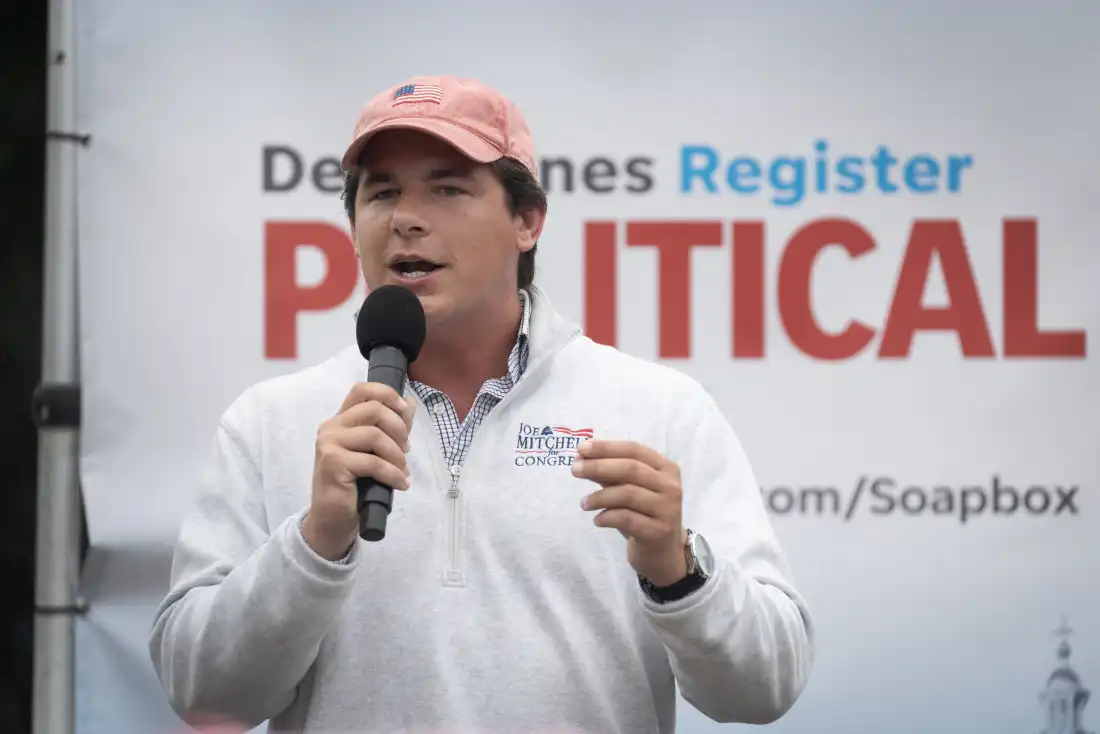
Joe Mitchell, a 29-year-old in northeast Iowa, is campaigning to represent the state’s second congressional district. His candidacy is part of a competitive race viewed as a tossup, with voters growing weary of President Trump while Democrats see control of Congress as increasingly attainable. Mitchell holds the endorsement of President Trump. If victorious, he would join a nascent group of Generation Z Republicans in Washington, D.C.
This potential group of leaders is emerging, though small in number. Besides Mitchell, only a few other Gen Z Republicans are competing for seats. One is in a traditionally Republican district, while others face challenging odds in predominantly Democratic areas. Despite these numbers, Mitchell emphasizes voters’ desire for a new generation of leaders.
I think people are looking for hope, regardless of what party they’re in. They want to see young people get involved, and I hear that everywhere we go.
As a former state senator and real estate developer, Mitchell focuses on an anti-corruption platform tailored to appeal across party lines. He advocates for term limits and a ban on congressional stock trading, distancing himself from corporate PAC donations. He believes young Americans demand economic security and transparency from institutions.
Young people—on both sides of the aisle or no party affiliates—are frustrated with the system. They’re frustrated and they should be.
Currently, only one House member is from Gen Z: 29-year-old Florida Democrat Maxwell Frost. However, two candidates are likely to win soon. Melat Kiros, a Democratic socialist in Colorado, is expected to succeed in a safe Democratic seat. In Wisconsin, Michael Alfonso, a 26-year-old endorsed by Trump, eyes a Republican stronghold. If elected, Alfonso would be the first Congress member born in the 2000s.
During a Wisconsin Public Radio interview, Alfonso described his age as his “greatest advantage,” reflecting shared values in his district.
I have the same values of everyone here in the 7th [district]: Hard work, faith, and family.
Younger candidates, especially Republicans, rarely run for Congress. The oldest Gen Zers will soon turn 30, barely meeting the House’s age requirement of 25. A Future Caucus report shows only 4% of congressional candidates are Gen Z, making them the least likely to advance past primaries. Most run as Democrats, with fewer as Republicans, and some in third parties.
While young Republicans receive less media coverage compared to young Democrats, conservative organizers are focused on cultivating future leaders. Adam Pennings, director of Run Gen Z, an organization helping young conservatives, underscores the need for younger voices.
Young people need a seat at the table. Does that mean they need to be the only seat of the table? No. We need to be building up young people who are ready to lead.
Run Gen Z recently endorsed over 220 young conservatives nationwide. This includes congressional hopefuls like Mitchell and Alfonso, as well as underdogs such as Riley Owen in Utah, who acknowledges his uphill battle in a Democrat-favored district.
People are hungry for a new solution, new faces, fresh ideas, and a grassroots campaign like the one we’re running.
As the GOP faces potential losses, young conservatives like Owen reflect on the party’s future. Owen sees an opportunity for conservatives to offer solutions aligned with American ideals.
People want to trust their government. People want to take risks and dream big and start a business, start a family, live the American dream. If we can provide solutions, I think the conservative movement has a very bright future.
In Iowa, Mitchell envisions the Republican Party continuing with an “America First” focus, highlighting questions about aiding Americans directly. He believes Vice President JD Vance and others in Trump’s administration share this view, though interpretations of “America First” vary.
Within the GOP, views on issues like the U.S. war with Iran vary. This conflict remains a critical point, particularly for candidates like Mitchell, who face heightened scrutiny as Democrats link it to increasing costs. While Mitchell opposes endless wars, he stresses preventing Iran from acquiring nuclear weapons.
When asked whether Trump’s agenda squares with his own definition of ‘America First,’ Mitchell argued that it does. But ‘like any definition,’ he said, ‘people can have a number of ways to interpret it.’