
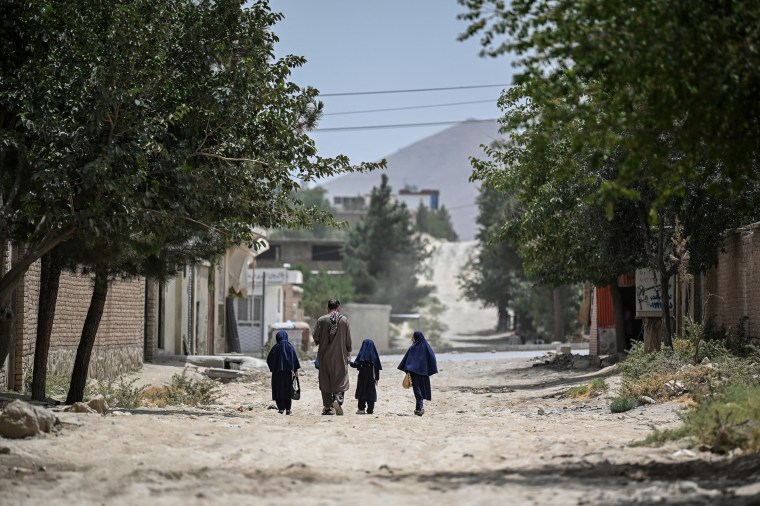
Ankara, Turkey — Approximately 2.4 million Afghan girls are still denied secondary education five years after the Taliban assumed control of the country. This was reported by a U.N. agency on Tuesday, which urged for the immediate restoration of their educational rights. UNESCO, a U.N. Educational, Scientific, and Cultural Organization based in Paris, emphasized that the continuous exclusion of women and girls from education is a severe breach of their fundamental rights.
“Afghanistan remains the only country in the world where girls and women are formally banned from secondary and higher education,” stated Hoda Jaberian, UNESCO’s program coordinator for education in emergencies, during a virtual news conference. She explained that five years of educational interruption goes beyond temporary and equates to almost an entire secondary school cycle.
Jaberian highlighted, “UNESCO continues to call for the immediate and unconditional restoration of girls’ and women’s right to secondary and higher education. It is not negotiable—it’s a basic human right, and there is no alternative to it.”

The Taliban took power on August 15, 2021, coinciding with the withdrawal of U.S. and NATO forces after a 20-year conflict. Soon after, they prohibited girls from attending secondary schools and eventually extended the ban to higher education, employment, and various sectors, largely removing women and girls from public spheres.
Despite calls from the U.N., humanitarian groups, human rights advocates, and several Islamic countries to rescind the ban, the Taliban maintains the restrictions as a domestic issue. Jaberian expressed concern that these limitations reverse the two decades of educational progress made in Afghanistan. By 2021, roughly 1 million girls were accessing secondary education, a significant increase since 2001.
“Afghanistan had made substantial progress in girls’ educational access,” Jaberian remarked. “Regrettably, much of this advancement has now been undone.”
UNESCO has been actively supporting education in Afghanistan through community-based education, literacy, and skills development programs. These initiatives take place in communal settings, often within the homes of literacy facilitators, with official acknowledgment. The agency noted that more than 1,000 literacy facilitators, primarily trained by UNESCO and its partners, play a crucial role.
“Although restrictions persist, we cannot abandon Afghan learners,” Jaberian stated. “UNESCO collaborates with communities to maintain all possible learning pathways.”