
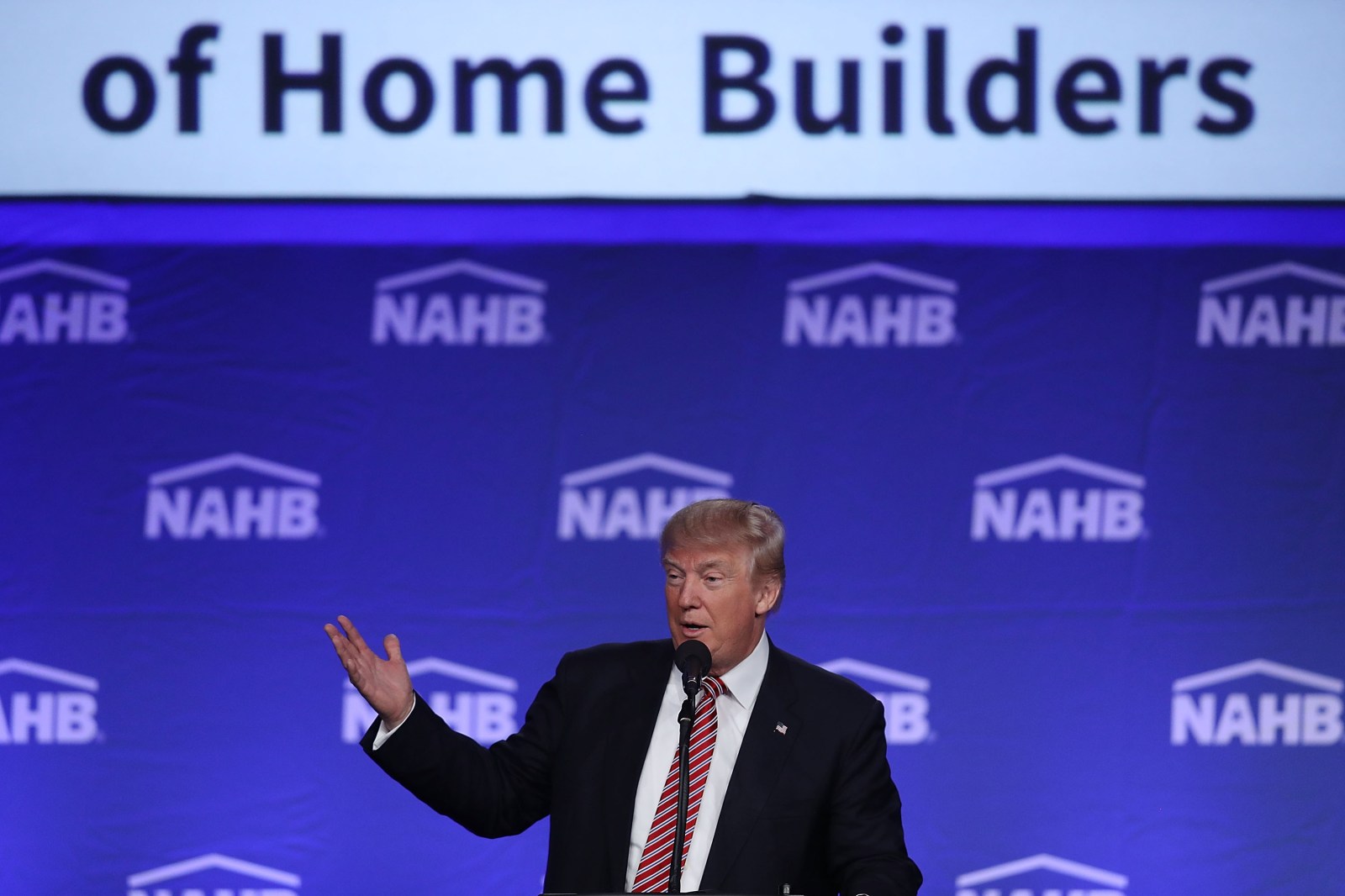
President Donald Trump’s decision to escalate the trade conflict with Canada has put him at odds with a key financial supporter of the Republican Party: the nation’s home builders. On July 20, three new proclamations were signed, imposing 50% tariffs on specific Canadian imports. This action was taken under Section 338 of the Tariff Act of 1930, marking the first time this authority has been used by a president. The tariffs cover products such as wine, hockey sticks, and cement, and apply even if goods qualify under the United States-Mexico-Canada Agreement. Roughly $20 billion worth of annual imports are affected, with the tariffs set to take effect on August 19.
Four days after the announcement, the National Association of Home Builders (NAHB) informed its members that the tariffs would increase uncertainty over building material supply chains and pricing. The association highlighted concerns about cement, plywood, and furniture. NAHB emphasized its ongoing efforts to get building materials exempted from the trade strategy and avoid new barriers that could exacerbate the housing crisis. In a blog post, NAHB stated that recent tariff developments might lead to further uncertainty for builders.
A Prominent GOP Donor
The NAHB is a significant player, not a minor critic. In the 2024 election cycle, its political action committee contributed $1,664,412 to Republican congressional candidates, which constituted 80.8% of its total candidate contributions. In contrast, it gave $393,099 to Democrats, as per OpenSecrets data. Overall, NAHB contributed $3,320,075 and spent $3,450,000 on lobbying activities that year. Its PAC, known as BUILD-PAC, supports candidates favorable to housing, and the association consistently ranks highly among Washington’s lobbyists.
NAHB has spent more than a year urging Trump to exclude construction inputs from tariffs. In February, the association collaborated with Senators Jacky Rosen and Chris Coons on the Housing Tariff Exclusion Act. This legislation aims to automatically exempt numerous home building materials from tariffs, both existing and future ones. NAHB chairman Bill Owens pointed out that about 60% of builders have already experienced cost hikes due to tariffs. Association data indicates that these tariff actions typically increase home costs by $10,900 per unit.
Canada plays a crucial role in the industry’s supply chain, accounting for around 85% of U.S. softwood lumber imports and nearly 25% of domestic supply. The July 20 tariffs do not affect existing duties on softwood lumber, steel, aluminum, and copper. Additionally, the Commerce Department plans to reduce combined antidumping and countervailing duties on Canadian softwood from approximately 35% to 25% by mid-August, according to NAHB.
This trade dispute comes at a time when builder sentiment is at a significant low post-recession. The association’s index in collaboration with Wells Fargo dropped two points to 34 in July, maintaining below 40 for 15 consecutive months, marking the longest stretch since 2012. Owens noted that many potential buyers remain hesitant, waiting for lower mortgage rates.
GOP Concerns on Capitol Hill
Republican lawmakers have expressed similar concerns. Senate Majority Leader John Thune from South Dakota stated he was not supportive of tariffs without a clear purpose, lacking an explanation for this one. Senator Mike Rounds, also from South Dakota, emphasized the importance of affordability, highlighting inflation as a growing issue.
Politico indicated that individuals close to the White House are worried the tariffs might undermine Republican messaging on costs as the November midterms approach. An anonymous source noted that discussing tariffs, unless to reduce them, is unfavorable for Republicans. The White House defends the tariffs as a response to Canadian discrimination against American cars, alcohol, and dairy, aiming to level the playing field for U.S. exports.
Canadian Prime Minister Mark Carney criticized the tariffs as a direct breach of the North American trade agreement. He stated that the dispute has increased costs for U.S. families. Carney later mentioned that he and Trump agreed to intensify negotiations in the upcoming weeks.
There is a 30-day window before tariffs take effect, offering a chance for negotiation. The builders’ lobby has three weeks to influence the administration that they supported in the election.
The Numbers Reflecting Concerns
A July poll by Washington Post/ABC News/Ipsos showed that 65% of adults disapprove of Trump’s economic management, and 66% find groceries unaffordable. A separate survey by Pew revealed a rise from 18% in January to 28% in Republicans who believe Trump’s economic policies have worsened the situation.
Republican strategist Alex Patton sees limited options for the party amidst these challenges. He told Newsweek that current events increase the difficulties GOP candidates face nationwide. Tariffs pose a more subtle issue. Although Republican voters still support tariffs more than the general population, the coalition isn’t secure. A February Pew survey indicated GOP approval for tariff hikes at 71%, but it drops to 43% among non-MAGA Republicans, according to ABC News/Washington Post/Ipsos polling. Even within the party, 47% expect tariffs to worsen inflation.
Patton emphasized affordability, noting voters frequently notice the costs of essentials like gas, food, and electricity. Such concerns are tangible for everyday Americans.