
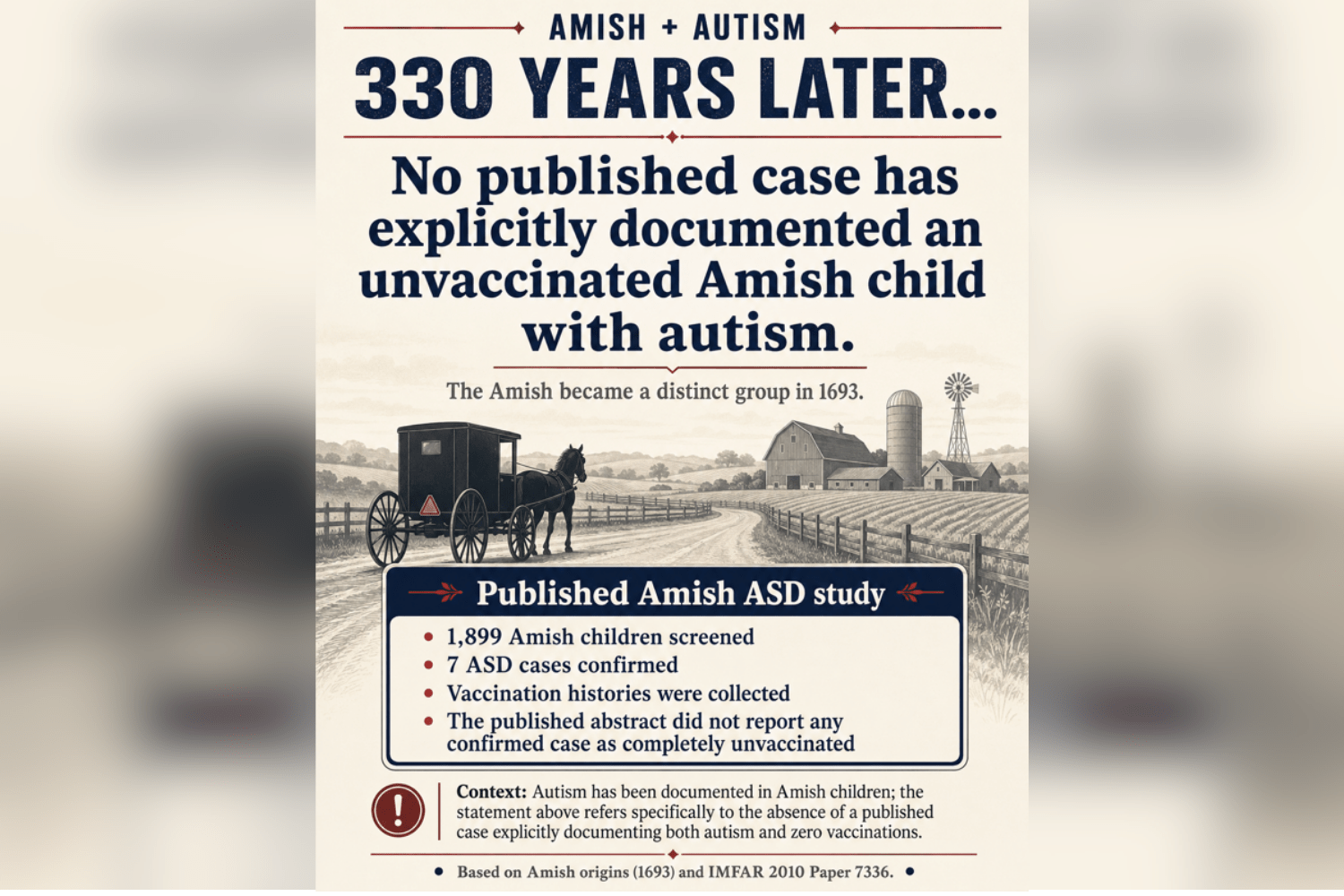
President Donald Trump recently shared a graphic on social media, asserting, “No published case has explicitly documented an unvaccinated Amish child with autism.” This claim is often cited by vaccine skeptics to suggest a link between vaccination status and autism rates. While the graphic Trump posted acknowledges the presence of autism in Amish communities, it implies that vaccination may be relevant to autism prevalence.
This claim involves two questions: does autism exist in Amish communities, and has research found any connection between vaccines and autism?
The Study and Its Findings
The 2010 study at the center of Trump’s post examined 1,899 Amish children in Ohio and Indiana over a 13-month span. Screening identified 25 children with autism spectrum disorder, while further evaluation confirmed seven cases. The study did not identify any confirmed case of autism as completely unvaccinated. However, researchers and public health experts warn that this doesn’t establish a causal link between vaccinations and autism.
The claim surfaces amidst Trump and his administration’s repeated inquiries into a possible vaccine-autism link. The broader “Make America Healthy Again” initiative, spearheaded by Secretary Robert F. Kennedy Jr., has sought to examine autism causes. Public health experts emphasize that a wealth of evidence exists, finding no causal connection between vaccines and autism spectrum disorder.
Research on Amish Communities
The 2010 study’s findings directly challenge the assertion that autism doesn’t exist in Amish communities. While the same study gathered vaccination histories, researchers didn’t conclude vaccines caused autism or that vaccination status influenced autism prevalence.
Comparing study populations to national data is complex due to variations in diagnosis influenced by healthcare access, screening practices, and cultural factors.
David Mandell, director of the Penn Center for Mental Health, stated to Newsweek, “It’s untrue to say that Amish communities have no autism.” He emphasized that diagnosing autism in Amish communities is challenging as it’s behaviorally determined and depends heavily on parental reporting.
Vaccination Rates Among Amish
Amish communities often feature in vaccine debates due to generally lower immunization rates compared to the broader U.S. population. While some communities have lower vaccination uptake, practices differ significantly between settlements and families.
Experts caution against uniform assumptions about Amish vaccination practices as they vary considerably across communities and households. Mandell underscored, “Amish people do get vaccinated. While rates are lower than surrounding populations, more than half of Amish children do get vaccinated.”
Scientific Consensus on Vaccines and Autism
The scientific consensus remains firm that vaccines do not cause autism. The Public Health Communications Collaborative notes that decades of research have found no causal link between vaccines and autism spectrum disorder.
National Institutes of Health Director Jay Bhattacharya affirmed during a Senate hearing this year that no study suggests any single vaccine causes autism.
Mandell highlighted extensive research on the vaccine-autism question, “There are now at least two to three dozen epidemiologic studies of vaccines and autism. All but two show that vaccines do not cause autism.” The two studies suggesting a link were later withdrawn following scrutiny of their methods.
Persistent Claims and Misinterpretations
Claims about lower autism rates in Amish communities continue due to misinterpretations of diagnosis rates as evidence of absence. Researchers stress that these numbers may reflect disparities in healthcare, diagnostic practices, and family evaluations, not the non-existence of autism.
Trump’s post spotlighted the lack of a documented case of an unvaccinated Amish child with autism, yet research confirms autism in Amish children, with no evidence supporting a vaccine-induced causation.