
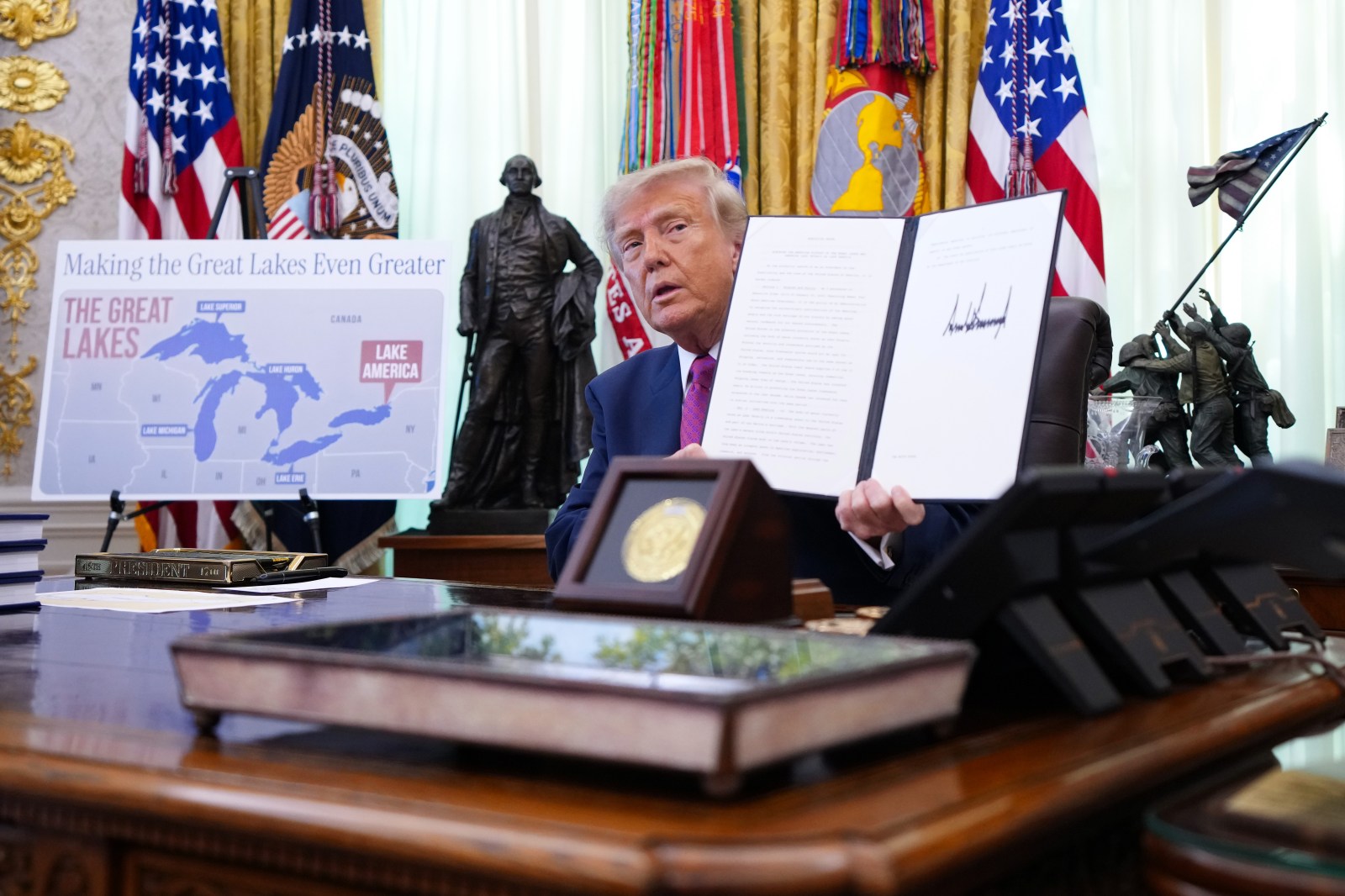
Donald Trump is advancing plans to rename Lake Ontario as ‘Lake America’. This rebranding effort stems from a failed trade negotiation between the U.S. and Canada in August. Trump announced that the U.S. might not do much business with Ontario anymore, introducing a formal executive order on August 27. This order instructed Interior Secretary Doug Burgum to take necessary actions to ensure all federal references to Lake Ontario reflect the new name.
Burgum responded affirmatively, emphasizing the importance of reflecting the greatness of the United States in the names of places and waters bordering the nation. The Geographic Names Information System (GNIS) has already been updated to reflect ‘Lake America’, and companies like Google and Apple have followed suit. However, not all providers have complied with the change.
The president’s approach might lead to increased costs for updating software, physical signage, and other documents. Experts point out that additional expenses are expected as public and private entities adjust to the change.
The August 27 order involves updating federal geographic databases and ensuring mentions of Lake Ontario are removed from government websites. This process could be financially demanding for various departments, including the U.S. Geological Survey and the FAA. Linda Bilmes, from the Harvard Kennedy School, noted that such changes involve complicated administrative costs.
Robert Corradino, mayor of Oswego, New York, estimated that the effort to update signage, maps, and tourism materials could cost several thousand dollars. For a small city, these expenses represent a significant financial burden, especially when maintaining essential services.
Beyond updating digital systems, physical changes like road signs, park signs, and maps require time and labor. Cost analyses for similar changes, like renaming the Gulf of Mexico to ‘Gulf of America’, suggested expenses of up to $500,000 over five years. Additional costs for schools and municipal services are also anticipated.
New York State, the only state with a shoreline on Lake Ontario, has not planned any changes in light of Trump’s order. Michael C. Dorf, a Cornell professor, explained that the state might still face expenses in coordinating programs with the federal government, training personnel, and public communication efforts.
The renaming could disrupt environmental data sets and scientific research, potentially costing millions of dollars, according to Mike Shriberg from the University of Michigan’s Water Center.
Philip G. Joyce from Maryland University emphasized whether such a name change offers any real benefit. Without cost reduction or improved government functions, renaming Lake Ontario might represent wasted resources.
Trump’s Broader Renaming Campaign
Trump’s administration has pushed for renaming various departments and landmarks to ‘honor American greatness’. Changes include renaming the Gulf of Mexico to ‘Gulf of America’ and the Department of Defense to ‘Department of War’. A full implementation of these changes could cost hundreds of millions of dollars.
Despite these efforts, polling shows limited public support. A Reuters/Ipsos poll revealed only 14 percent of Americans favor renaming Lake Ontario. Among Republicans, 43 percent oppose the executive order.
The renaming initiative continues with proposals like renaming the Strait of Hormuz and possibly New Mexico.
For more insights on the financial impact of these changes, sign up for Newsweek’s Accountable Newsletter by Hugh Cameron.